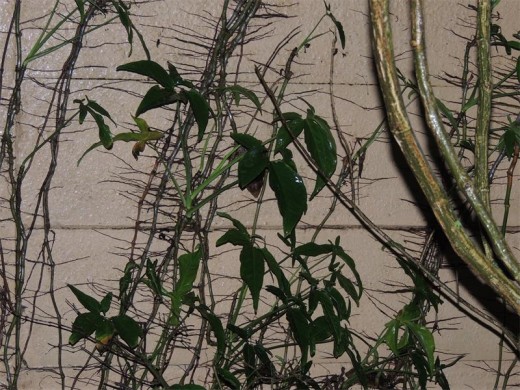
IF there is anything that gives me goosebumps in my garden it’s the sight of a leaf or two of goosefoot sprouting forth from the soil, usually in some inaccessible spot, safe from my predations.
When we first bought our home some 30 years ago, these Syngonium species had colonised whole corners of the garden, climbing up walls, draping themselves over branches and generally making a nuisance of themselves.
They proved incredibly hard to evict. Drop one little piece of goosefoot stem and it quickly takes root, transforming itself into a full-grown plant before your very eyes.
YOU MIGHT ALSO BE INTERESTED IN: Dead end for aliens
Ignore it at your peril. Before you know it will be twisting its way up the tallest of trees or creeping into the thorniest bushes, well out of your reach.
After all this time and in spite of my best efforts this persistent plant still pops up in my garden while I’m not watching and my neighbour has a healthy crop that climbs up our shared boundary wall, from where it does its best to sneak into my property.
I was therefore not surprised to find Syngonium species on the emerging weed list in my Wildlife and Environmental Society of South Africa (Wessa) handbook on Invasive Alien Plants in KwaZulu-Natal.
Many gardeners plant goosefoot and similar species to create a jungly tropical effect but by using plants native to our coastal areas it is easy to create a well-wooded, more natural looking subtropical coastal garden, complete with an assortment of striking trees, shade loving plants and striking climbers.
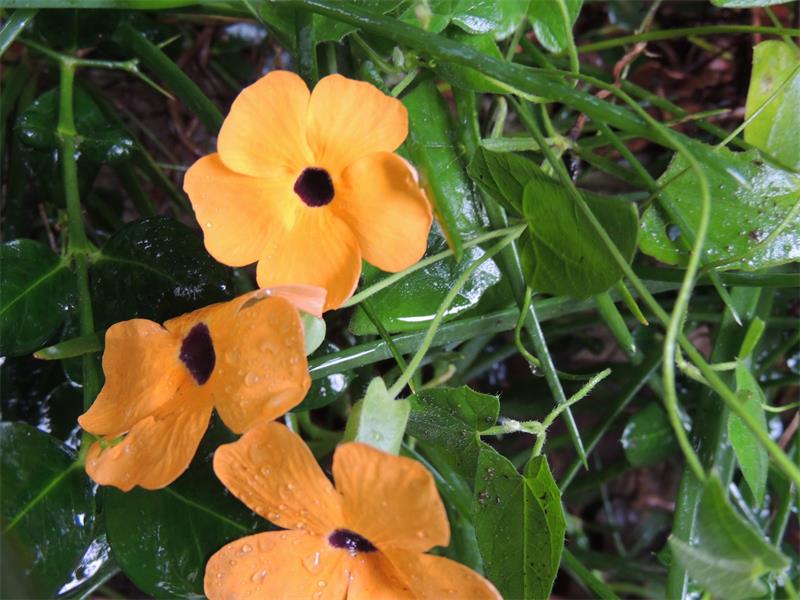
If you are looking for a more reticent climber to replace your robust goosefoot, you can’t go wrong with pretty lack-eyed Susan.
It goes by the botanical name of Thunbergia alata and has an attractive yellow or orange flower with a signature, central ‘black eye’. Once it is established in a garden it chooses its spots to seed itself and soon peeks shyly out at the gardener from all corners of the property.
YOU MIGHT ALSO BE INTERESTED IN: Alien trees pose a threat
Like all climbers it needs a little discipline from time to time but it is generally better behaved than the more vigorously growing climbers – like goosefoot.
I have another less showy Thunbergia species growing in my garden, a prized grassland species, Thunbergia atriplicifolia, that I obtained from the annual BotSoc Indigenous Plant Fair and Sale that takes place in Durban every September.
I’ve planted it among my indigenous grasses where it dozes away the winter month then pops up again when the sun returns to our hemisphere, gracing my mini-grassland with its creamy yellow flowers.
It is a shrublet, not a climber like its black-eyed cousin.
There are a number of Thunbergia species in South Africa. This genus was named after Carl Pehr Thunberg (1743 to 1828), a well-respected Swedish botanist who visited South Africa where he undertook various plant-collecting journeys.
It would be a great honour to have an attractive genus like Thunbergia named after you.
HAVE YOUR SAY
Like our Facebook page, follow us on Twitter and Instagram
For news straight to your phone, add us on BBM 58F3D7A7 or WhatsApp 082 421 6033