LIKE fashions in clothing, cars, furniture or home décor, our gardens are subject to ever-changing trends, attitudes and the contemporary mindset.
Thank goodness most, although not all, modern gardeners are becoming more and more aware of the need for sustainable, environmentally sound practices in the creation of their green paradises.
Green thinking is a very positive garden trend that is catching on fast.
We are becoming more water-wise, more aware of the dangers of dousing our gardens with chemicals and poisons and we are more knowledgeable about the link between what we do in our gardens and the effect this has on local wildlife.
We are also starting to take a look at what Mother Nature cultivates in her garden in and around the areas in which we live.
In previous years, there was a distinct aversion to indigenous plants, with many people believing that their imported aliens were superior to native species as garden subjects.
In a country whose flora is just so amazingly diverse, colourful and interesting, this attitude is puzzling to say the least.
It is also an attitude that has had some very serious consequences for our natural vegetation. Many aliens that were touted as wonderful, easy to cultivate ground covers and space fillers have succeeded beyond the nurserymen’s wildest expectation.
Not only have they filled up difficult spaces, they have escaped from gardens into the wild and are causing havoc in our waterways and natural areas today.
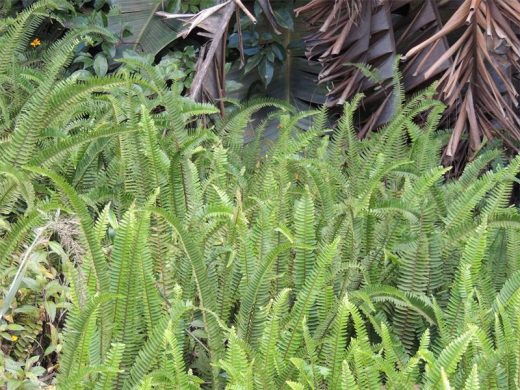
One such alien that has been mass-planted for years because of its usefulness as a big space filler is the sword fern, at one time a staple of almost any garden – and green-thinking gardeners working to evict these aliens know just how hard it is to get rid of these plants.
It is a real problem in the Ivungu River Nature Reserve where members of the Ivungu River Conservancy have spent years trying to get rid of it.
YOU MIGHT ALSO BE INTERESTED IN : Invasives and Natives: The green, green grass of home
No doubt it has crept into many of the Hibiscus Coast’s other little urban reserves where it is just as much of a pest to those who look after them. Getting rid of these ferns usually involves plenty of old-fashioned weeding.
Not surprisingly, two sword fern species, Nephrolepsis exaltata and cordifolia, appear on the Nemba Alien Invasive list. In our province they are Nemba category 1b invaders so you are not permitted to grow them in your garden.
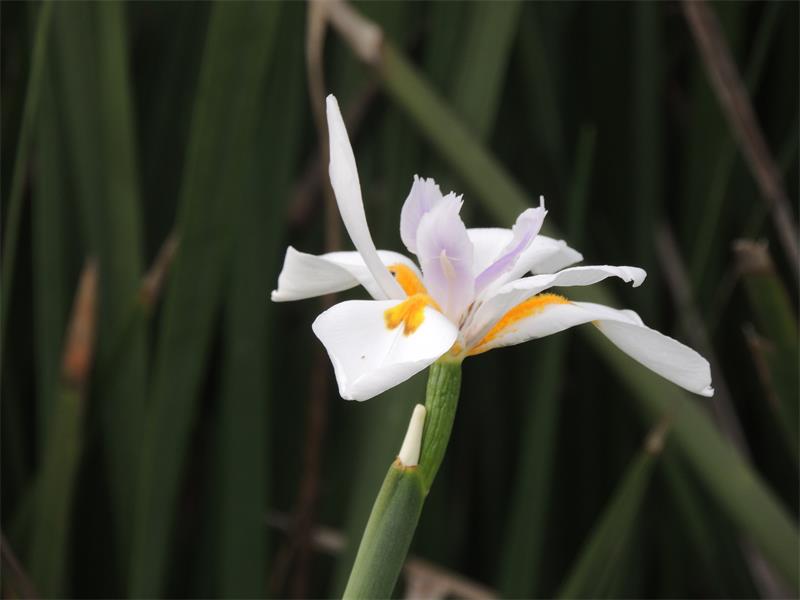
Many gardeners will bemoan this fact as the fern really is useful when it comes to covering large area, but there are alternatives. An indigenous genus that does extremely well when mass planted is the Dietes, or wild irises as many people call them.
Like sword ferns, these plants have plenty of sword-shaped leaves and they grow rapidly, even in difficult situations, to fill large tracts of unplanted garden.
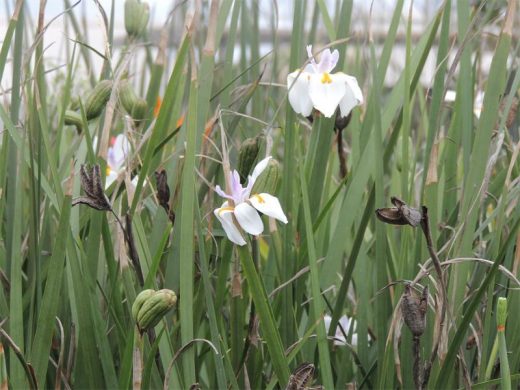
Unlike the sword ferns, though, they offer gardeners the benefit of sudden flowering, particularly when rain is expected, turning a patch of dull, uniform green into a flurry of white, cream or pale lemon flowers.
Knowledgeable gardeners know to get their brollies out when their Dietes bloom.
Although they are so popular for mass planting they can be striking form plants and are good mix-and-matchers in a lovely mixed bed of low-growing indigenous plants.
In her ‘Wildflowers of Natal’ field guide, Elsa Pooley points out that the Dietes are members of the Iridaceae or iris family, along with the similar Moraea.
If you are a technically minded gardener you would be interested in Elsa’s explanation of the difference between these two. The Dietes have short creeping rhizomes, whereas the Moraea have corms.
The best known of our dietes is probably the Dietes grandiflora, a species with a lovely large white flowers with yellow nectar guides. This is the species most commonly used by gardeners and landscapers in mass plantings.
Also a fairly common mass planting garden subject, the Dietes bicolour, known by the common name of peacock flower, really puts on a show when it blooms.
It is such a pretty plant, with dainty lemon butterfly flowers and it is perhaps my favourite Dietes.
In their book, ‘Bring Nature Back into your Garden,’ Charles and Julia extol the virtues of two rather special Dietes that are forest dwellers and useful subjects for the shade garden.
YOU MIGHT ALSO BE INTERESTED IN : Invasives and Natives: Dig out the Indian shot and plant a shady glade
According to the Bothas, the dainty Dietes iridiodes is the smallest and has the widest natural distribution in our country. It is a darling little plant, the flowers of which have long trailing stems that root and grow into new plants when they touch the ground.
I have a few of these plants in my garden and, thanks to this habit, they are spreading nicely under my trees.
A very beautiful species, the forest-dwelling Dietes butcheriana flourishes in deep shade and has large, creamy white flowers. I am glad to report they like living in my garden as well.
Sunshine or shade, there is a Dietes for anywhere in your garden, either mass planted or used more sparingly to show off its special qualities – once you’ve gotten rid of your boring sword ferns. As well as being classed as alien invasives sword fernse just oh, so, yesterday!
HAVE YOUR SAY
Like our Facebook page, follow us on Twitter and Instagram
For news straight to your phone, add us on BBM 58F3D7A7 or WhatsApp 082 421 6033