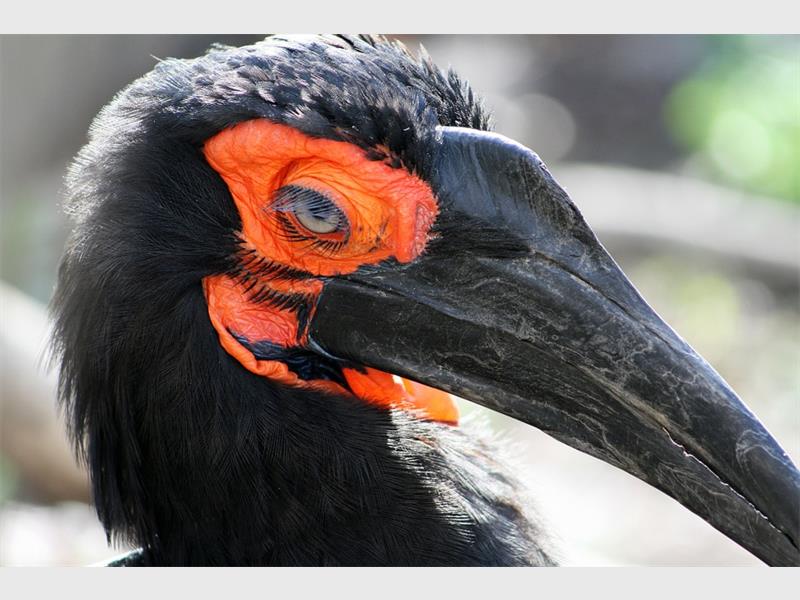
Ground hornbills, to be exact the southern ground hornbill (Bucorvus leadbeateri), is one of our most spectacular birds. Its sheer size, dramatic appearance and its habit of slow marching through the grass makes it so. Sadly, however, like so many of our birds and other wildlife, it is under threat and officially recognised as vulnerable or even endangered. The threat comes from the habitat loss and other human interventions, including traditional and cultural uses of the bird.
YOU MIGHT ALSO BE INTERESTED IN : From My Hide: The very little five
Now, a well-known local biologist, Dr Yvette Ehlers Smith, is working on a project with other conservationists and wildlife conservation bodies, to map sightings of these birds in KZN and the Eastern
Cape. The idea is to establish and then secure breeding and roosting habitats for ground hornbills and to raise awareness of the species. Yvette is eager to get information on where they may be found down here. If you spot a ground hornbill (and they are definitely unmistakable) please contact Yvette at kzn.ground.hornbill@gmail.com or at 072 9428183. She would also like photographs if possible.
Andy Ruffle of Birdlife Trogons, the local branch of Birdlife South Africa, tells me that ground hornbills may be seen in the Oribi Gorge area and further west towards Harding, so keep your eyes peeled.
Andy also told me that the southern bald ibis had also been spotted down here, so, keep your eyes peeled doubly so. My first experience of the ground hornbill was up in Namibia’s Caprivi Strip many years ago.
It was early morning and I was looking out over the Zambezi River towards Zambia on the other side. Suddenly there was a distinct boom, boom, boom, from the other side of the river and given the situation in that part of the world at the time I was tempted to dive for cover, but it was of course ground hornbills.
Staying with birds, we had two surprise and very welcome visitors in the hide the other day. Two spurwing geese, a male and a female, arrived to tackle the bird seed provided every day.
The current batch of wild bird seed that we are on has large chunks of mealies in it which are difficult for the little guys like the canaries, but just fine for the geese.
We know that there are a number of them around us because we’ve seen them, but this is the first time they have dropped in on us. They are very large birds and are described by Ken Newman as ‘common residents’, the male being somewhat larger than the female, he also says that they are not very vocal.
YOU MIGHT ALSO BE INTERESTED IN : From my Hide: Of dogs, battles, trees and a cat box
Both are handsome in flight, showing off their black and white plumage. A big plus in their favour is that they are monogamous.
And finally, changing the subject, the ultimate braai for the travelling braai master, a portable braai that packs away in a briefcase. The braai, or briefcase, is a British invention, opens out to reveal a charcoal braai, a grid, and fold-out legs. The cost? A modest R800.*
*The Week: The Best of the British and Foreign Media.
HAVE YOUR SAY
Like our Facebook page, follow us on Twitter and Instagram
For news straight to your phone, add us on BBM 58F3D7A7 or WhatsApp 082 421 6033