AT a time when human greed is driving the callous and pointless decimation of our rhino populations it is good to know that Botswana has a safe place for them, a haven that offeris them efficient, professional and effective round-the clock protection from poachers.
YOU MIGHT ALSO BE INTERESTED IN : Tent Travels: Communing with the ancient shades and the eagles of Eagle Rock
Way back in 1989 residents of Serowe came up with the idea of creating a wildlife reserve at Serwe Pan, then a cattle post near their town. This area had once teemed with wildlife and the townsfolk wanted to re-establish populations of the animal that had previously called it home.
Mammals selected for reintroduction included both black and white rhino, animals that would surely thrive as the proposed reserve contained suitable habitat for both species.
Best of all, the proposed reserve was right next to a Botswana Defence Force base. This meant there would be tight security and 24-hour protection, seven days a week for the sanctuary and its rhinos.
And so the Khama Rhino Sanctuary, centred around Serwe Pan and comprising 4 300 ha of Kalahari sandveld, was born. Today it is a well-established reserve and a successful community trust enterprise, governed by a board of trustees, elected from neighbouring towns.
It was to this lovely haven for wildlife that we were heading after our stay in Tuli Block. Khama Rhino Sanctuary is another of our favourite lesser-known Botswana destinations and over the years we have got to know it quite well.
We arrived there at around 11am and set up camp in Mokongwa Camping area. Although the sites are not electrified they are very comfortable, large and secluded, equipped with braai areas, taps and well-used bird baths.
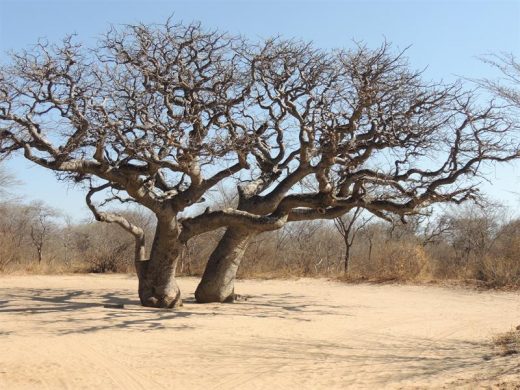
The nearby communal ablution blocks are attractive and clean. However, the camp’s most striking features are Mother Nature’s magnificent natural sculptures, the tall Mokongwa (Ricinodendron rautananii) trees that decorate every site.
We were soon on our way to nearby Malema’s Pan for a short lunchtime drive. This pan, not far from camp, is named after the original owner of the cattle post, who was involved in the establishment of the sanctuary.
It is an excellent spot for game viewing as it is a popular watering hole, regularly visited by most of the park’s mammal residents, and there is always some activity there.
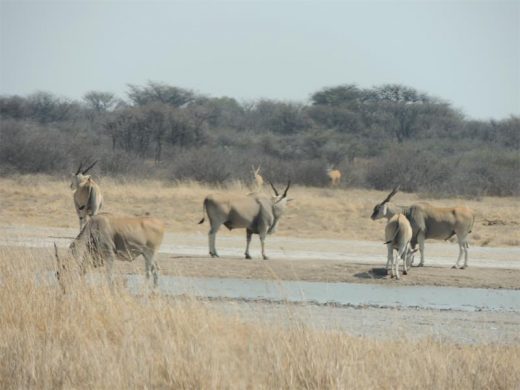
Khama Rhino sanctuary isn’t just about rhinos of course. It is well stocked with a good assortment of game. A herd of some of the biggest eland we have ever seen were taking a drink when we arrived at the pan and they were soon joined by strings of thirsty impala, springbok, warthog and gemsbok.
YOU MIGHT ALSO BE INTERESTED IN : Tent Travels: Revisiting a place of astounding beauty
Then three rhinos suddenly hove into view and we watched them with pleasure as they ambled down to the pan in their leisurely rhino-ish way. It was good to know that they were so well protected.
The Sanctuary’s rhino population has come a long way since 1993 when its first four rhino residents were translocated from northern Botswana – interestingly with the help of the then Natal Parks Board. The local people had helped to build the boma where they were initially placed.
Sadly one had been badly injured by poachers and died soon after its arrival. In spite of the excellent veterinary care these VIPs received, another rhino died the following year. However, a newcomer, a young bull, thrived.
In 1995 a 28km electric security fence sponsored by Debswana and De Beers, was completed around the sanctuary and the rhinos were able to leave the boma to roam free in their secure new home.
Later that year North West Parks Board of South Africa donated five more white rhino to the sanctuary and they settled in well, soon starting to breed. Over the years, the now thriving, breeding white rhino popular has been augmented by more translocations from other parks and black rhino were successfully introduced in 2008.
Today, safe in the well-guarded and secure sanctuary, the flourishing rhino population will become part of a programme for the eventual repopulation of rhino in the rest of Botswana.
With so many sad rhino stories doing the rounds it is heartening to hear a happy one.
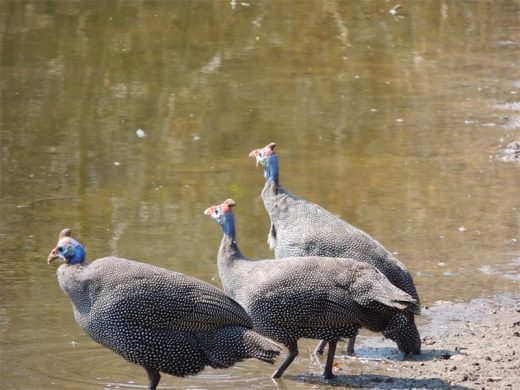
We made a quick stop at the sanctuary’s bird hide, a peaceful pretty spot where plenty of bird and animal action is always assured. When we arrived there a huge flock of guinea fowl were lazing around the pool, many of them enjoying a lunchtime sand bath.
Amusing creatures, these spotty fellows, but they weren’t the only avian visitors to provide us with first class poolside entertainment. The collection of colourful little birds paddling in the shallows was just too amazing for words and included golden breasted
buntings, a whole rainbow of different waxbill species, the cutest little scaly-feathered finches, red-eyed bulbuls and, perhaps the most eye-catching, a pair of brilliantly hued crimson-breasted shrikes.
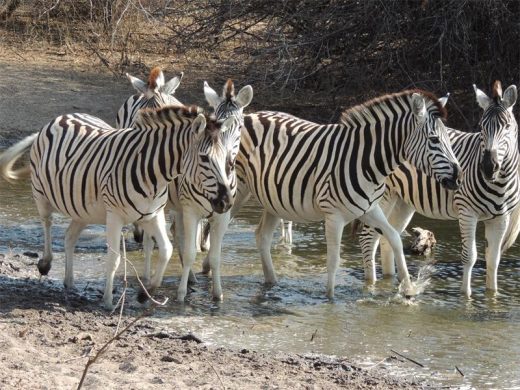
There were plenty of mammal visitors, too, including some more huge eland, a large herd of zebra, quite a few shy kudu, a couple of mongoose and a solitary wildebeest that looked a little lost.
We were just about to leave when the drama began. A Gabar goshawk with murderous intent suddenly arrived at the pan. Its attempts to catch its lunch, however, were foiled by a gang of noisy and rather ferocious arrow-marked babblers who mobbed the raptor and sent it on its way.
We ended our first day at the sanctuary with a short evening drive, stopping for sundowners at Malema’s Pan where, once again, there was plenty of action.
YOU MIGHT ALSO BE INTERESTED IN : Tent Travels: First road trip stop, our largest flood plain
The next morning was officially the first day of spring and we celebrated it with a long, slow, early morning drive to Serwe Pan, at the heart of the sanctuary.
This pan was apparently formed by wind erosion thousands of years ago and it is situated in an area that supports large populations of zebra, wildebeest, springbok, hartebeest and other plains animals. After a good game-watching session atthere we continued on our way along an interesting network of sandy roads.
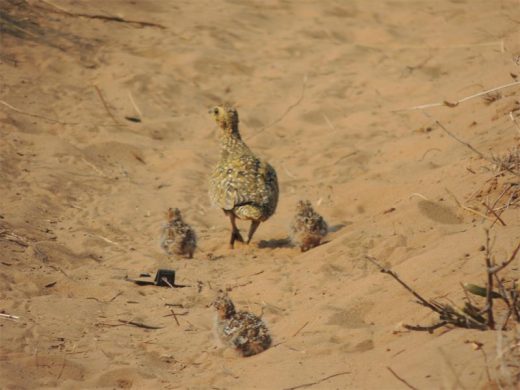
Our route took us through ‘Camelthorn Island’, a thicket of magnificent camelthorn trees where we caught up with a substantial herd of giraffe. Further along the road we encountered quite a few sandgrouse families, the babies minute, speckled dust balls.
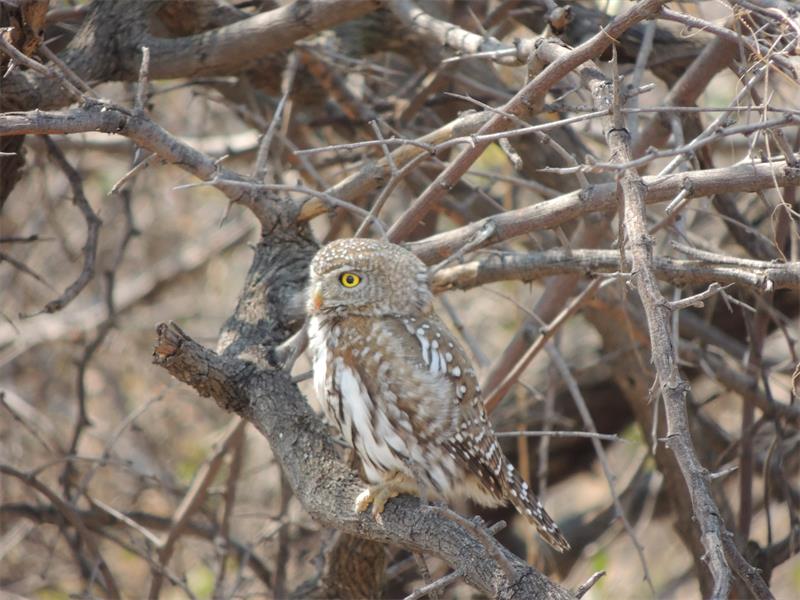
By then in was nearly midday so we stopped at the bird hide for a rest. The Gabar goshawk sneaked back without the babblers spotting it and managed to snatch a little bird for lunch, then a pearl-spotted owlet flew in and stayed to keep us company in a nearby tree.
We only meant to stay a while but there was so much action at the hide that we only got back to camp later that afternoon. It was a Friday and the camp was filling up but the sites are so big and secluded we could hardly see any of our neighbours.
We spent the rest of the afternoon arm chair – or camp chair – birding in camp. The amount and variety of birdlife visiting our little bird bath was too amazing for words. As well as a sanctuary for rhino Khama is a birder’s paradise.
It was windy when we woke up on our third and last day at Khama Rhino and there wasn’t much happening at either of the pans when we did an early morning drive. It was such a pleasant drive, though, the landscape still dry and spiky although some green shoots were starting to come through in recognition of the official advent of spring. We
were also pleased to see how well our recently acquired 4motion Kombi camper was handling the thick, Kalahari sand.
With the wind still howling, it wasn’t very pleasant at the hide so we returned to our fairly well protected campsite to spend the rest of the day marvelling at all the avian action and trying to identify the many different trees and bushes in the camping area. With most of them in winter mode it wasn’t an easy task but we thoroughly enjoyed our little
tree-hugging session.
The wind had dropped by late afternoon and the warm, starry evening was lovely. We then enjoyed the final, pleasant night of our too-short Botswana adventure at Khama
Rhino, surely one of the country’s special little gems.
HAVE YOUR SAY
Like our Facebook page, follow us on Twitter and Instagram
For news straight to your phone, add us on BBM 58F3D7A7 or WhatsApp 082 421 6033