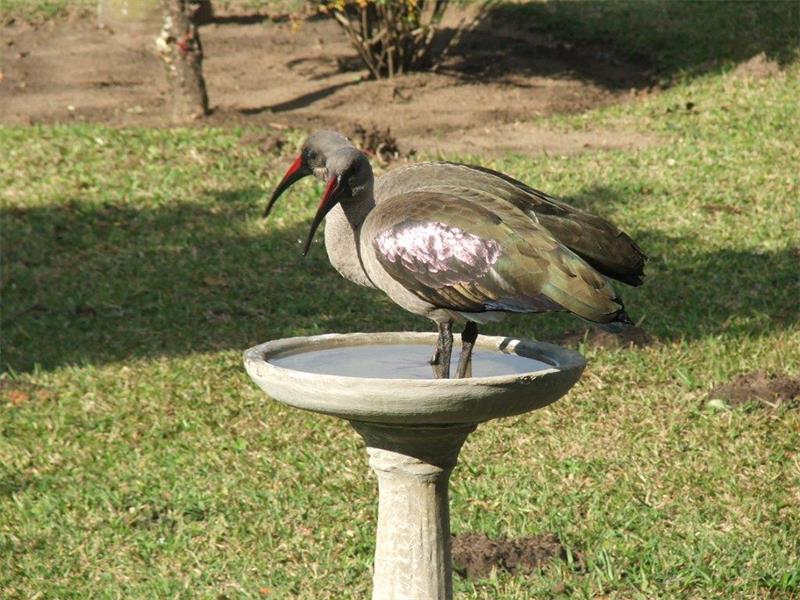
I think we are going to have to get a bigger birdbath.
We have up to a dozen birds at a time using the ablutions provided – sparrows (lots of sparrows), manikins, mousebirds, bulbuls, white-eyes, canaries and weavers – it’s often like Margate beach on New Year’s Day.
YOU MIGHT ALSO BE INTERESTED IN : From my hide: A Chinese surprise and other good news
When I put out breakfast of wild bird seed they descent en masse, twittering and chirping, fighting and feuding (that’s the mossies) and cleaning up in minutes, then just as suddenly they all fly off and disappear into the trees and silence reigns – “The sedge has withered from the lake and no birds sing” with apologies to John Keats.
The trouble is, a bigger birdbath might encourage bigger birds. As you know, we’ve had woolly-necked storks and hadedas in the current one and may well end up with the Egyptian geese and the occasional spur-wing goose fighting over it.
We’ll have to think about it, but in the meanwhile the birdbath remains a constant source of joy and entertainment. Meanwhile, we’ve had an interesting visitor to the birdbath: A female village weaver with a broken leg.
The leg sticks out behind her at a most unnatural angle and she hops around on the good leg. Interestingly, she seems to cope with both the birdbath and the seed we put out on the ground and we’ve seen her a number of times which means she is clearly surviving quite well with her disability.
Changing the subject completely, a United Nations report on the status of indigenous peoples worldwide shows that the cultures and very survival of indigenous people in Africa are seriously threatened.
Indigenous peoples are those original inhabitants or ‘first’ peoples.
The UN estimates that there are about 50-million indigenous peoples in Africa, many of them in North Africa, such as the Amazigh, in West Africa, where there are many populations of pastoralists, in East Africa, where there are more pastoralists, and in Southern Africa, where there are pastoralists but also hunter-gatherers.
The report says that biggest challenges facing these people are land grabs and land dispossession caused by extractive industries, such as mining, agri-business and other forms of big business.
It says that in many instances indigenous people are being driven back to what it calls ‘their last boundaries’. A UN spokesman involved in the report has said that Africa’s indigenous people are ‘marginalised economically and politically and are only to a very limited extent participating in decision-making processes’.*
And then, among the characters I was brought up on were Christopher Robin and Winnie the Pooh, not forgetting some of their chums, Tigger, Piglet and Eeyore. Bless AA Milne. Well, Pooh Bear has been banned from major social media networks in China.
YOU MIGHT ALSO BE INTERESTED IN : From my Hide: Neanderthal teeth tell tales of aspirin
The Beijing government, in announcing the ban, said that images of chubby Pooh Bear were being juxtaposed with images of President Xi Jingping, making a mockery of the not-so-slim communist leader.** Poor Pooh Bear, poor Christopher Robin, poor Xi Jingping.
*Third World Resurgence, magazine of the Malaya-based Third World Network.
**The Week: The Best of the British and Foreign Media.
HAVE YOUR SAY
Like our Facebook page, follow us on Twitter and Instagram
For news straight to your phone, add us on BBM 58F3D7A7 or WhatsApp 082 421 6033