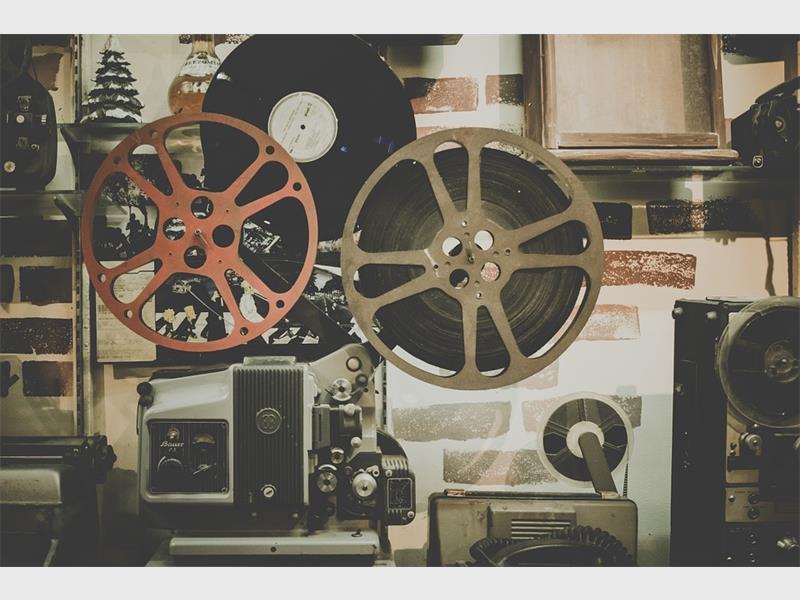
WE had never used the striping machine before, so we thought we had better practise. The instructions said that we should use a projector to pull the film through the striper, but ours simply refused to wind against the tension, so we had to wind by hand on the editing machine, with the whole family holding it down to stop it wobbling.
The first film we striped had tape splices in it, and there was no way that the sound stripe would stick to them. We asked advice and found that a special type of splicer was required. We ordered one. It never arrived.
Meanwhile, we striped an unspliced film and tested the projector. It hummed. In trying to get rid of the hum, Corrie blew something and the machine had to be sent for repair.
We respliced the entire film with old-fashioned glue and borrowed another projector. The projector jibbed at the splices and we found that the splicer was out of alignment. This was cured by adding a G-clamp to the assembly, but it meant that the whole thing had to be respliced yet again. The projector still spat out the splices, so we borrowed another projector.
The second projector ran beautifully, but it had no ‘sound on sound’ facility, so the entire sound track would have to be assembled on tape and transferred to the sound stripe in one go.
The success of this would depend on our having two tape recorders and a projector running at the same speed. After a week of testing with tapes and films of known length, and a stopwatch which usually didn’t – stop, I mean – but sometimes did when it wasn’t supposed to, we found two reliable recorders, but the projector speed varied by up to 20 percent.
We thought the variation might be due to the vagaries of the power station, so we put a voltmeter on the supply. There seemed to be no connection between the voltage fluctuations and the antics of the projector. Perhaps it was the frequency?
So we borrowed an inverter and connected it to a car battery. The battery was flat. So we borrowed a battery charger, boiled up the battery acid, and filled the workshop with fumes. Eventually we could test the projector on an absolutely stable supply. It went mad, so we borrowed another one.
Meanwhile, we had striped the film. Odd sections had not stuck and bits of film had to be cut out, re-striped and spliced back in again, but, by and large, it looked all right, though we hadn’t tried it through a projector. We had also assembled our sound effects in the right order on one tape and decided to add the commentary, sound on sound, afterwards.
So with one tape, one microphone and one 600-foot reel of striped film, we were all set to go when the third projector arrived.
Our Land Rover had broken down, so Judy gave me a lift to collect the projector. Rummaging in the cubby hole of her vehicle, I found a scrap of paper, bearing the following legend: “Out of the gloom a voice said unto me, ‘Smile and be happy; things could be worse.’ So I smiled and was happy and, behold, things got worse.” The third projector took only 400-foot reels.
HAVE YOUR SAY
Like the South Coast Herald’s Facebook page, follow us on Twitter and Instagram
For news straight to your phone, add us on BBM 58F3D7A7 or WhatsApp 082 421 6033