Wimbledon, the world’s oldest and most famous tennis tournament, starts next Monday (July 2). It’s an annual frenzy of strawberries and cream, fashion, and occasionally some tennis (not to mention uncontrolled outbursts from the world’s tennis prima donnas).
YOU MIGHT ALSO BE INTERESTED IN : From My Hide: Read a story through the eyes, paws and purrs of ‘Rafiki’
Anyway, perhaps some statistics about the place itself are appropriate. How about half-a-million spectators, 534 players using 57 000 balls in 674 matches on 40 courts before 330 umpires and linesmen over 13 days. And to make sure no one goes hungry, there are 150 restaurants, food courts and kiosks (think strawberries, 28 tons of them, and champagne) and 8 000 catering staff. And then there is Rufus, a single Harrier hawk. And what does a single hawk do at Wimbledon? He keeps the pigeons away of course, that’s what Rufus does.*
Staying with summer in the UK – Britain once ruled the waves, but it never waives the rules. A five-year-old girl was selling lemonade from a stand outside her home in east London and apparently doing quite well, but, a posse of four local council officers marched up to her and slapped a £150 fine (that’s about R2 500) on her for trading without a licence.
The case hit the media and as a result the little girl has been invited to run her lemonade stand at festivals and markets across London (this kid’s going to go far). The council has withdrawn the fine and apologised.*
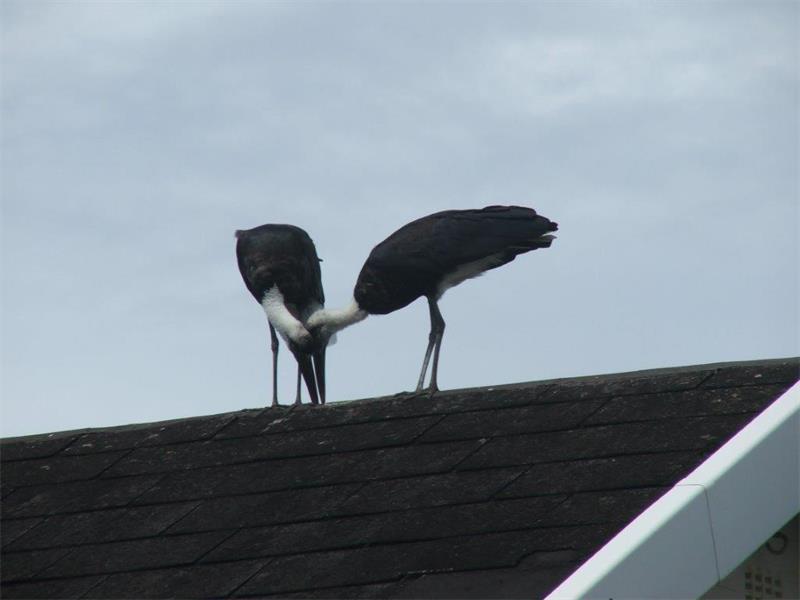
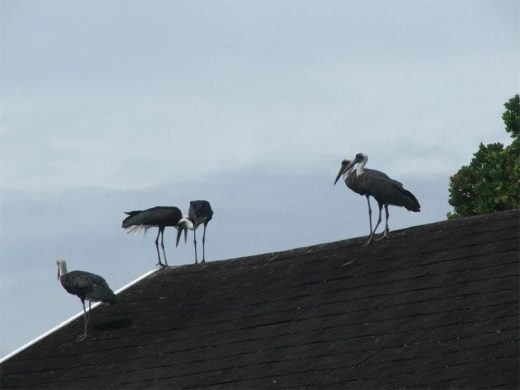
Back home – as I’m sure you know, we have a colony of woolly-necked storks (Ciconia episcopus) in our community, the biggest count ever was eight of them in a row on a nearby roof, but a couple of them must have been visitors because usually there are just six of them. The other day we spent rather a lot of time observing two couples of storks on a neighbour’s roof and without doubt they were courting.
Now here’s the thing, woolly-necked storks are monogamous, so they are frequently seen in pairs and these two couples were definitely courting.
There was much mutual grooming with those long black, red-tipped beaks of their woolly, white necks, head touching and necking (if you’ll pardon the expression). There was also a lot of beak clacking, a particularly diagnostic sound as these storks are largely mute. The problem is, their official breeding season is August to November, so they’ve either started very late or very early – or maybe they were just practising.
Woolly-necked storks range throughout much of sub-Saharan Africa, and then the whole of the Indian sub-continent, South East Asia and on to Indonesia and the Philippines.They are rather dignified birds when on the ground marching around gardens, but in the air they become spectacular flyers. They use thermals to glide seemingly effortlessly from horizon to horizon, usually in small groups, looking for all the world like a Japanese painting – they are spectacular and magnificent. We are very fortunate to have them around. Enjoy the storks, if you have them, and Wimbledon.
*The Week: The Best of the British and Foreign Media.
HAVE YOUR SAY
Like our Facebook page, follow us on Twitter and Instagram
For news straight to your phone, add us on WhatsApp 082 421 6033