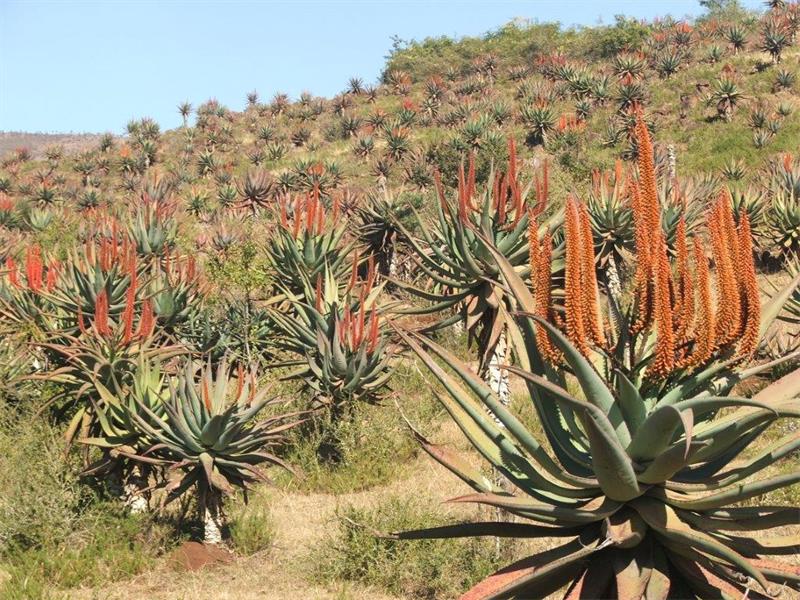
We have just enjoyed a very different excursion – we ventured forth from ‘the Hide’ and did a steam train meander through Creighton Valley, following the Umzimkhulu River and then the Ngwagwane, chugging slowly through dense forests of flowering aloes on the rocky hillsides and beige winter grass. The river was obviously enjoying its journey too, bubbling over a rocky bed in a seemingly endless set of rapids (and yes, the Umzimkhulu does join the river of that name that eventually reaches the sea at Port Shepstone).
YOU MIGHT ALSO BE INTERESTED IN : From my Hide: Anyone for tennis …. or a bit of bird-necking-watching?
The main species of aloes to be seen in the Creighton Valley are the Aloe ferox, the Aloe arborescens and the Aloe maculata. It was the Aloe ferox that dominated our view, it being in full flower and standing shoulder to shoulder on the hillsides and down to the river. This is probably South Africa’s most common aloe, also known as ‘bitteraalwyn’, ‘bitter aloe’, and ‘umhlamaba’. As a matter of interest, there are some 500 species of aloes worldwide, 120 of them indigenous to South Africa.
Coming back to the Aloe ferox, it is farmed commercially and has a vast array of medicinal uses (who hasn’t had bitter aloe smeared on fingernails to stop nail-biting?). It is a remarkably useful plant and I would be surprised if you don’t have something of Aloe ferox lurking in your medicine chest or bathroom cupboard.
Of course, apart from the aloes, the river and the general scenery, the really big attraction was the steam engine, the original carriages and the restored Creighton station.
For those of you to whom these things are important, the engine is a Class GMAM Garrett, a mainline locomotive designed and built in South Africa – this particular one was built 63 years ago and is still going strong, very strong (lots of steam, whistling and puffing, and no shortage of coal smoke to get grits in your eyes as you hang out of the window – who didn’t do that as a youngster?). The coaches are all original and painstakingly restored and the station is a restored picture of wooden ‘broekie lace’, green tin roofs and (modernised) rest rooms.
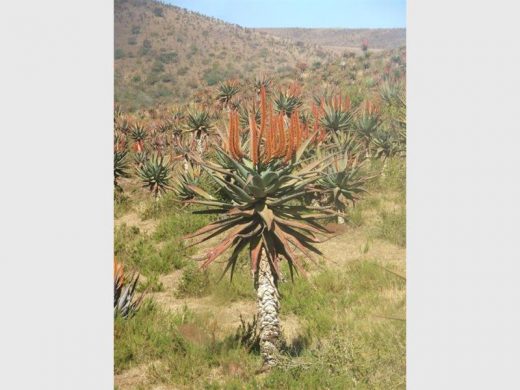
The line was originally an off-shoot of the main line from the Witwatersrand to Durban, swanning off in the general direction of Matatiele. It follows the rivers closely, chugging over original iron bridges, otherwise sticking to terraces cut in the hillsides and passing through cuttings hacked out of the rock. One has to wonder at the incredible energy of these people who designed and built steam engines, decided where they needed to go and marked out and laid the tracks.
It all brought back great memories of train journeys long ago, when the ‘railies’ was the way to go. Anyway, a great day out (and we didn’t actually get grit in our eyes).
Sources: Medicinal Plants of South Africa, Ben-Erik van Wyk, Bosch van Oudtshoorn, Nigel Gericke, Briza, Pretoria, 1997;
Sasol Field Guide to the Aloes of Southern Africa, Editor Gideon Smith, Struik, Cape Town, 2003.
HAVE YOUR SAY
Like our Facebook page, follow us on Twitter and Instagram
For news straight to your phone, add us on WhatsApp 082 421 6033