LAST week, we found out about some of the small, intriguing members of the plant kingdom that dwell in forests.
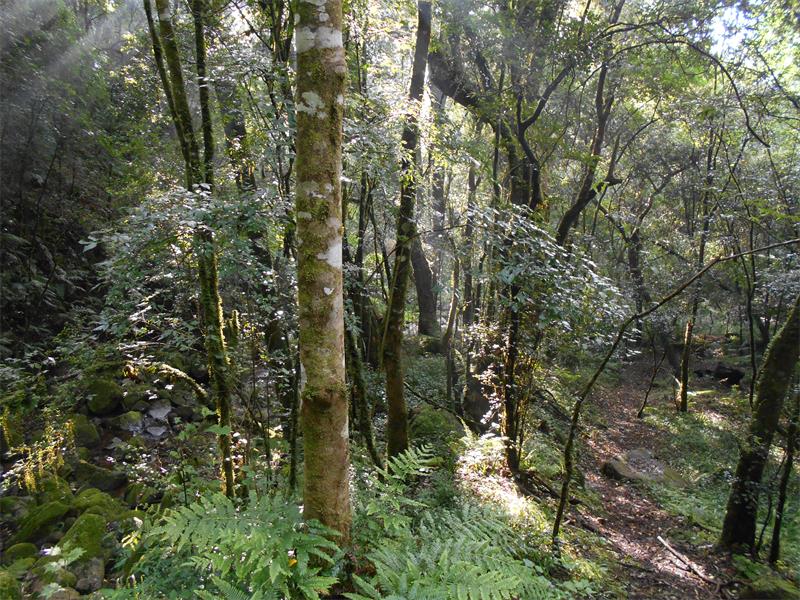
This week, let’s look at the bigger picture and discover what exactly a forest is.
YOU MIGHT ALSO BE INTERESTED IN : Invasives and Natives: The forest small fry
For a start it is not a community of alien trees, neatly planted in rows and destined to be harvested for the timber industry. That is a plantation – definitely not a forest. While we need timber and paper and other products that a plantation can provide, it is a concern that many plantation dwellers, like wattle, pine and gum trees, have escaped into the wild. As alien invasive plants they have become a serious problem.
A forest according to Richard Boon, author of the field guide, ‘Pooley’s Trees of Eastern South Africa’, is simply a vegetation type where trees dominate and grasses are scares. Multi-layered in structure, forests have a combined canopy cover of at least 75 percent.
Savanna on the other hand is a grass-dominated biome with scattered tall trees. Often referred to as open or closed woodland, depending on how closely trees are spaced, savanna has many different types. For instance, when thorn trees dominate, it is often described as thornveld . Bushveld is used to describe savannah with short, interlocking trees or shrubs. Scrub, by the way, is a term used to describe various vegetation types where woody plants are small and limited by difficult growing conditions or factors like fire and flooding.
Forests are not all equal. In fact, the biome we call forest is extremely varied and complex.
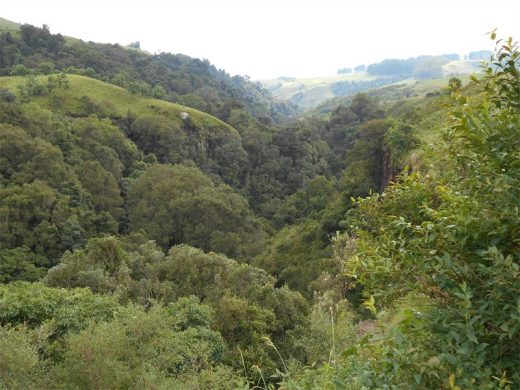
Comparatively species-poor, montane forest is found in small, protected patches in certain mountainous areas like parts of the Drakensberg.
As the name suggests, mist belt forests grow in our cool, moist areas and are relatively species-rich. Then there are scarp forests, which are transitional between temperate and sub-tropical forests. Rich in tree species, often this type of forest boast many endemics.
The label ‘coastal forest’ covers our dune forest and our coastal thicket, both species-rich and very interesting. Also noteworthy from a botanical point of view are South Africa’s small but precious sand forests . These dry forests are found on deep sand on old coastal dunes in a discontinuous strip from False Bay to southern Mozambique. Another type of dry forest, ironwood dry forest, is only found in the north of Kruger National Park.
YOU MIGHT ALSO BE INTERESTED IN : Invasives and Natives: A winter stroll along Saint’s Walk
Tree huggers who visit KwaZulu-Natal would find it interesting to see the suite of water-loving plants that inhabit low-altitude patches and narrow ribbons of swamp forests along the KwaZulu-Natal and Pondoland coast. Also hugging our coastline are our intriguing mangrove forests. Rather spooky places, mangroves are found in the intertidal areas of estuaries and lagoons. These trees have adapted to cope with their ever-changing, soggy, saline homes. ‘Pooley’s Trees’ informs us that Kobonqaba in the Eastern Cape is their southern-most limit in Africa.
Finally there are those majestic Lowveld riverine forests, so admired by visitors to Kruger National Park and made up of massive, robust, eye-catching trees.
They are found at low altitudes, growing on floodplains and around pans.
The trees benefit from the deep, fertile alluvial soil offered by their natural homes, but are subjected to frequent flooding. According to Richard, Cyclone Demoina had a devastating effect on many of KwaZulu-Natal’s magnificent fig forests, back in 1984.
So there you have forests in a nutshell. And if you are a tree hugger, you will be pleased to know that the comprehensive tree guide, ‘Pooley’s Trees’ decribes more than tree 1 000 species for you to seek out and hug.
HAVE YOUR SAY
Like our Facebook page, follow us on Twitter and Instagram
For news straight to your phone, add us on WhatsApp 082 421 6033