IT was six years since our first visit to Clocolan’s famous annual vintage tractor festival. Would it still be such a fabulously festive country fair? Happily it was. Our return visit this year was just as much fun as before, starting with the a warm welcome we received when we arrived at the show grounds on Friday, the beginning of the show weekend. We’ve always found the Eastern Free State to be a particularly hospitable, friendly part of South Africa.
ALSO READ: Wrapping up Kruger Trip
Although we’d left our friends’ Himeville home early that morning we’d had some business in Pietermaritzburg before we could set off for Clocolan. Then we took a leisurely scenic route that included the Oliviershoek Pass so only reached Clocolan late in the afternoon. On our previous visit to the Clocolan Tractor Fair we’d camped at a nearby cherry farm, but we decided it would be more fun to spend the night in the showgrounds on the eve of the main show day. That way we’d take a behind-the-scenes peek at the preparation for the town’s biggest annual event.
Soon we found a pleasant little corner in the pop-up tent village near the main arena. With our Kombi now fully kitted out as a campervan, setting up camp for the night was easy. It only entailed parking the vehicle, taking out our chairs and table and pouring two glasses of wine. Soon we were ready to take an exploratory amble around the show grounds.
Preparations for the festival were already well underway and there was a lively buzz in the air. The sounds of boeremusiek – and some good old rock ‘n roll thrown in for good measure – wafted over the showgrounds as everywhere big groups of campers gathered round blazing braai fires.
Most of our fellow campers seemed to be exhibitors and members of the amazing array of vintage tractor, engine or car clubs taking part in this year’s show. Hoards of vintage – and cutting-edge modern – tractors had already arrived and were lining up to be on parade the next day. Various agriculture-related companies were preparing their stands and festooning them with colourful bunting, feathers and flags. It was already all so very festive.
In another corner of the grounds was the encampment of South Africa’s modern-day gypsies, those roaming smouses and hawkers who spend much of their lives on the road, following the festival circuit, often with assorted pets in tow.
Their homes on wheels also served as their store fronts and catering kitchens when they set up shop at the myriad festivals and agricultural shows in larger tourist centres, platteland towns and small country dorpies scattered across our land. Some stalls were already open for business, particularly those offering fast food, festival fare, snacks and refreshments.
Smokey light illuminated various other stalls, selling everything from cheap trinkets, festival fashion, fake tattoos and assorted novelties to expensive leather goods and up-market hand-crafts. Business was slow, a maker of hand-tooled knives told us as he carefully laid out his finely crafted wares, but he expected it to pick up the next day.
Following the festival circuit wasn’t an easy life but he and his wife and their elderly border collie wouldn’t have it any other way, the stall holder said.
We were up early the next morning, long before the start of the first event on the packed arena programme, and we were soon enjoying the pleasant drive to Ladybrand, one of those friendly, charming and attractive Free State towns nestling at the foot of the Maluti Mountains. Our motive was the fairly new Ladybrand parkrun, which we were keen to try out. It was worth the early start as the attractive route, at the Ladybrand Golf Club was great. It was a fairly flat course, well signposted, that crisscrossed sections of the golf course and its parklike surrounds. Best of all were the stunning views of the mountains overlooking the town, the beautiful scenery making completing the 5km route a thoroughly enjoyable undertaking.
Glad to have added a Free State parkrun to our total, we returned to the Clocolan showgrounds where the festival was revving up. We found ourselves a programme and were pleased to see that little had changed in the way of the arena entertainment. What had changed was the name of the festival. It was now officially called the Clocolan Plaaskulture (farm culture) fees, a much more descriptive name as the festival , although groaning with tractors old and new, big and small, was so much more than a celebration of old tractors.
Many of the events, like the Volkspele traditional dancing, the boereorkes performances and the ox wagon inspanning demonstration reflected not only the world of farming but the culture and way of life of a hardy farming people. Part of our overall South African rainbow culture, the traditions and way of life represented by the arena events had developed over generations, in sync with the Afrikaners’ working of the land.
The food on sale at the various charity stalls also mirrored their robust way of life. Like South Africa itself, our country’s cuisine is wholesome, hearty and flavoursome. It reflects the diversity of our local ingredients plus all the international influences, including the Far East, that have come together to form our often under-appreciated but proudly South African cuisine.
Take the curry and rice we sampled, for instance. This ubiquitous curried mince – well spiced, slightly sweet and golden yellow, thanks to the requisite generous addition of turmeric – makes its appearance at any sort of South African church bazaar, fair or festival. It is a far cry from the Indian curry that probably initially inspired it but it is a versatile and very tasty stock-in-trade that also finds its way onto the vetkoeks and jaffels that no self-respecting bazaar would be without.
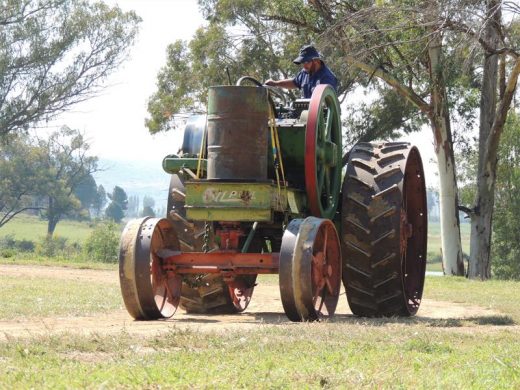
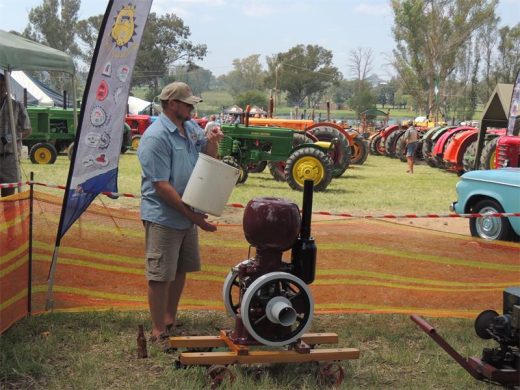
After rounding off our traditional fees breakfast with a bowl of ice cream and locally produced (and very delicious) cherry sauce– after all, Clocolan is cherry country – we strolled around the grounds, looking at the rainbow rows of every make and type of vintage tractor imaginable. There were also vintage and classic cars and, to Bill’s delight, massive and many varied collections of stationery engines, all fired up and working away. I have to say, in all honesty, that I do not quite understand Bill’s attraction for these engines but even I found it fascinating to watch so many people absolutely absorbed in the task of showing off their treasured, carefully restored and immaculately maintained little workhorses. Some of them, still efficiently puffing away, were more than 100 years old.
We watched the arena events for a while and enjoyed the wonderful community spirit that underpins the colourful country fairs and small-town happenings that take place throughout our land. All the organisers and officials – and most of the visitors – seemed to know each other. Everyone seemed so dedicated to the task of ensuring the success of what must be one of Clocolan’s most ambitious annual undertakings.
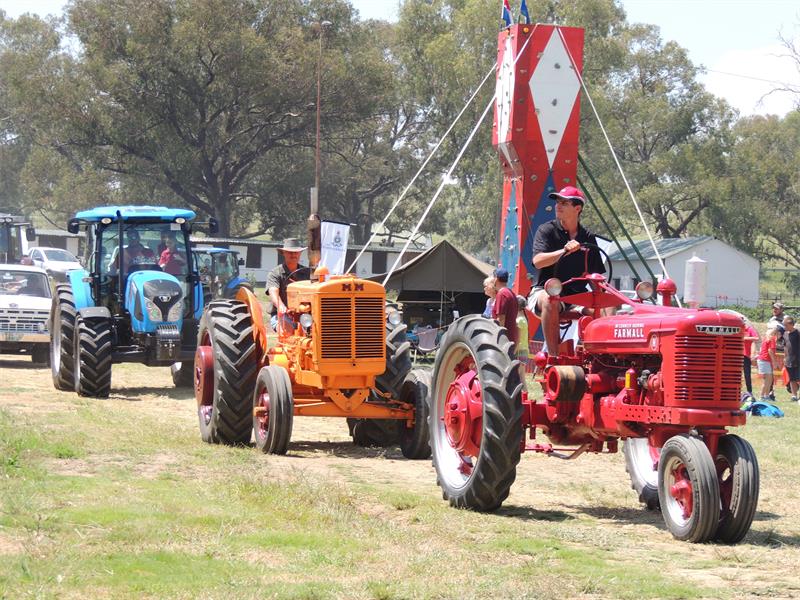
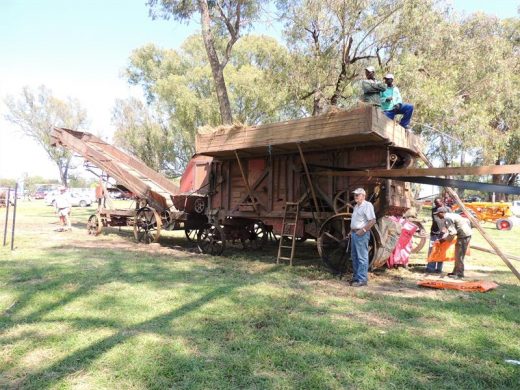
The highlight of the entertainment programme was the tractor parade and what a grand parade it was. Tractors of every colour, make and description, ancient and modern, big or small, together with an assortment of wheeled antique farm machinery and vintage and classic cars and trucks, proceeded round the sunny arena to much applause.
Children and teenagers hitched rides on the procession vehicles, waving at the cheering crowds and adding to the festive atmosphere. What fun it all was. Eventually, after quite a few laps, then a final lap of honour, the wonderful old vehicles puttered off to rest after all the excitement.
There were more arena events coming up after the post-tractor parade lunch break, but we’d seen enough and we decided to head off to enjoy some of the Eastern Free State’s scenic splendour. We’d do a leisurely drive, taking in some of the towns with their lovely sandstone architecture, then carry on the Golden Gate National Park where we wanted to camp overnight.
Our tractor festival experience had been wonderful and we were so pleased we’d made the effort to get to Clocolan. All South Africans need to try to attend some of their country’s many festivals and agricultural shows. Schlepping to a festival in some remote corner of our land is, of course, a great excuse for a road trip to somewhere we don’t know and it is also a fine lesson on how Community works.
Mostly, though, travelling across the country to some far-away festival or fair is far more than a pleasant road trip. It is a journey of discovery to find out more about where we, as South Africans, come from and who we really are.
HAVE YOUR SAY
Like our Facebook page, follow us on Twitter and Instagram
For news straight to your phone, add us on BBM 58F3D7A7 or WhatsApp 082 421 6033