BEING retired means you don’t need to get home in time for work on a Monday morning!
When we’d set off to see the Clocolan Tractor Fair on the Friday, after two nights in Underberg, we’d planned to head homewards on Sunday after spending a night at Golden Gate. However, we were enjoying our little mountain jaunt so much that we decided to extend it by another day.
ALSO READ : Tent Travels: Through a sandstone portal to a highland retreat
We would then meander home slowly on Monday – while the working world was returning to work after the weekend. Hurray for retirement!
We’d originally planned to be up early on Sunday to do the Golden Gate National Park Oribi Loop drive and to do a quick check on the vulture restaurant before heading home. Instead, we would take our time driving the loop and looking for vultures before heading for the Royal Natal National Park where we would spend a leisurely afternoon and Sunday night at the park’s Mahai campsite.
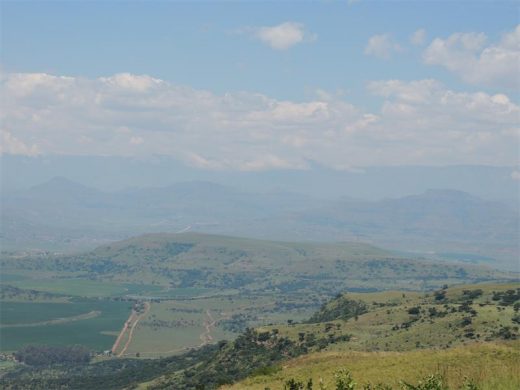
We did pack up early but we took a leisurely drive along the Oribi Loop, enjoying the views on the way to the vulture restaurant. On a previous visit we’d had a wonderful experience after what had then been a fairly arduous climb to a ridge overlooking the feeding station.
It had been a cool, windy day so we’d found a sheltered spot from where we could watch a couple of ravens pecking at the paltry remains of a carcass.
Just as we’d been about to retreat down the hill, two large birds had glided into view. We’d hardly believed our luck when we’d realised they were a mature and an immature bearded vulture, endangered raptors that are a rare and beautiful sight in our southern African skies.
From our vantage point we had initially been looking down on them but after they’d inspected the remains of the carcass, they had slowly circled upwards, higher and higher to where we hadn’t even needed our binoculars to see them clearly.
Eventually they’d popped over the ridge to circle directly over our heads a couple of times before heading off into the wide blue yonder, leaving us with a sense of wonder and awe.
Sadly there would be no vultures patronising the restaurant on this occasion, but there was another surprise. Instead of a narrow path up to a ridge overlooking the restaurant there was now a car park and a neatly paved pathway leading to a handsome new vulture hide.
ALSO READ : Tent Travels: Beautiful Balule and a river sunset
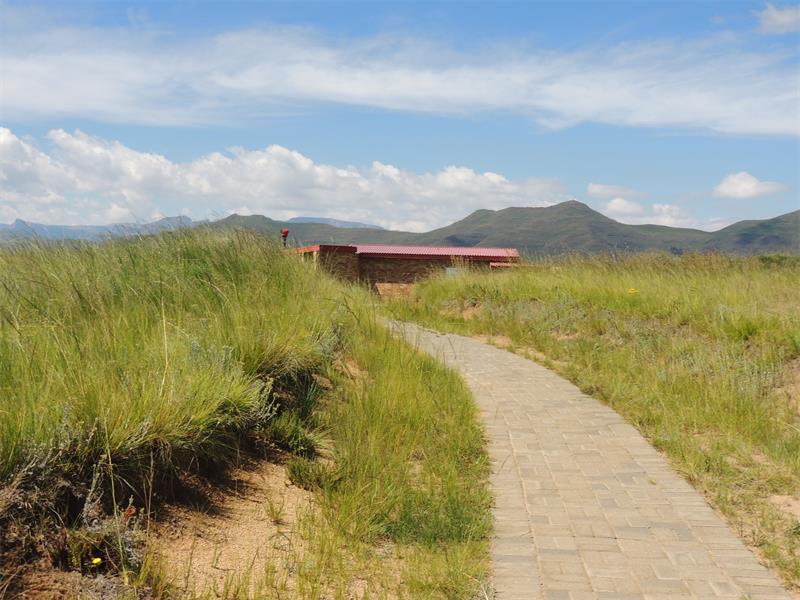
A lovely 300m walk along the pathway, through the flowery summer grassland, took us to the new facility, which had been built soon after our last visit to this area. Although we didn’t see any raptors we were so impressed with the wonderful new hide. What a great facility for birders, photographers and nature lovers.
Not long after returning to our car and heading off on our next adventure, we left the fabulous Free State, crossing into our home province, KwaZulu-Natal, shortly before winding our way through the Drakensberg via beautiful Oliviershoek pass on the R74.
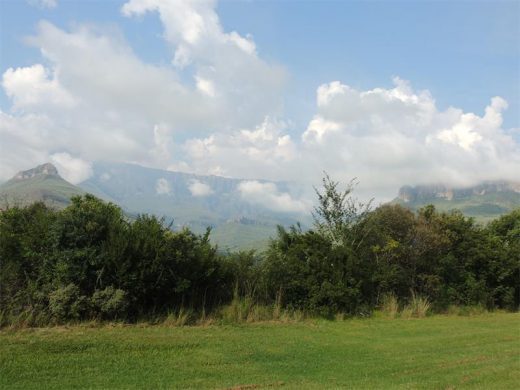
This incredibly scenic alternate to the better-known Van Reenen’s Pass offers panoramic views of the northern Drakensberg and the sapphire blue Sterkfontein Dam. It was the pass used by Voortrekker leader Piet Retief and his party in 1837.
A while ago the road had deteriorated to such an extent that it was almost unusable but the good news is that it has now been rehabilitated and is in good condition.
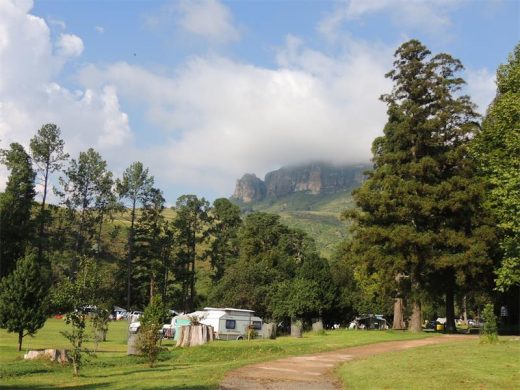
Soon we reached the turnoff to the park then, after following the gravel road for a short way, we booked in and set up camp at Mahai. For a Sunday afternoon it was remarkably busy although quite a few groups were packing up and preparing to go home. With good reason, Mahai is a particularly popular camping site. It is close enough for families from Durban, Pietermaritzburg and other nearby centres easily to spend a weekend there. It is also incredibly family-friendly, the roomy sites overlooking a grassy ‘commonage’ where, over a busy weekend, there is non-stop action. Even the littlest cyclists and scooter riders can safely ride around this communal area and over a busy weekend it is the scene of non-stop games of cricket, rugby, football and Frisbee throwing. There is always some sort of action in that grassy central oval.
Over weekends and holidays, it attracts many big groups of gung-ho young families and the atmosphere is always festive and happy. With pretty streams, waterfalls and pools, plus plenty of gorgeous walks and hikes suitable for all ages and physical abilities, there is always plenty to do.
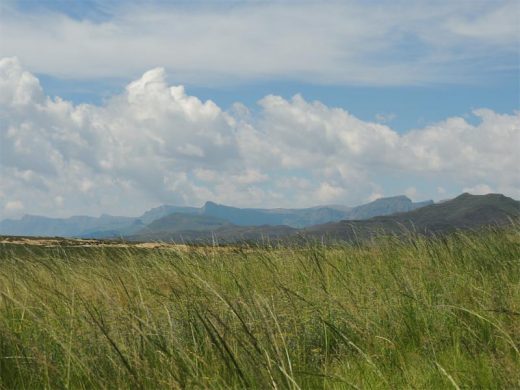
The camp and its surrounds are just so pretty. Royal Natal is part of the 240 000 ha uKhahlamba Drakensberg park, declared a World Heritage Site in 2000, one of the reasons for this honour being its wealth of rock paintings that reflect the spiritual life of the San. It is the largest ‘natural gallery’ displaying this form of art in sub-Saharan Africa.
Together, uKhahlamba Drakensberg and Sehlathebe National Park in Lesotho form the Maloti-Drakenberg Transfrontier Park, a conserved international space of scenic mountain splendour that shelters a wide range of plants and animals, many of them endangered.
Dominating the mountain scenery that surrounds Royal Natal is the iconic Amphitheatre, a 5km long rock face, bracketed by the Eastern Buttress, about 3 047m high and the Sentinel, 3 165m high.
Among the peaks rising from the plateaux is the Mont-aux-sources – the mountain of fountains – and the start of the Tugela River’s easterly journey to the Indian Ocean. On its way, this substantial river drops a dizzying 94m over the escarpment to form the Tugela Falls the second highest series of falls in the world.
The source of the westward flowing Orange River and that of one of its major tributary, the Caledon River, are near there, too. It is fascinating to think that, at a particular spot, if a raindrop split into two, one part could eventually end up in the Indian Ocean and the other part could travel thousands of kilometres to the Atlantic.
We love the walks Royal Natal has to offer but by the time we’d set up camp, we were feeling lazy. Instead of doing anything too strenuous we opted to spend a rest Sunday afternoon simply appreciating the pristine natural environment, the crystal air and the magnificent scenery that make Royal Natal and all the other mountainous places we’d recently visited so very special.
HAVE YOUR SAY
Like our Facebook page, follow us on Twitter and Instagram
For news straight to your phone, add us on WhatsApp 082 421 6033