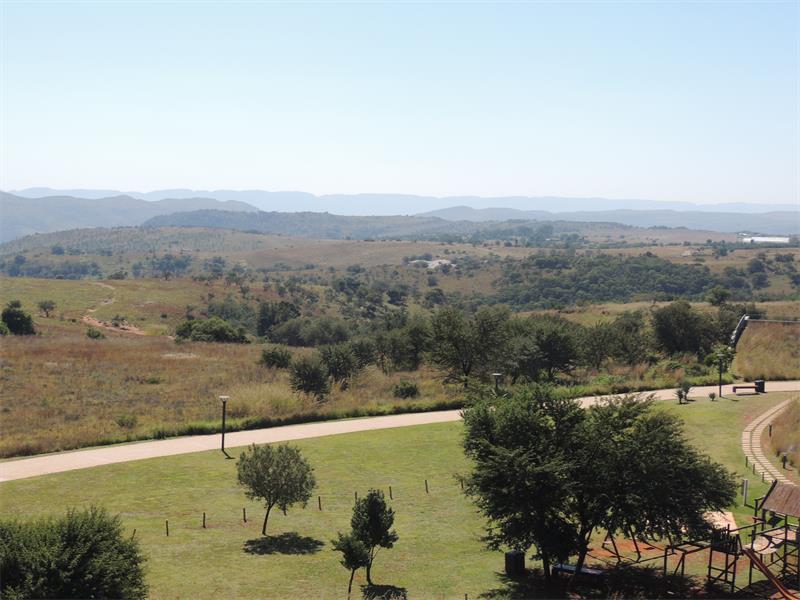
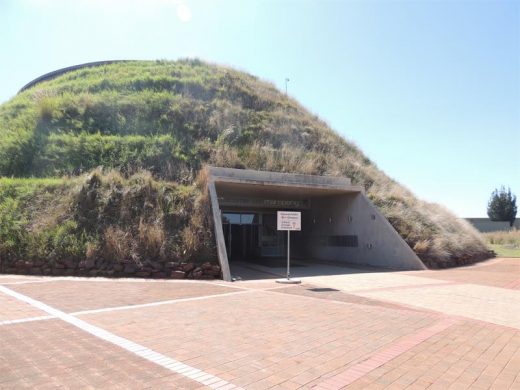
FROM the viewpoint at the top of the Tumulus Building, the grassy mound that is the entrance to the Maropeng Visitor’s Centre, the gently undulating terrain, ringed by blue ridges and rocky hills, did indeed resemble a cradle.
ALSO READ : Tent Travels: A new vulture hide on golden grasslands
Was it here that our ancestors climbed down from the trees and walked out into the savanna, in response to their changing environment?
If this is what happened (there are other scenarios) it would have been a trigger for bipedalism. And it would also have represented a giant evolutionary leap for mankind, according to a poster that is part of one of the many informative displays housed in this impressive centre.
Maropeng is the official visitors’ centre of the Cradle of Humankind, one of South Africa’s eight World Heritage Sites and the world’s richest hominin site. Nearly 40 percent of the world’s human ancestor fossils have been found here.
The Cradle of Humankind has long been on my ‘to do’ list. I am fascinated by the intricate and mysterious prehistory of mankind – and by how scientists and explorers are slowly unwinding its many convoluted strands.
I am also intrigued by the concept, engraved in stone alongside the pathway leading to the visitor’s centre that: “All of humanity shares an African heritage. We are one diverse species across the globe, with our roots in Africa.”
For a long time I have looked forward to the visiting the place where it all began – then a wedding invitation and a damaged vehicle awning provided the perfect opportunity to do so.
When we were invited to the wedding, in the KwaZulu-Natal Midlands during what would be a busy long weekend in April, we immediately booked our camping site at the popular Midlands Glensheiling Caravan Park in Nottingham Road.
During our recent Eastern Free State road trip, the awning on our vehicle had suffered storm damage and we needed to get it to the manufacturers in Roodepoort for repairs.
ALSO READ : Tent Travels: Through a sandstone portal to a highland retreat
Courier fees for such an ungainly item were high so, as we were going to the Midlands – on the way to Gauteng – we might as well do an ‘add-on’ and take the awning up to Gauteng, ourselves. It was a great excuse to turn the Midlands weekend into an expanded little camping trip, so that is what we did. We even added extra mileage and a new route to the road trip.
At that time, my son and his family were in Richard’s Bay, preparing their yacht, Irene, for the first leg – to Cape Town – of a one-year cruise they are planning.
We wanted to see how they were doing so we set off a day earlier than planned and spent the night at the Zululand Yacht Club with them. This also gave us the chance to try out a new, rather long and windy route to Gauteng via the R34, R66 and R68 to Dundee then the N11 to Volksrust then R23 to Standerton.
It was a lovely, scenic route, initially quite mountainous then stretching across the flat grasslands and mielie fields one associates with the Highveld. As we proceeded inland, it became more and more obvious that summer had given way to autumn, the browning veld reminding us that winter was on the horizon.
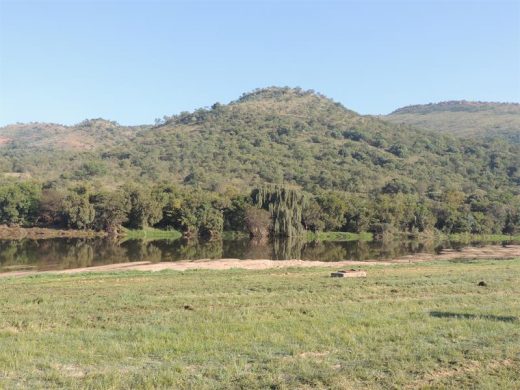
Arriving in Roodepoort early in the afternoon, we dropped off the awning and proceeded to the Magaliesberg area to look for somewhere to park our campervan for the night. We found a rustic, but attractive and almost ludicrously inexpensive little resort , ‘Roos se Oord’ and set up camp on the banks of the Crocodile River. Facilities were very basic but it was a lovely spot and the birding was amazing. It was also perfectly placed for an early start to the Cradle.
Maropeng is a Setswana word meaning ‘place of origin’, a good name for the Cradle’s visitor centre. It was also a name that resonated with me as I grew up in what was then called the Western Transvaal and the Cradle’s grasslands, rocky koppies and low, flat-topped hills were the landscapes of my childhood.
While living in nearby Carletonville, my siblings and I looked forward to our regular family outings to the Magaliesberg area.
Road signage to the visitors’ centre could have been better but we eventually found our way to Maropeng where an attendant welcomed us and gave us directions to the entrance of the centre. (He and all the other staff members we met at Maropeng were incredibly friendly, enthusiastic about their centre and helpful. As many foreign tourists visit this World Heritage Site, we couldn’t but appreciate what wonderful ambassadors for South Africa they were).
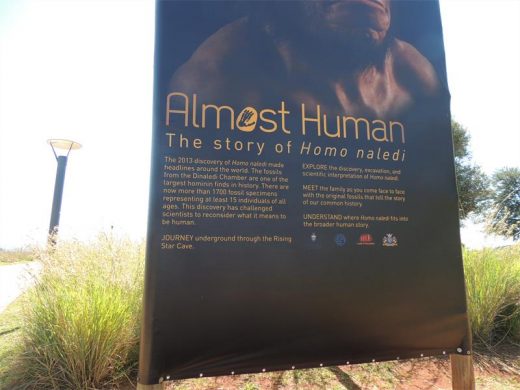
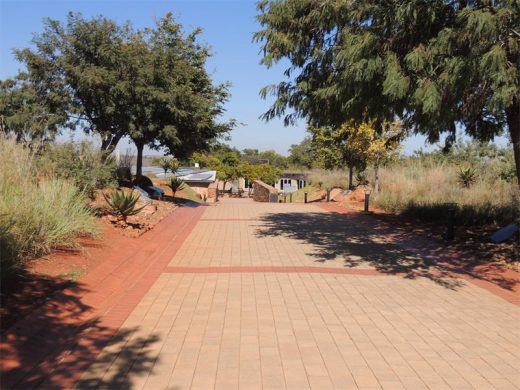
We made our way through the beautiful indigenous gardens to the entrance of the centre, only to be diverted by a poster advertising a very special exhibition entitled ‘Almost Human, the story of Homo naledi’. And what a fascinating story the exhibition told.
This story has its roots in the furthest reaches of our pre-history but the modern chapter begun in September 2013 when recreational cavers Rick Hunter and Steve Tucker found a narrow entrance into an underground chamber while exploring the Rising Star cave complex. What made their find exciting was that it contained fossils of bones.
Two months later, Professor Lee Berger of the University of the Witwatersrand organised an expedition into the cave, now known as the Dinaledi Chamber. Dinaledi means ‘stars’ in Setswana and the expedition was funded by the South African National Research Foundation and the National Geographical Society.
Interestingly, when choosing members of the excavation team, Prof Berger needed to restrict his choice to small-framed paleoanthropologists who would be able to enter the chamber via the narrow, 18cm wide opening.
The all-woman Rising Star Expedition team eventually consisted of petite ‘underground astronauts’ Hannah Morris, Marina Elliott, Becca Peixotto, Alia Gurtov, Lindsay Eaves and Elen Feuerriegel.
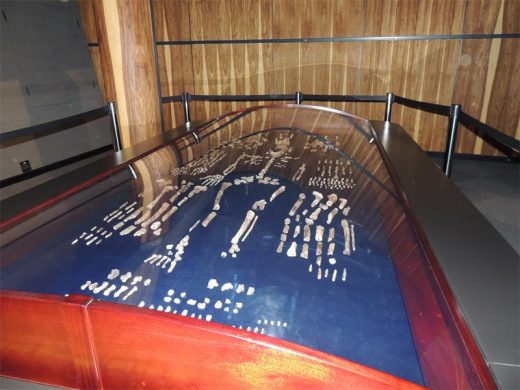
Using delicate instruments like paintbrushes, plastic spoons and tooth picks they painstakingly freed the fossils from the earth of the cave, carefully recording each fossil’s original position, harnessing modern technology, before bringing it up through the narrow passages leading to the cave. A wealth of fossils representing many individual members of a formerly unknown hominin species, named Homo naledi, were excavated, representing one of the biggest hominid finds in history.
Some 18 months later the underground astronauts explored a second chamber, situated about 100m away from the first. This, too, yielded Homo naledi remains, including the almost complete skeleton of an adult male. They named the second chamber Lesedi, meaning light, and the skeleton, Neo, meaning gift.
As the fabulous interactive, multi-media Homo naledi exhibition showed, the Rising Star Complex finds profoundly challenge modern thinking about our origins, even about what it means to be human. For a start the age of the Dinaledi Chamber remains have been revealed as being startlingly young. It appears Homo naledi was alive between 335 000 and 236 000 years ago.
This means primitive small-brained hominins were around at a time when they could well have lived alongside Homo sapiens, the first humans in Africa. There is also strong evidence to suggest that Homo naledi deliberately placed the bodies of their dead in the chambers. This has huge ramifications as it shows that these not-yet-human hominins were capable of symbolic thought and gestures and ritualistic behaviour, formerly thought to be the prerogative of us humans.
The exhibition should be seen by everyone for it leaves one thinking profound thoughts of our origins – and perhaps the very meaning of life. Most moving of all the exhibits for me, though, was the one of the reconstructed skeleton of a dainty Homo naledi hand, placed next to the more robust hand of a modern human. With its gracefully curved fingers it was a hand that could still be used for clambering around trees – but it was also a handy hand, one that could use tools. It was a beautiful little hand.
Much later, after we’d seen the rest of the impressive visitor centre (more about that next week), Bill and I had a cup of coffee on a bench in Maropeng’s tranquil gardens. It was a peaceful spot, designed for silent contemplation and perhaps it was the memory of that exquisite little hand that prompted a thought.
I give it to you as a fanciful journalist rather than a fact-seeking scientist: These little almost-people who perhaps shared the African plains with our distant forefathers might well have survived as part of our ancestral, communal memory. Are the distant sparks of memory of these oh-so-nearly-humans the sources of our ‘little people’, the pixies, elves, sprites and fairies of our folklore and traditional fairy stories? You never can tell.
HAVE YOUR SAY
Like our Facebook page, follow us on Twitter and Instagram
For news straight to your phone, add us on WhatsApp 082 421 6033