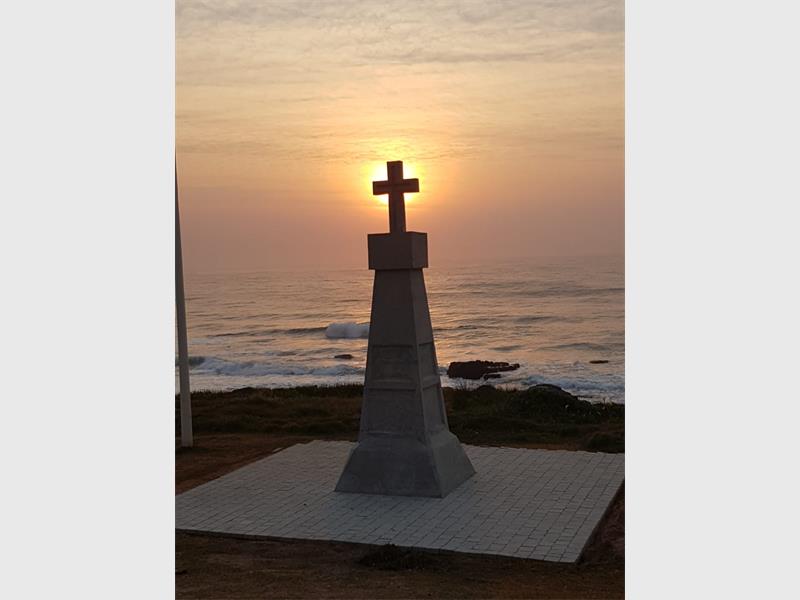
We were in Port Edward the other day and were delighted to find a padrão* on the beachfront – this could only mean one of two things, firstly, that the 15th century Portuguese explorers had passed this way in their ghost ships or, secondly, the local 21st century Portuguese community had been at work. It turned out to be the latter.
ALSO READ : From my Hide: Ancient mariners skirt Africa aeons before Vasco arrives
Padrãos go back to the late 1400s when Portuguese explorers were seeking a trade route by sea to the east, men like Diago Cão and Bartholomew Dias. The latter, Dias, left Lisbon in 1487 with a little fleet of two tiny, but remarkably seaworthy, caravels and a square-rigger supply ship. He sailed south down the west coast of Africa and with him he was carrying a number of stone padrãos, stone crosses which were used to mark new landfalls.
In 1488 he successfully rounded the Cape of Storms (his nomenclature for the Cape of Good Hope) and kept sailing east.
He reached what is now Mossel Bay, where he, as the first European to ever reach these shores, had an unfortunate incident with the Hottentots (or Khoi) on shore (significantly, it was a dispute of water).
He sailed on eventually to reach the eastern end of Algoa Bay (named by him), but it was here, at a place called Kwaaihoek (not named by him) that his men said “Thus far and no further…” so he planted a padrão and headed for home.
That may well have been as far as Dias was to go, but he was well into the Indian Ocean, giving the Portuguese access to the rich lands of the east, starting with India. On his way home he landed and set up his most westerly padrão at Lüderitz in what is now Namibia and although the original stone crosses are long gone (although fragments of them have been found) there are replicas of them tracing the adventurous path of those extraordinary men.
Now, the Port Edward padrao: For many years there was a memorial in that spot commemorating the wreck of the Portuguese galleon, the São João, in the bay in 1552 on her way home from India carrying pepper, Chinese porcelain and slaves. Of the something like 600 souls on board, most of them made it to shore, but remember that this end of Africa was very much terra incognita at this time, so there was no chance of any rescue, by land or sea.
ALSO READ : From my Hide: National parks open for mining and other sad news from Africa
The story of the wreck and the trials and tribulations of the survivors, most of whom marched north and a handful of whom eventually made it to Inhambane in Mozambique, is one of South Africa’s great sea sagas. The original memorial was badly damaged in a storm some years ago and this new padrão project is the work of the local Portuguese community and the general community of Port Edward.
Apparently there is a way to go with the project, but so far it looks great. Boa sorte e bem feita! (Good luck and well done!)
* A padrão; plural: padrões) is a large stone cross inscribed with the coat of arms of Portugal that was placed as part of a land claim by numerous Portuguese explorers during the Portuguese Age of Discovery.
HAVE YOUR SAY
Like our Facebook page, follow us on Twitter and Instagram
For news straight to your phone, add us on WhatsApp 082 421 6033