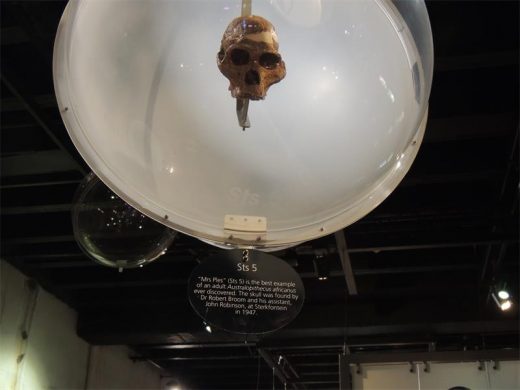
WHILE exploring the impressive and informative underground complex of the Maropeng Visitors’ Centre in the Cradle of Humankind, one of the exhibits stopped me in my tracks.
It was a model of the skull of ‘Mrs Ples’, a name from my childhood that stirred memories of long-ago visits to Sterkfontein Caves. These world-renowned caves are part of the Cradle of Humankind World Heritage Site and are situated about 10km away from Maropeng.
ALSO READ : Tent Travels: Rocking the Cradle with the almost-people
When we were young my siblings and I viewed a visit to the caves as an adventure, a chance to explore a strange underground world and to see the stunning rock formations. We learnt that stalagtites – those icicle-like mineral deposits growing downward from the roof of the cave – had to hold on ‘tight’ while upward-growing stalagmites ‘might’ grow to be tall.
We were also told about Mrs Ples, a name somehow related to childhood concepts like ‘cave men’ and ‘missing link’. Somehow we thought of her as part of a clear-cut linear chain of discoveries that would eventually reveal the evolutionary pathway of humankind. Find the so-called missing link and – bingo – all would fall in to place.
Not so, it seems. Scientists’ search for human origins appears to become more and more convoluted and complex with every new discovery. The more you read about the subject, the more you realise that, far from a linear process, human evolution appears to have been one of trial and error, with many evolutionary dead ends along the way. Every find is not a link in a chain but just another small piece of a giant jigsaw puzzle.
As children, we were unaware that Sterkfontein Caves are one of the richest paleo-anthropological sites in the world.
And as for the 2,1-million year-old skull known as ‘Mrs Ples’, – it is the best example of an adult Australopithecus africanus ever found. Also uncovered in the caves was ‘Little Foot’, an Australopithecus skeleton more that 3-million years old. Together, these Sterkfontein fossils have much to tell scientists about the precursors of modern human beings – us Homo sapiens.
A visit to Maropeng offers great insights into the evolutionary process of humans – but it is so much more. It starts with a journey back to the very beginnings of time, a lifeline following the entrance ramp highlighting major events in our earth’s history.
The interactive adventure really starts, though, with a fabulous boat ride through time, taking guests through various stages of creation, through snow, ice, water, the formation of the earth’s crust and all the way back to when our planet was a fiery ball of molten rock.
This introduction to the wonders that await you is just one of the incredibly impressive inter-active, multi-media exhibits that have been so cleverly and colourfully crafted to inform and interest visitors.
There were plenty of young visitors at Maropeng when we were there and they were absolutely enthralled with the interactive zone describing cave formation and introducing them to the concept of evolution.
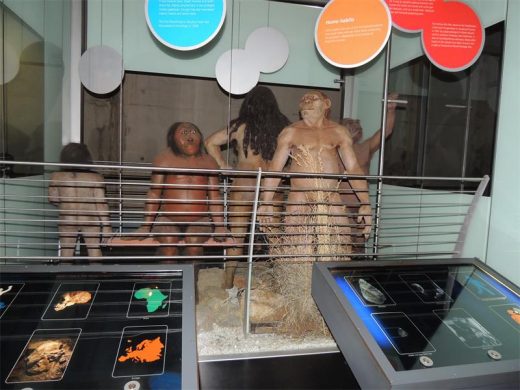
Striking audio-visual displays and life-like recreations of species, based on fossil finds, explained the complex pathway to humanity.
ALSO READ : Tent Travels: A new vulture hide on golden grasslands
An exhibit discusses the advent of the genus Homo, to which we belong, that began to appear about 2,5-million years ago, “Distinct because of their bigger brains and more prominent noses the ultra-adaptable, omnivorous Homo would succeed where other Hominids failed. Use of specialised tools, control of fire, a higher quality diet and the development of language enabled the descendants of Homo habilis, the earliest named species of Homo so far, to flourish.
We as members of Homo sapiens are relative newcomers, probably only making our appearance on earth about 300 000 years ago. However, look how far we have come since then.
Of all the exhibits, I found the most thought-provoking ones to be those discussing what it means to be human. This section celebrates our incredible diversity but it also explores our relationship with the modern world and our interaction with our environment over time.
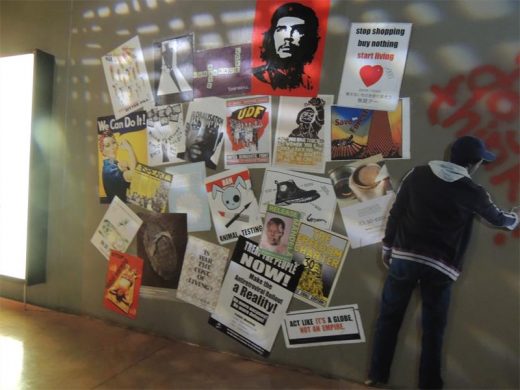
It demonstrates rather frighteningly our voracious – and often unsustainable – consumerism and the growing gap between rich and poor.
Among the many amazing consumer-related statistics highlighted in one of the exhibits are these from the Worldwatch Institute. “Pet food consumed in Europe and the United States annually: $17-billion. Estimated cost of eliminating hunger and malnutrition worldwide each year: $19-billion.”
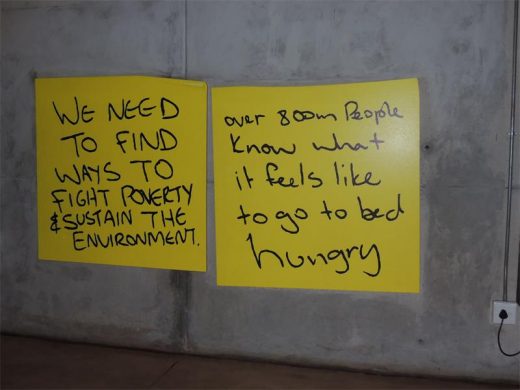
And, finally, here are two poignant reminders scrawled on giant mock-ups of those sticky labels we use to post notes to ourselves:
“Over 800m people know what it feels like to go to bed hungry.”
“We need to find ways to fight poverty and to sustain the environment.”
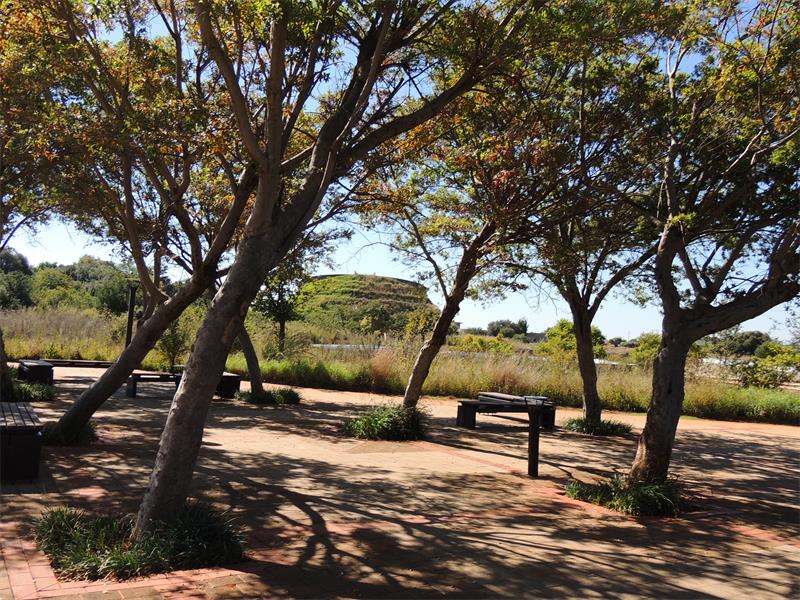
After leaving the centre we sat quietly for a while, enjoying the tranquility of the beautiful gardens. The visit had been an enlightening, entertaining, thought-provoking and extremely moving journey of discovery, from the Tumulus building, representing prehistoric times through to the exit and the 21st century. Now we needed a bit of time to process the experience. There was just so much food for thought.
Yes, Maropeng had taken us back to the time of the earth’s creation and had taught us so much about the beginnings of humankind, but it also posed important questions about the future of the ultra-successful species we call Homo sapiens. We have flourished. We have populated the world. We’ve learnt to control fire to such an extent that we can send rocket ships to space. We are an amazing product of evolution – but are we perhaps too successful?
Later, we went to Roodepoort to pick up the damaged awning we’d had repaired then we drove through rush hour traffic to Springs where we would spend the night with my brother and his family.
The frenetic traffic highlighted just how fast our human population was growing and how crowded our little planet had become. With our big brains, our super-adaptability, our ability to use incredibly sophisticated tools, our control of the elements and our highly evolved communication systems we can achieve so much; but have we the will and the wisdom to solve the new, even bigger problems our continuing, burgeoning existence on planet earth presents?
HAVE YOUR SAY
Like our Facebook page, follow us on Twitter and Instagram
For news straight to your phone, add us on WhatsApp 082 421 6033