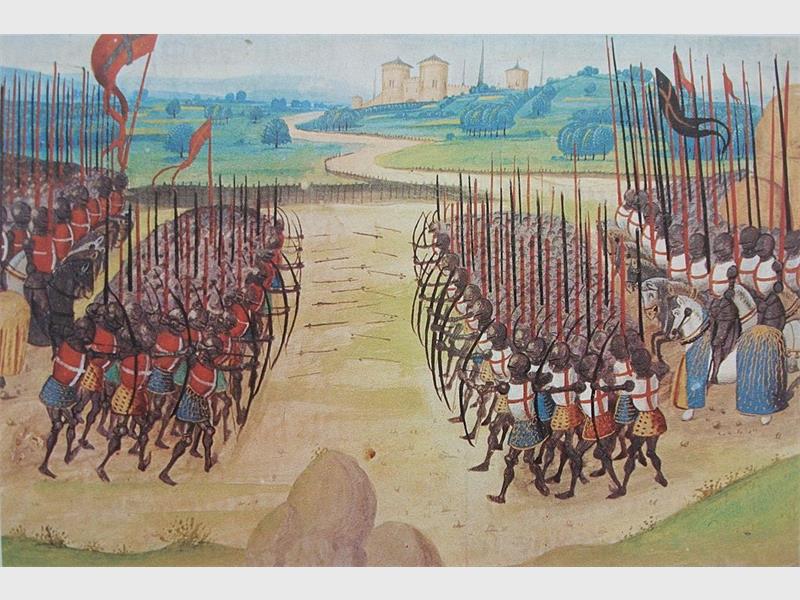
Just in case you needed to know, today, October 25, is the anniversary of the Battle of Agincourt in 1415 between the armies of Henry V of England and Charles VI of France.
It was a decisive battle that had an impact on European affairs, but the victory by the English army over a numerically much bigger French force, was largely due to one element of Henry’s army.
ALSO READ : From my Hide – Facing a farmer’s dilemma: Bears or bees?
I’ve mentioned the famous English longbow before, the WMD (Weapon of Mass Destruction) of the medieval world, but some interesting new statistics have been revealed.
The best bows were made of yew, they were a little over 1.8m, considerably longer (or taller) than the average archer of that time, they were bent slightly forward at each end tipped with horn to take the notch for the bowstring.
This was made of woven linen or hemp strands that had been soaked in hoof glue.
The arrows were made of ash or pine, exactly 0.94m long and tipped either with a spike or bodkin, or a tanged head.
The spike was armour-piercing and the tang flesh piercing. The arrows were stabilised with goose feather flights.
The pull on a longbow was at least 60kg and the rate of fire was over 16 arrows a minute.
The archer could hit a small target two out of three times at 100m, slightly less accurate at 200m, with a maximum range of 400m.
The effectiveness of the English longbow and archers were legendary. At the Battle of Crecy in 1346, an armour-piercing arrow was recorded as having gone through a mounted French night’s leg armour, his saddle and into his horse, badly injuring it.
The longbow, first introduced in the 13th century, was much used by the English armies of the 14th and 15th centuries, even into the 16th century, until it was gradually replaced by firearms.
It wasn’t only used by English armies, however, but by the navy as well. They became an essential part of naval warfare, not only to kill soldiers and sailors on the decks of enemy ships, but to even damage the wooden hulls – an English arrow could pierce 10cm of solid oak. A formidable weapon indeed.*
ALSO READ : From my Hide: On World Food Day, spare a thought for the hungry
Changing the subject, I made a beef curry the other day, which has nothing to do with anything, but I had basmati rice with it. There was lots of other choices on the plate, like mango achar (local, like our curry blend), home-made chutney (from a friend) and veggies, but as I settled down a butterfly landed on the rice (I was in my hide).
We shared the meal in complete peace, in fact the butterfly gave me time to consult Mr Williams**, where I could not find my luncheon guest. The butterfly only moved on when I cleared the table, but butterflies are like that, enigmatic and difficult to identify.
*Sources: many and various, including Scuttlebutt, a magazine of the British Royal Navy. (If you are wondering about a scuttlebutt, it is nautical slang for the latest gossip, usually generated by the gathering of tars around the water cask).
**Butterflies of Southern Africa, Mark Williams, Southern Books, Halfway House, 1994.
HAVE YOUR SAY
Like our Facebook page, follow us on Twitter and Instagram
For news straight to your phone, add us on WhatsApp 082 421 6033