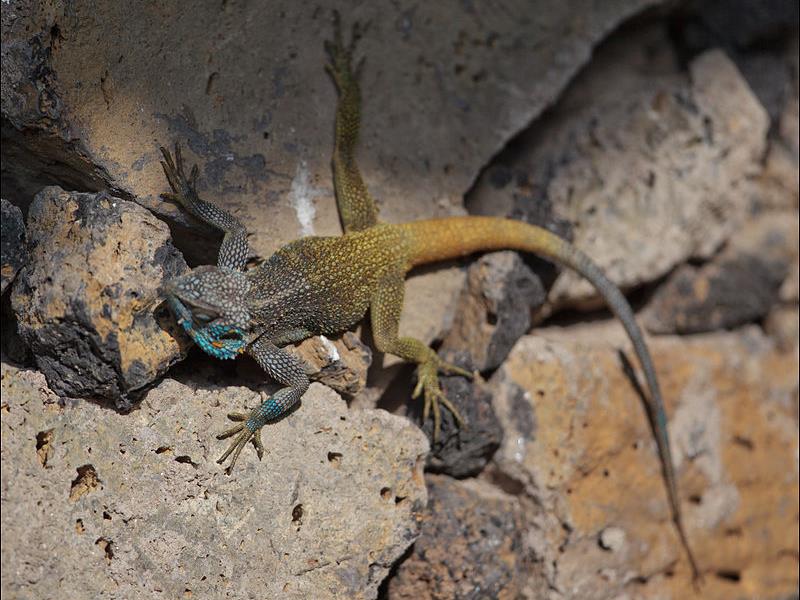
You may or may not have seen a blue-headed lizard, also going by the alias of Southern tree agama.
If you have, however, you are not likely to have forgotten it – they really are rather special.
They are a large family of about 320 species, the greatest diversity being in Asia and Australia, but with a considerable presence in Africa too.
ALSO READ : From my Hide: Illegal wildlife trading surpasses the ‘big five’
These lizards are generally large and rather spectacular and often very colourful.
Well, a student at the University of KwaZulu-Natal, Nikisha Singh, is doing her masters (first year Biological Sciences) on the blue-headed lizard.
She is studying the urban ecology of these agamas and other aspects of their biology and ecology, as well as currently conducting a survey to collect opinions from the public in urban areas around KZN.
According to Bill Branch* these agamas occur mainly on the north coast, but you may well have come across them down here – and this is the sort of information that Nikisha wants.
For identification purposes, the male of this particular species is up to 16cm long, the female up to 15cm, and breeding males have a bluish head (hence the name).
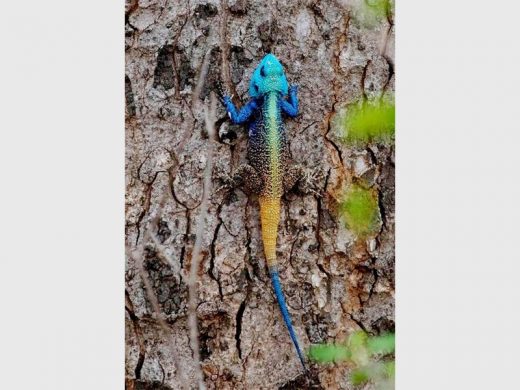
The rest of the male’s body is very colourful, coppery green to shades of blue – definitely not your common or garden lizard.
We had one resident for quite long time, certainly within the view of the Hide.
It lived in an open storm-water drain a few metres away, spending a lot of time sunbathing and seemingly also enjoying the attention.
Our agama eventually moved on, but we enjoyed his (her?) company as long as it was around.
We have also enjoyed agamas aplenty in Namibia, a territory perhaps far more likely to produce them than our present locality.
You may not have the time to complete Nikisha’s survey form, but she would surely be grateful for an email if you have one resident in your neck of the woods.
Her email address is nikishasingh555@gmail.com.
Moving on, sadly, we are all aware of suicide bombers, but here’s a new angle – an ant discovered in the jungles of Borneo will blow itself up if threatened by a predator.
The ants, Colobopsis explodens, in this case the small worker ants of the species, have glandular sacs in their abdomens which will ‘blow up’ when the ant is attacked by an adversary, covering the attacker with a toxic substance.
Suicide bombing isn’t the only unusual tactic employed by these ants – larger worker ants mostly stay in the colony’s nest and will resist an attack by creating live-ant barricades around the colony.
ALSO READ : From my Hide – Medieval weapons of mass destruction can take a bow
Scientists with the Natural History Museum in Vienna who made the discovery say the ant colonies nest in the tree tops. Well, let’s hope they stay there.**
*Snakes and other Reptiles of Southern Africa, Bill Branch, Struik, Cape Town, 1998.
**The Week, the Best of the British and Foreign Media.
HAVE YOUR SAY
Like our Facebook page, follow us on Twitter and Instagram
For news straight to your phone, add us on WhatsApp 082 421 6033