- Heir(s). Any person or organisation to whom I leave a part of, or all of, the residue of my estate.
- Will. This is a legal document that details how I want the residue of my estate to be distributed. Its full name is “Last Will and Testament.” What occurs if I have minor children, still dependent on me? In my will I can specify who I want to take guardianship of my children. Will templates are available at stationery stores. However, as this blog shows, a will is not a do-it-yourself project.
- Inheritance. This is anything given to a person or organisation, in terms of my will. Fairness in deciding who should inherit the residue of my estate is critical. I don’t want to cause family feuds (that may go on for generations) because of unwise decisions. This is especially important where there is an ex-spouse (or spouses), step-children, and children born outside marriage. Guidance from experienced executors of estates is essential.
- To die intestate. This refers to dying without leaving a valid will. The State will then appoint an executor to wind up my estate, and distribute what is left. Distribution will be mainly according to family relationships. This may or may not be what I desire.
- Marriage in community of property. In this (most common) type of marriage, each spouse owns everything jointly and equally. In case of the death of one spouse, ownership must transfer from the two owners, to the one surviving owner. In the case of fixed property, SARS sees this as a sale, and transfer duty is payable. There are various other types of marriage, but they are outside the scope of this blog. (In terms of what happens when one spouse dies, marriage can be thought of as a business partnership. Hence, the type of marriage has a critical influence on the contents of a will.)
- Debt insurance. A car and a house/flat are major items that we nearly always buy via bank financing (a loan). Ideally, I do not want to pass this debt on to my heirs. Debt insurance is recommended. It pays off the debt when that inevitable event occurs.
- Power of attorney. If I become incapacitated, I may legally appoint a person to act on my behalf. This person has my “power of attorney”, and is appointed by completing a form from the particular organisation with which I want him/her to act for me. For example, this may be SARS, or my bank. The authority transfer granted by the power of attorney falls away when I die – and then my executor becomes my legal representative.
- Bequest. A bequest is some part of my estate that I want to leave to an individual or organisation.
ALSO READ : RIP Jay Pillay: Learning by Pretending to Die: Some definitions of dying/living words
What I hope should be clear now, is that death is not for the faint-hearted. The irony is that the more wealth I have, the more likely it is that I’ll leave hell on earth for those I love, when I die – if I don’t plan for my death. I’ve heard people say, “What happens after I die? That’s not my problem!” Yes, very sadly, it isn’t their problem.
ALL my coming blogs are based on the information given already. It may be worth your life to go back and read this blog, and the previous two blogs, again. And again.
Let’s pause for breath. Read those six definitions again. I’ve made them specific to me, the author of this blog, Jay Pillay. Insert your name, and your face, wherever you see I, ME, or MY. Why? Because it’s simply a matter of life or death. We are not finished with the language of dying yet. A few more definitions are coming up in my next blog.
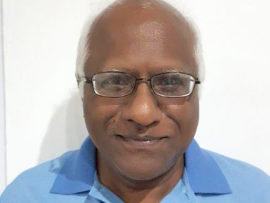 Jay Pillay’s first two critical decades were spent where his first decade began – in Pietermaritzburg. After studying at ML Sultan Technikon in Durban (anyone remember that place?), he then joined the sugar industry, working in Tongaat, Durban, and Xinavane – a sugar mill village 120km north of Maputo. Oh yes – there was a brief period of unfaithfulness, when he flirted with aluminium in Richard’s Bay. Upon retirement, he and his wife Dorothy – settled in Southport
HAVE YOUR SAY
Like our Facebook page, follow us on Twitter and Instagram