The scourge of unemployment blighting our country will not be fixed by short-term thinking and actions. A long-term solution requires a fundamental realignment of our economy and absolute honesty from all stakeholders. No amount of BEE, land distribution or radical economic transformation is going to change the status quo.
ALSO READ : Good Business Basics: Stamp out corruption to encourage investment
In my recent travels to India, I was struck by the fact that even in the face of a population 20 times larger than ours, most businesses, both private and public, operate with the optimum levels of staff.
At airports for example, the cleaning crews, check in staff, and baggage handlers are perfectly balanced to the needs of the operations, with no impact on the service delivery or output. Facilities are clean and well maintained, boarding and check in procedures are no worse than anywhere else.
Multitasking
This is also particularly striking in America, where multitasking is a given for any job. Now contrast this with the resistance to multitasking in our country – the South African Social Security Agency for example refused to take biometric data from pensioners without being compensated.
There is a myth that ‘right-sizing’ an operation by cutting staff is merely done to enhance the bottom line, a view actively promoted by organised labour. In fact, optimising labour while cutting costs generally improves operating efficiencies.
Further, increased profitability tends to drive increased investment, which tends to spur increased employment, albeit in different parts of the entity. Telkom is a case in point. By cutting its workforce by over 15 000 over the last 10 years, it has increased its profitability, share value and dividends to the State exponentially.
Wide impact
Many of the retrenched employees have gone on to start their own businesses in the same or other sectors with great success. While many would dispute that Telkom has become more efficient given its generally poor customer service, other areas of the business have certainly benefitted.
The travails we are facing with Eskom’s rolling blackouts (one has to tip one’s hat at the PR person who created the word ‘load shedding’) can be attributed to one simple fact – It is spending much more than it is receiving.
The impact on this is constrained resources to conduct essential maintenance, purchase coal and other vital inputs.
One of the key components of this over-expenditure is staff costs. General consensus is that Eskom is 30 – 35 percent overstaffed, a fact exacerbated by statistics that reveal Eskom pays the highest average salaries in the country. In figures, Eskom’s staff count increased by 16 000 between 2007 and 2018, with associated costs increasing from R9,5-bn to R29,5-bn, all in the face of declining revenues and non-payment by consumers.
Economic benefits
So the reality is that there will be a lot more pain over the next few years while we right-size our economy. Allowing enterprises, both private and state, to reconfigure their workforces will in the long term free up significant resources to the benefit of the wider economy.
Unions will need to adjust their thinking to beyond their (shrinking) membership and towards the country as a whole. The task at hand is a frightening and challenging one: the need to put aside platitudes and old rhetoric has never been more urgent. If we don’t confront this-we will forever be doomed to an underperforming country on a steady downward spiral.
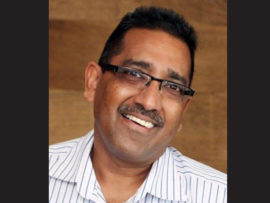
After matriculating, Vijay Naidoo studied Economics in the UK. Upon his return, hejoined the family construction business as MD for 10 years.
He subsequently joined his sister in their furniture manufacturing business as director for quality assurance and operations. He was responsible for all quality aspects of their products, and led the project to the business achieving an ISO 9000 quality accreditation. As an export focused business, this was important for our international competitiveness.
Mr Naidoo has an abiding interest in quality management and productivity improvement, particularly in manufacturing.
More recently, he has focused a lot of his time on giving back to the community by way of mentorship of small businesses and sitting on the executive of the South Coast Chamber of Commerce. He also sits on the Board of the Ugu South Coast Development Agency.
HAVE YOUR SAY
Like our Facebook page, follow us on Twitter and Instagram