The Road to Heart Disease
We all know people – friends or loved ones – who have succumbed to heart disease – many in their senior years. We may also have heard of some middle-aged men who have died from a heart attack. But we hear reports of the increasing incidence of heart disease amongst ever younger men, even in their 20’s. It is always tragic when people’s lives are cut short with diseases that are preventable or even reversible.
ALSO READ : Turning the Tide – Dealing with the main lifestyle-related conditions in South Africa (Part 9)
What are the factors that predispose to this increasing risk of heart disease?
The Physician’s Committee for Responsible Medicine has produced an infographic called the “Road to Heart.
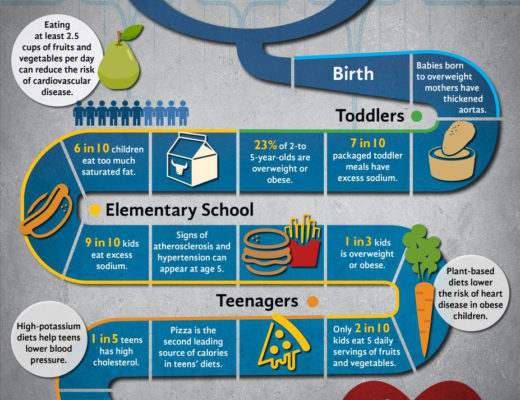
Unfortunately the original infographic is no longer on their website. (PCRM specifically states that their graphics can be reproduced if not used for commercial purposes).
Today we will discuss all the different points brought out in the infographic and try to make practical recommendations.
Research has shown that the process starts even before birth. A child’s health destiny is determined by various factors – certainly by genetic considerations, but even more importantly by the home environment. This environment includes eating habits, recipes or methods of food preparation and choices of foods, as well as lifestyle practices of the particular family. It has been shown that the aorta of intrauterine babies of obese mothers already shows thickening. This may be due to maternal high blood pressure and poor vasculature to the placenta, associated with maternal obesity, causing intra-uterine growth restriction (IUGR) of the baby. It is well known that babies subjected to IUGR are at greater risk of high blood pressure and heart disease themselves later in life.
The best milk for babies is breast milk. Each animal species produces the most ideal constituents from its mother’s milk for its baby’s needs. As much as manufacturers of milk formula do their best to modify cow’s milk for human baby consumption, there are still problems. This includes such things as the presence of oestrogenic hormones, heavy metals (such as lead and cadmium as well as excess zinc and copper), pesticides and herbicides in animal feeds, antibiotic residues (from treating and preventing mastitis and other cow diseases). Obviously not every mother can breast feed her infant, but the best is still mom’s milk if at all possible.
Seven out of 10 packaged toddler meals evidently have excess salt and also often sugar. This is found in prepared baby cereals, and bottled convenience infant foods.
Recommended maximum amount of salt for babies and children:
- Up to 12 months – less than 1gm of salt per day (less than 0,4 gm sodium)
- 1-3 years – 2 gm salt per day (0,8 gm sodium)
- 4-6 years – 3 gm salt per day (1,2 gm sodium)
- 7-10 years – 5 gm salt per day. (2 gm sodium).
In the USA 23% of 2-5 years olds are overweight or obese, setting the trend for the rest of their lives. In S Africa 25% of girls and 20% of boys between the ages of 2-14 years are overweight or obese. The reason they are overweight is because of the types of foods and beverages given them by their parents.
Habits developed at such a young age are difficult to break later. Very often their parents are also overweight or obese.
Parents often give children highly processed snacks like chips, sweets and biscuits whenever they go to town to reward them for good behaviour, or to bribe good behaviour. It takes effort and planning to give children healthy snacks like fruit or vegetables, but it can be done.
In the USA 6 out of 10 children eat too much saturated fat. This is found in all animal fat, but also in palm oil so commonly used in processed foods these days. Common sources of saturated fats are eggs, milk, yoghurt, cheese, meat, chicken, fish and processed meats like burgers and sausages. Another very harmful fat is trans fats, such as in baked goods, fast foods, cakes, flavoured popcorn, flaky-roughed products, foods made with frozen dough, biscuits snacks with creamy centres and cakes with frosting. Most countries have enacted legislation to greatly reduce trans fats in foods. But obviously if we reduce these kinds of foods for our children, as well as for ourselves we reduce the risks. Have a look at the Nutritional Facts label on the packaging of foods you feed your child to check on total fat content, saturated fats, trans fats, salt and sugar. You may be shocked. Most processed foods these days contain palm oil which is high in saturated fats.
In the US, 9 out of 10 primary school age children eat excess salt – normally as found in snacks and fast foods, which is such a common part of children’s diets.
Early signs of atherosclerosis are already manifesting in the arteries of children from the age of 5! Yes I said 5 years.
In teenagers in the USA, only 2 in 10 children eat the recommended 5 or more servings of fruit or vegetables per day. We know that fruits and vegetables are powerful inhibitors of cardiovascular disease, as well as helping to prevent such diseases as diabetes and auto-immune diseases, and boosting immunity. Pizza is the second leading source of calories in the diet amongst American teenagers. This is caused by the high cheese content, as well as fatty meat fillings. One in 5 US teens has elevated cholesterol levels – a precursor to heart attacks later in life. This is strongly correlated with raised saturated fat intake. (There are many people who try to deny this correlation, but the science is sound: read this. for the perspective of a former president of the American College of Cardiology, who was heavily involved in the writing of some of the guidelines.)
The frightening statistic though is that between ages 17-22 in the USA already half a million young people qualify for statins because of elevated cholesterol levels. Thus they are prime candidates for deadly heart disease.
This tragic story unfolds in far too many young people’s lives, even in South Africa. The drama starts from before birth and in a series of unhealthy practices driven by the norms of society ends in the inordinately high risk of cardiovascular disease.
As parents YOU can change your child’s health destiny, but it is going to take some resolve and consistent intervention to buck the system, and protect your child from the ravages of marketing and peer pressure.
Next week we will specifically look at Prof Vicky Lambert’s comments on the Healthy Active Kids South Africa Report Card from 2016, and then discuss some practical ways to implement healthier dietary practices for your children.
To a week ahead thinking about practical ways you can protect your children from future heart disease.
Dave Glass

Dr David Glass graduated from UCT in 1975. He spent the next 12 years working at a mission hospital in Lesotho, where much of his work involved health education and interventions to improve health, aside from the normal busy clinical work of an under-resourced mission hospital.
He returned to UCT in 1990 to specialise in obstetrics/gynaecology and then moved to the South Coast where he had the privilege of, amongst other things, ushering 7000 babies into the world. He no longer delivers babies but is still very clinically active in gynaecology.
An old passion, preventive health care, has now replaced the obstetrics side of his work. He is eager to share insights he has gathered over the years on how to prevent and reverse so many of the modern scourges of lifestyle – obesity, diabetes, ischaemic heart disease, high blood pressure, arthritis, common cancers, etc.
He is a family man, with a supportive wife, and two grown children, and four beautiful grandchildren. His hobbies include walking, cycling, vegetable gardening, bird-watching, travelling and writing. He is active in community health outreach and deeply involved in church activities. He enjoys teaching and sharing information.
HAVE YOUR SAY
Like the South Coast Herald’s Facebook page, follow us on Twitter and Instagram
To receive our FREE email newsletter, click HERE