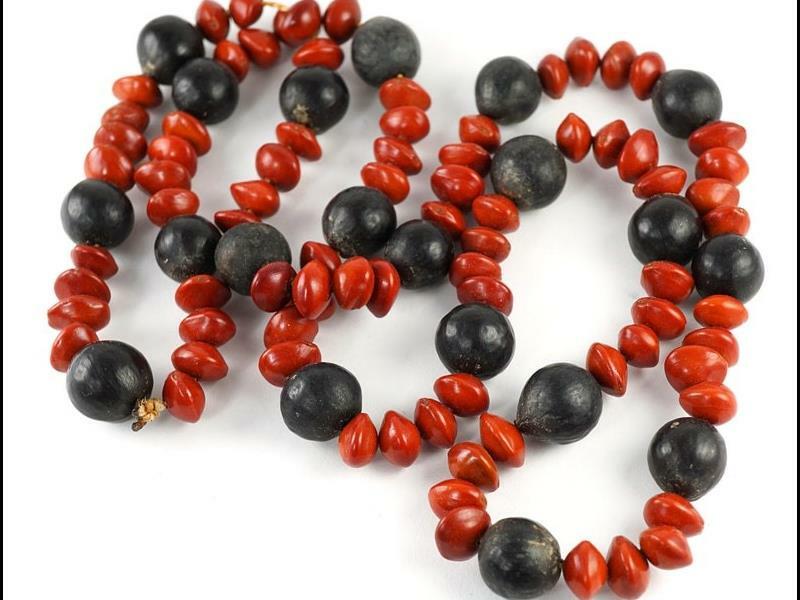
Back in the 1970s, during school holidays on the South Coast, my grandmother used to collect beautiful lucky beans for us – ‘one for a wish, two for a kiss’ was the rule, and I still carry two lucky beans in my wallet today.
Lucky beans are the seeds of our common, albeit underappreciated, coastal coral tree called Erythrina caffra, known in isiZulu as umsinsi.
The legendary luck of the seeds is known around the world, and the beautiful flowers feature in many city and state crests. The seeds are often turned into jewellery, especially in South America.
Erythrina caffra is July’s Indigenous Gem of the Month in The Green Net’s Biodiversity Calendar 2024.
The genus Erythrina is a group of shrubs and trees which have their origin not only in South Africa but also in the West Indies, Brazil and Australia.
The genus contains just over 170 species, six of which are found naturally in South Africa. These are Erythrina caffra, E. lysistemon, E. latissima, E. humeana, E. acanthocarpa and E. zeyheri.
Medicinally, the genus Erythrina possesses a wide range of antioxidant, cytotoxic, and anti-inflammatory properties, allowing species to treat infections, cough, malaria, inflammation, asthma, bronchitis, and insomnia.
Coral trees provide us with a stunning show of red-orange flowers in the depth of winter, providing precious nectar for up to 25 species of birds, butterflies and pollinating insects. The soft wood also provides a habitat for many insects and birds.
Coral trees are very easy to grow from seed or cuttings.
If you plant your little coral trees close together, they will form a beautiful living fence that supports pollinators while keeping out veggie bandits. And, because coral trees are so moist, they don’t burn and thus make for an excellent firebreak.
Don’t plant corals too close to the house or driveway, though, as they have aggressive roots and also, for a few weeks a year, are host to larvae commonly referred to as spitting bugs.
For this reason, corals don’t make great shade trees and are best enjoyed from a little distance; it’s a joy to behold the woodpeckers, mousebirds, bulbuls, white-eyes and weavers, butterflies, moths, wasps, honey and carpenter bees that flock to this beautiful African tree.
HAVE YOUR SAY
Like our Facebook page, follow us on Twitter and Instagram