Adriana wants a one-way ticket to Mars
The dynamic Tuesday Rostrum speaker astounded her listeners.
WILL earthlings be packing for Mars in just 10 years’ time?
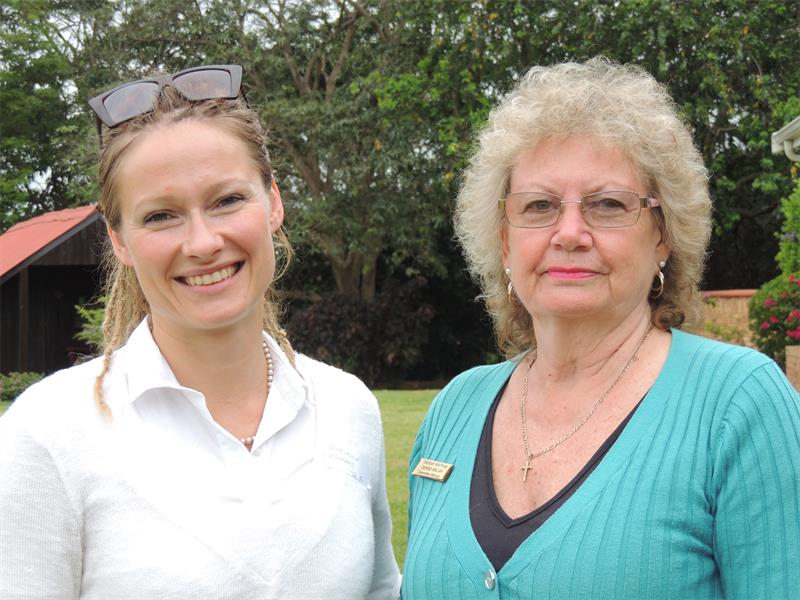
“Watch this space,” said November Tuesday Rostrum guest speaker Adriana Marais. She gave a mind blowing but highly plausible presentation on the Mars One project, of her hopes for a one-way ticket to the red planet and of her aspirations of being among the first people to colonise it in 2026.
Mars One was a not for profit foundation that aimed to establish a permanent human settlement on Mars. It was steered by a formidable team led by two visionary scientists from the Netherlands, Bas Lansdorp and Arno Wielders. Funds were sourced from the private sector. A substantial amount of money was also expected to be raised by the making of a reality television programme on the process of choosing the final teams of astronauts to go to Mars, she explained.
The concept astounded her listeners but, as Adriana spoke, the fantastic idea of living on Mars became more and more possible and, disturbingly, on a rather surreal level, perfectly logical, too.
Adriana’s listeners felt they were looking into a future that seemed as crazy – but as crazily possible – as our digitally enhanced world would have appeared 50 years ago. Like the advent of computers the Mars project appeared to be science fiction fast turning into fact. So just who was this dynamic young speaker whose talk was perhaps the most riveting that had ever come from the Tuesday Rostrum podium?
Adriana is a beautiful, bubbly, intelligent, articulate young woman with a lovely sense of humour. She is a highly qualified scientist – a physicist and quantum biologist – who sees the prospect of moving to Mars as an amazing opportunity to advance her research on the origins of life. She is also one of three South Africans in the Mars 100 group, the 100 people from around the globe who have been selected for round one of the the Mars One project. This number would be whittled down to 24 astronauts, who would be divided into six four-person teams, one of which would be selected for the first one-way mission to Mars in 2026, Adriana explained.
As she spoke, some of the excitement she felt about the project started to rub off on her audience. She pointed out that all corners of our crowded planet had been thoroughly explored and that the only new terrains left to discover were beyond Earth’s confines.
In centuries past many people had left their homes on one-way journeys into the unknown, to new colonies like those in South Africa, for instance, she said. The difference between those early settlers and the modern-day space explorers was the access to good communications. Some of the early settlers hadn’t even had a postal service. Modern technology meant that the Mars settlers would be in constant contact with their loved ones.
Mars was an incredibly inhospitable place. According to Adriana, temperatures could plunge to as low as minus 143 degrees centigrade. However, the average temperatures of minus 50 to 60 degrees at the equator, where the first settlement would be established, would make living there a bit like living in Siberia.
With 96 percent of the Mars atmosphere made up of carbon dioxide, the new settlers would have to wear special masks to breathe outside their living quarters. With the atmospheric pressure much lower that on earth, the new settlers would be three to four times lighter, Another threat to earthlings would be the high levels of radiation, so they would have to wear protective suits to wander outside.
Modern technology would therefore also be needed to create a sustainable, zero-waste environment in which earthlings could live. The recent discovery of small quantities of water on Mars made the Mars One project more viable as oxygen could be extracted from water.
Cutting edge design was being used to create the modular outpost that would be home to the new settlers. These living quarters would contain food production areas, recreational areas and an operation station. Mars One was creating Earth-based simulation outposts for training purposes.
While Nasa was looking at reaching Mars by 2035, Mars One was planning to win the race through its one-way policy. By not having to return to earth, far less equipment and supplies would be needed aboard the spacecraft, making a Mars expedition much more viable, technically and financially, Adriana explained.
Economically sound as it perhaps was, the the one-way policy, which meant the Mars pioneers had little chance of ever returning home, was also the most disturbing aspect of the talk to most of Adriana’s listeners.
However, at least one older member of the ‘thinking women’s club’ declared that if she were young she would be lining up to go to Mars. As well as being absolutely fascinating, Adriana’s presentation gave her listeners much food for thought – and an inkling of a brave new world of endless possibilities that even the more earthbound among us might face in the future.