William the Conqueror invades England
Were it not for what happened 950 years ago today, the English language would not exist.
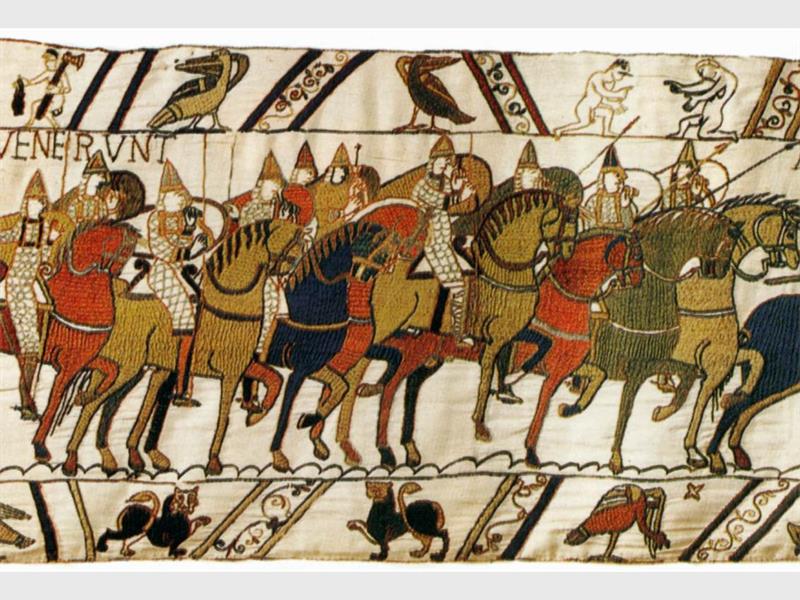
CLAIMING his right to the English throne, William, Duke of Normandy, invaded England at Pevensey on Britain’s southeast coast on Sepember 28, 1066. His subsequent defeat of King Harold II at the Battle of Hastings marked the beginning of a new era in British history.
William was the illegitimate son of Robert I, Duke of Normandy, by his concubine Arlette, a tanner’s daughter from the town of Falaise. The duke, who had no other sons, designated William his heir and, with his death in 1035, William became Duke of Normandy at age seven. Rebellions were epidemic during the early years of his reign and, on several occasions, the young duke narrowly escaped death. Many of his advisers did not.
By the time he was 20, William had become an able ruler and was backed by King Henry I of France. Henry later turned against him, but William survived the opposition and in 1063 expanded the borders of his duchy into the region of Maine.
In 1051, William is believed to have visited England and met with his cousin Edward the Confessor, the childless English king. According to Norman historians, Edward promised to make William his heir. On his deathbed, however, Edward granted the kingdom to Harold Godwine, head of the leading noble family in England and more powerful than the king himself.
In January 1066, King Edward died, and Harold Godwine was proclaimed King Harold II. William immediately disputed his claim, as did King Harald III of Norway and Tostig, brother of Harold. King Harold rallied his forces for an expected invasion by William, but Tostig launched a series of raids instead,
In September, Tostig joined forces with King Harald III and invaded England from Scotland. Harold met them at Stamford Bridge on September 25 – leaving the English Channel unprotected – and defeated and killed them both. Three days later, William landed.
With approximately 7 000 troops and cavalry, William seized Pevensey and marched to Hastings, where he paused to organise his forces. On October 13, Harold arrived near Hastings with his army and, the next day, William led his forces out to give battle. At the end of a bloody, all-day battle, King Harold II was killed – shot in the eye with an arrow, according to legend – and his forces were defeated.
William then marched on London and received the city’s submission. On Christmas Day, 1066, William the Conqueror was crowned the first Norman king of England, in Westminster Abbey. French became the language of the king’s court and gradually blended with the Anglo-Saxon tongue to give birth to modern English.
HAVE YOUR SAY
Like our Facebook page, follow us on Twitter and Instagram
For news straight to your phone, add us on BBM 58F3D7A7 or WhatsApp 082 421 6033