Rosa sparks a revolution
Little did Rosa Parks know, when she boarded a bus in Montgomery, Alabama, on December 1, 1955, that she was about to start one of the largest and most successful mass movements against racial segregation in history.
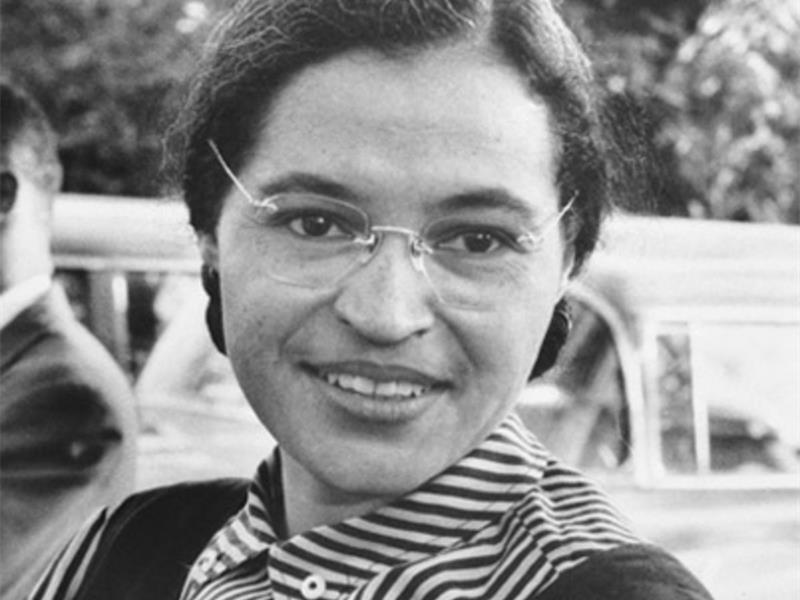
ON December 1, 1955, Rosa Parks boarded a bus in Montgomery, Alabama. She refused to give her seat to a white man and, five days later, the Montgomery Bus Boycott began. The American Civil Rights Movement was under way.
The Montgomery City Code required that all public transportation be segregated and that bus drivers had the ‘powers of a police officer’.
Drivers were required to provide separate but equal accommodation for white and black passengers by assigning seats.
This was accomplished with a line roughly in the middle of the bus separating white passengers in the front of the bus and African-American passengers in the back.
When African-American passengers boarded the bus, they had to get on at the front to pay their fare and then get off and re-board the bus at the back door. When the seats in the front of the bus filled up and more white passengers got on, the bus driver would move back the sign separating black and white passengers and, if necessary, ask black passengers to give up their seats.
On December 1, 1955, after a long day’s work, Rosa Parks boarded the bus for home.
She took a seat in the first of several rows designated for ‘coloured’ passengers. Though the city’s bus ordinance did give drivers the authority to assign seats, it didn’t specifically give them the authority to demand a passenger to give up a seat to anyone (regardless of colour).
However, Montgomery bus drivers had adopted the custom of requiring black passengers to give up their seats to white passengers, when no other seats were available. If the black passenger protested, the bus driver had the authority to refuse service and could call the police to have them removed.
As the bus Rosa was riding continued on its route, it began to fill with white passengers. Eventually, the bus was full and the driver noticed that several white passengers were standing in the aisle. He stopped the bus and moved the sign separating the two sections back one row and asked four black passengers to give up their seats.
Three complied, but Rosa refused and remained seated. The driver demanded: “Why don’t you stand up?” to which Rosa replied, “I don’t think I should have to stand up.” The driver called the police and had her arrested.
Later, Rosa recalled that her refusal wasn’t because she was physically tired, but that she was tired of giving in.
The police arrested Rosa at the scene. Later that night, she was released on bail.
When Rosa arrived at the courthouse for trial on the morning of December 5, she was greeted by a bustling crowd of around 500 local supporters. Following a 30-minute hearing, Rosa was found guilty of violating a local ordinance and was fined $10, as well as a $4 court fee. Inarguably the biggest event of the day, however, was what Rosa’s trial had triggered. The boycott was a huge success. The city’s buses were, by and large, empty. Some people car-pooled and others rode in African-American-operated cabs, but most of the estimated 40 000 African-American commuters living in the city at the time had opted to walk to work that day – some as far as 20 miles.
For 382 days, almost the entire African-American population of Montgomery, including Martin Luther King Jr, refused to ride on segregated buses, a turning point in the American civil rights movement.
Due to the size and scope of, and loyalty to, boycott participation, the effort continued for several months. Dozens of public buses sat idle, ultimately severely crippling finances for Montgomery’s transit company. With the boycott’s progress, however, came strong resistance. Some segregationists retaliated with violence. Black churches were burned and Martin Luther King Jr.’s home was destroyed by bombing.
The African-American community took legal action and the district court declared racial segregation laws unconstitutional. The city of Montgomery appealed but the US Supreme Court upheld the lower court’s ruling.
With the transit company and downtown businesses suffering financial loss and the legal system ruling against them, the city of Montgomery had no choice but to lift its enforcement of segregation on public buses and the boycott officially ended on December 20, 1956.
HAVE YOUR SAY
Like our Facebook page, follow us on Twitter and Instagram
For news straight to your phone, add us on BBM 58F3D7A7 or WhatsApp 082 421 6033