jinaug24:Invasives and Natives: Winged pest is a declared invasive alien
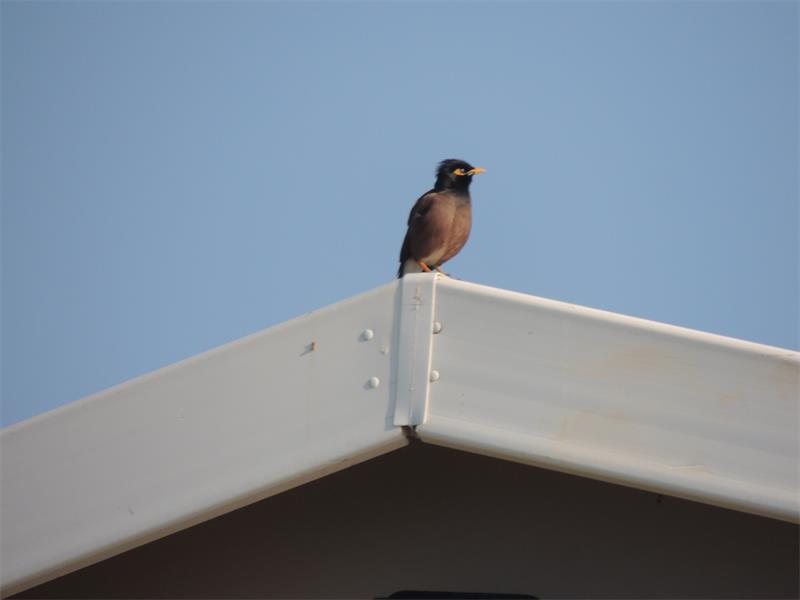
The common myna is an aggressive bird that competes with other birds for resources.
DID you know that not all of South Africa’s invasive aliens are plants?
Imported bugs and even birds can become pests in their adopted country, threatening its natural fauna and flora.
Perhaps our best known alien avian invasive is the very successful settler, the common myna, previously known as the Indian myna. This bird hails from India, South East Asia and parts of the Middle East but has successfully colonised a good deal of South Africa, Madagascar and parts of Australia and New Zealand.
It was first introduced into South Africa from India around 1900 since when it has spread its wings and wandered further afield. This cheeky, chirpy character, an eye-catching dark brown bird with yellow beak, eye patches and legs, belongs to the starling family. Another introduced starling – the common or European starling, is also an invasive alien and is sometimes spotted in Uvongo consorting with the myna. I have been asked if another of the myna’s relative, the red-winged starling, is an alien. It is not a foreigner. It is an indigenous bird and definitely belongs here with us.
The myna breeds rapidly and huge flocks of these birds can often be found roosting communally in big trees. This can be a nuisance in towns as they are very noisy.
The biggest drawback to having them here, though, is that they are very aggressive birds that compete with other indigenous birds for limited resources. The myna also eats the eggs of other species and kill their babies.
Fortunately this opportunistic foreigner is quite the city slicker, very much at home in our urban areas, so doesn’t pose much of a threat to birds in our game reserves and natural areas.
There is not much we as individuals can do about the common myna in our towns, but we can turn our gardens into bird-friendly places to help provide more resources for our struggling indigenous urban birds.
A bird friendly garden should provide avian visitors and residents with food, shelter, nesting opportunities, resting space and water so keep these requirements in mind when you design your green space.
Here are some of my favourite bird-friendly plants that grace my indigenous garden:
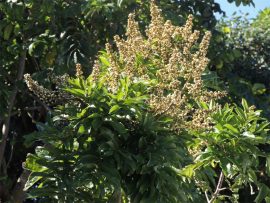
Top of my list must go to the beautiful Halaria lucida tree, bearer of nectar-rich orange flowers that the sunbirds love. The flowers also attract insects for the insect eaters and the fruit eaters love the rich crop of juicy black berries.
Aloes and the so-called wild dagga, Leonotus leonuris, provide plenty of nectar in winter. In spring and summer the bright red flowers of the Schotia brachypetalia or weeping boer-bean literally weep with nectar and attract flocks of sunbirds, insects and insect eaters.
Birds, especially our robins, like to nest in the leaves of the Dracaena aletriformis or large-leafed dragon tree, such an integral part of our coastal bush and an excellent form plant. The tall, thin Deinbolia oblongifolia tree or dune soap berry, also an attractive garden subject, is an insect magnet when it flowers, attracting insect eating birds. Later the fruit eaters love the large creamy berries. I am always fascinated to watch the black-collared barbets swallowing them whole! Surely it must give them indigestion?
My Hoslundia opposita or orange bird lantern bush is very pretty and provides a feast of tasty orange fruit for my avian residents. The bulbuls seem to be particularly attracted to this treat.
Some other striking plants that offer tasty berries and fruit for the fruit eating birds include the various Diospyros species, including the striking bladdernut, Ehretia rigida or puzzle bush, which has pretty little mauve flowers, the various Carissa species including Carissa macrocarpa or amatungulu (humans like their fruit, too, and it makes good jam) and, finally, Chrysanthemoides monilifera or bird tick berry, which has cheerful yellow flowers.
Fig trees are wonderful bird magnets but often gardens are too small to accommodate the bigger, pushy species. Ficus burtt-davyi is a smaller fig, a low growing shrub near the coast and a scrambler in more sheltered spots, so it is a good choice for smaller gardens. It also copes well with our coastal salt-laden winds if planted in an exposed spot.
Set aside a little corner of your garden for some of the striking wild grasses available at indigenous nurseries. The seed eaters will thank you and your garden will benefit from this interesting new feature. A wild grass bed, rippling in the breeze, looks particularly lovely near a pond. Add some grassland flowering plants and grass aloes and this section of your garden will earn plenty of applause from human visitors, too.
Acacia species, asparagus ferns and other spiky trees and bushes provide good nesting sites for birds. Erythrina or coral trees often have dead branches that can be hollowed out for nests.
Finally, grow thickets of trees and densely planted beds to provide plenty of shelter and safe resting places for your visiting and resident birds. Add a bird bath or two to your garden design, then sit back and wait to welcome your winged visitors.