September 21: On This Day in World History … briefly
Most notable historic snippets or facts extracted from the book ‘On This Day’ first published in 1992 by Octopus Publishing Group Ltd, London, as well as additional supplementary information extracted from Wikipedia.
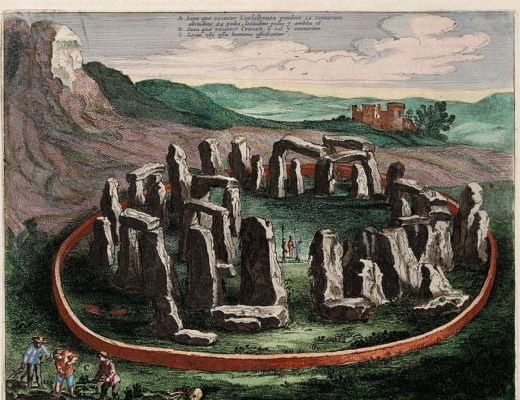
Seventeenth century depiction of Stonehenge from the Atlas van Loon – Wikipedia
Stonehenge, including surrounding fields, was sold to farmer Cecil Chubb for £6 600 at an auction. The finest and most elaborate of Europe’s prehistoric megaliths, the concentric circles of standing stones remain a powerful mystery. The antiquarian William Stukeley said 150 years ago Stonehenge was a Druid temple, but it is now known that it was already ancient when the Druids arrived in England and dates back to before Christ. In 1136, Geoffrey of Monmouth wrote that the stones had magical healing powers. How they were transported also remains a mystery.
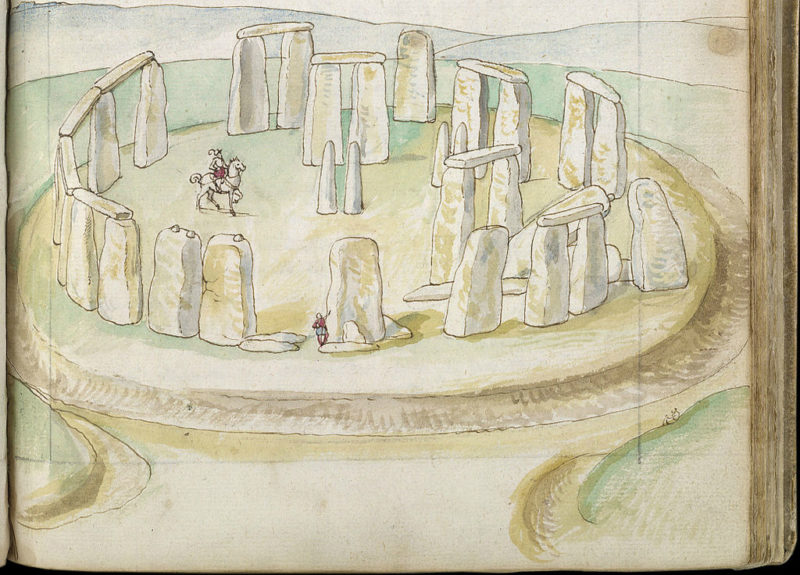
The earliest-known realistic painting of Stonehenge, drawn on site with watercolours by Lucas de Heere between 1573 and 1575 – Wikipedia
Stonehenge has changed ownership several times since King Henry VIII acquired Amesbury Abbey and its surrounding lands. In 1540 Henry gave the estate to the Earl of Hertford. It subsequently passed to Lord Carleton and then the Marquess of Queensberry. The Antrobus family of Cheshire bought the estate in 1824. During the First World War an aerodrome (Royal Flying Corps ‘No. 1 School of Aerial Navigation and Bomb Dropping’) was built on the downs just to the west of the circle and, in the dry valley at Stonehenge Bottom, a main road junction was built, along with several cottages and a cafe. The Antrobus family sold the site after their last heir was killed in the fighting in France. The auction by Knight Frank & Rutley estate agents in Salisbury was held on 21 September 1915 and included ‘Lot 15. Stonehenge with about 30 acres, 2 rods, 37 perches (12.44 ha) of adjoining downland.’ Cecil Chubb bought the site in 1915 and gave it to the nation three years later. Although it has been speculated that he purchased it at the suggestion of—or even as a present for—his wife, in fact he bought it on a whim, as he believed a local man should be the new owner.
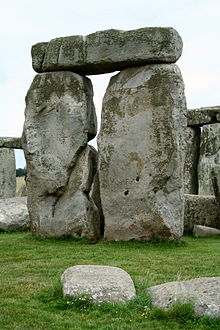
Trilith in Stonehenge – Wikipedia
In the late 1920s a nationwide appeal was launched to save Stonehenge from the encroachment of the modern buildings that had begun to rise around it. By 1928 the land around the monument had been purchased with the appeal donations, and given to the National Trust to preserve. The buildings were removed (although the roads were not), and the land returned to agriculture. More recently the land has been part of a grassland reversion scheme, returning the surrounding fields to native chalk grassland
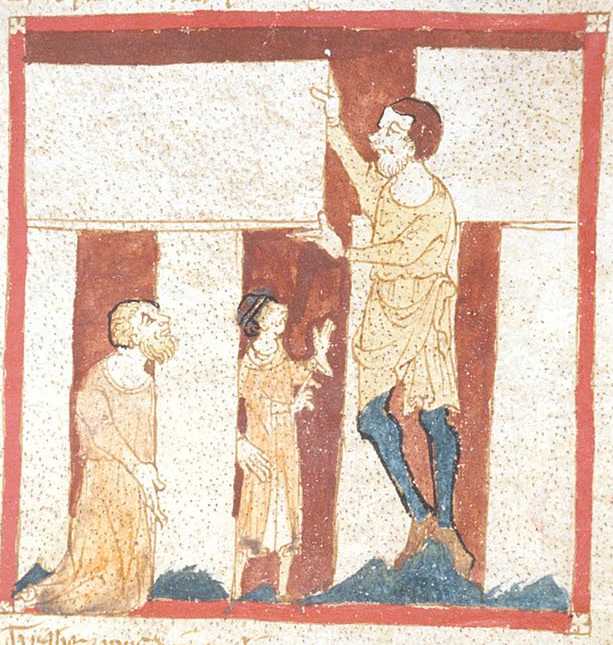
A giant helps Merlin build Stonehenge. From a manuscript of the Roman de Brut by Wace in the British Library (Egerton 3028). Dating back to the second quarter of the 14th century, this is the oldest known depiction of Stonehenge – Wikipedia
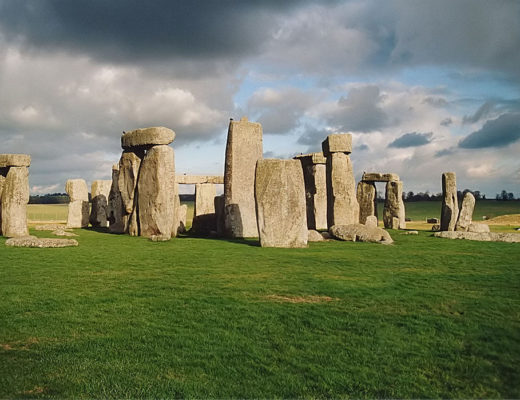
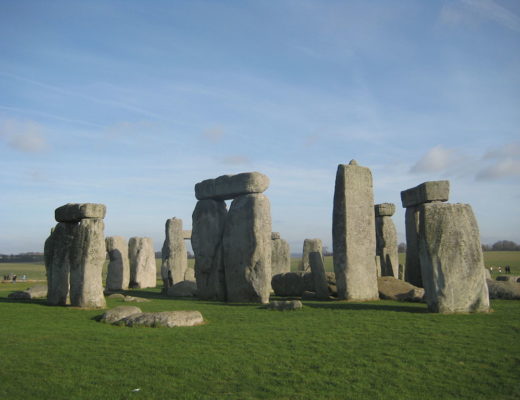
The prehistoric monument in Wiltshire, England, 2 miles (3 km) west of Amesbury consists of a ring of standing stones, with each standing stone around 13 feet (4m) high, 7 feet (2.1m) wide and weighing around 25 tons. The stones are set within earthworks in the middle of the densest complex of Neolithic and Bronze Age monuments in England, including several hundred burial mounds.
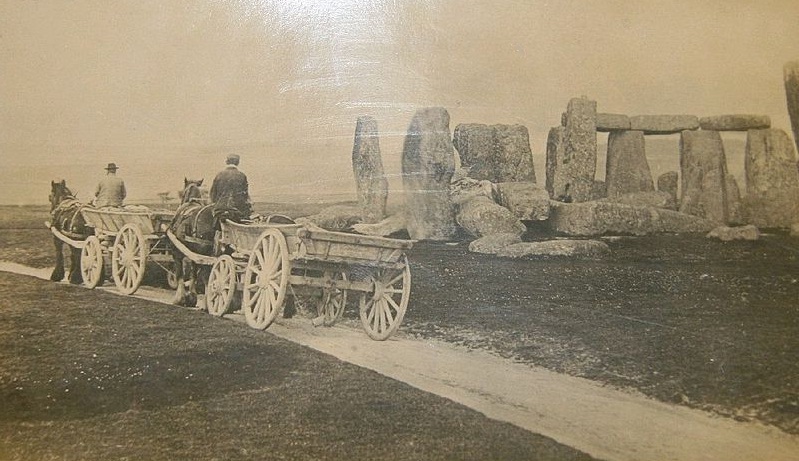
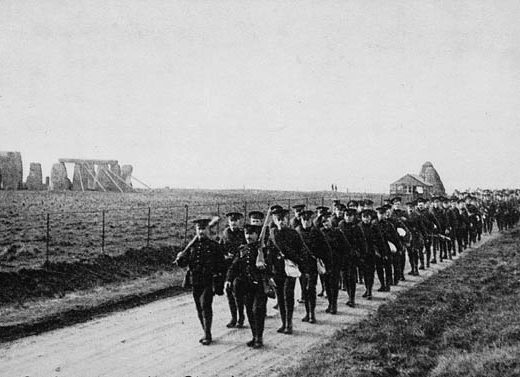
10th Battalion, CEF marches past Stonehenge, winter 1914–15 WW I – Preservation work on stones, propped up by timbers – Wikipedia
Archaeologists believe it was constructed from 3000 BC to 2000 BC. The surrounding circular earth bank and ditch, which constitute the earliest phase of the monument, have been dated to about 3100 BC. Radiocarbon dating suggests that the first bluestones were raised between 2400 and 2200 BC, although they may have been at the site as early as 3000 BC.
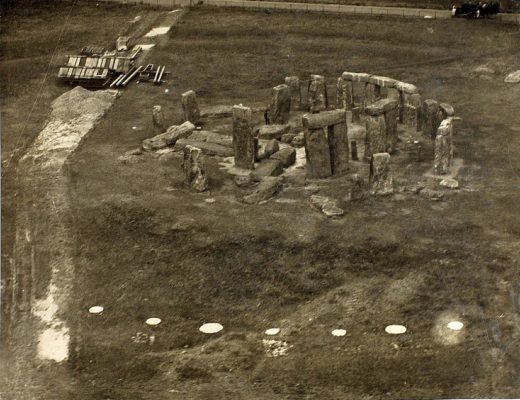
Post-WWI aerial photograph of Stonehenge – Wikipedia
One of the most famous landmarks in the United Kingdom, Stonehenge is regarded as a British cultural icon. It has been a legally protected Scheduled Ancient Monument since 1882 when legislation to protect historic monuments was first successfully introduced in Britain. The site and its surroundings were added to UNESCO’s list of World Heritage Sites in 1986. Stonehenge is owned by the Crown and managed by English Heritage; the surrounding land is owned by the National Trust.
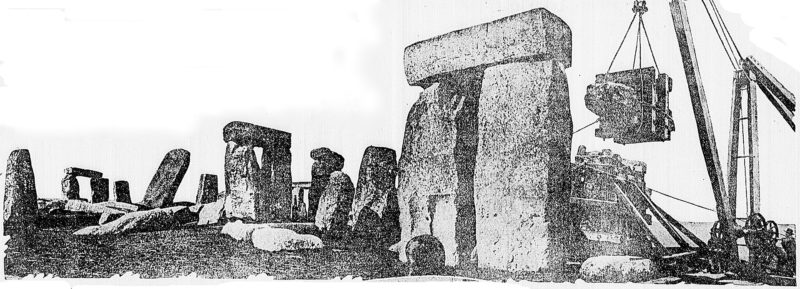
A contemporary newspaper depiction of the 1920 restoration – Wikipedia
Stonehenge could have been a burial ground from its earliest beginnings. Deposits containing human bone date from as early as 3000 BC, when the ditch and bank were first dug, and continued for at least another five hundred years
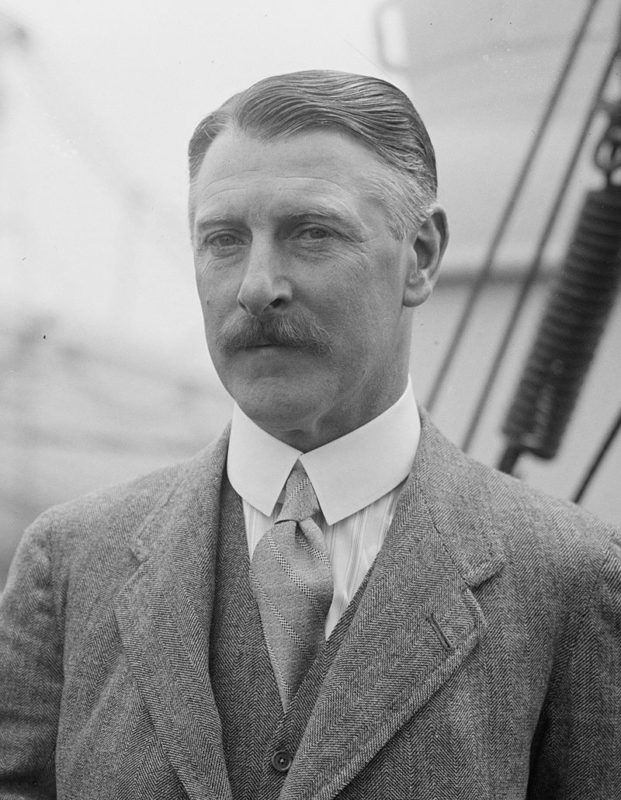
Sir Cecil Chubb in May 1926 – Wikipedia
Sir Cecil Herbert Edward Chubb, 1st Baronet (14 April 1876 – 22 September 1934) was the last private owner of Stonehenge, which he donated to the British government in 1918. He was born in Shrewton, a village 4 miles (6.4km) west of Stonehenge, the eldest son of Alfred and Mary Chubb. ‘Fred’ was the village saddler and harness maker, as was his father before him. He attended the local village school and then Bishop Wordsworth’s School in Salisbury, where from the age of 14 he worked for a time as a student teacher. He met his future wife at a cricket game between his Bishop Wordsworth School and Fisherton House Asylum. He then attended Christ’s College, Cambridge where he was awarded a double first in Science and Law, leaving with Master of Arts and Bachelor of Law degrees. He became a barrister and amassed a considerable fortune.
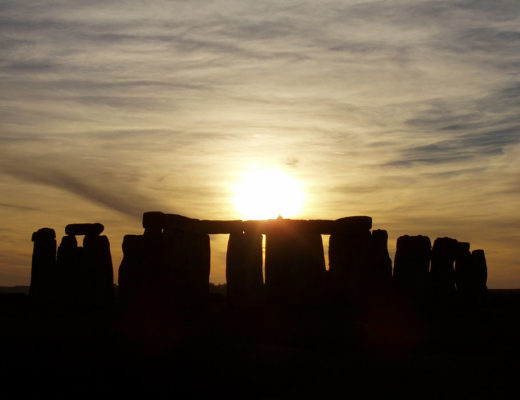
Stonehenge at sunset – Wikipedia
In 1902 he married Mary Bella Alice Finch, whose uncle, Dr. W Corbin Finch, owned Fisherton House, which was a mental asylum (later the Old Manor Hospital, now Fountain Way). Five years after her uncle’s death in 1905, the business and buildings were transferred to her. Following financial difficulties, a limited company was formed to run the hospital in 1924, and Sir Cecil became chairman. Whilst he was in charge, the hospital became the largest private mental hospital in Europe. There is a plaque in the hospital commemorating his life and work. Sir Cecil also served on Salisbury City Council, was a Justice of the Peace and became a successful racehorse owner and breeder of Shorthorn cattle.
Stonehenge – Wikipedia
Stonehenge was put up for auction in 1915 by the Antrobus family following the death in World War I of the only surviving male heir. Cecil Chubb’s interest in the local area led to him attending the sale, with him bidding and purchasing Lot 15 on a whim for £6 600 (about £485 000/€573 000/$635 000 today), as he wished to avoid the stones being acquired by someone overseas. It is also speculated that he bought the stones as a present for his wife, only for her to be less than pleased with his new purchase. He gave Stonehenge to the nation on October 26, 1918. The deed of gift included the following conditions:
‘First that the public shall have free access to the premises hereby conveyed and every part thereof on the payment of such reasonable sum per head not exceeding one shilling for each visit and subject to such conditions as the Commissioners of Works in the exercise and execution of their statutory powers and duties may from time to time impose Secondly that the premises shall so far as possible be maintained in their present condition Thirdly that no building or erection other than a pay box similar to the Pay Box now standing on the premises shall be erected on any part of the premises within four hundred yards of The Milestone marked ‘Amesbury 2’ on the northern frontage of the premises and Fourthly that the Commissioners of Works will at all times save harmless and keep indemnified the Donors and each of them and each of their estates and effects from and against all proceedings costs claims and expenses on account of any breach or non-observance of the covenants by the Donors to the like or similar effect contained in the Conveyance of the premises to the Donors.’
Local residents are still entitled to free admission to Stonehenge because of a different agreement concerning the moving of a right of way.
The monument from a similar angle in 2008 showing the extent of reconstruction – Wikipedia
To mark his generosity, he was made a baronet in 1919 by Lloyd George. Chubb’s arms feature a trilithon representing Stonehenge. Sir Cecil lived at Bemerton Lodge, where Bertie, the future King George VI, was a regular guest. The prince liked the estate because it was small, secluded and away from London. Chubb died of heart disease at his house (from 1930) in Bournemouth, Rothwell Dene, on 22 September 1934 aged 58, leaving behind his wife, son John, who succeeded him, and daughter Mary. A plaque commemorating his birth was erected in the late 1980s on the house in Shrewton where he was born. It was unveiled by his two surviving nephews.
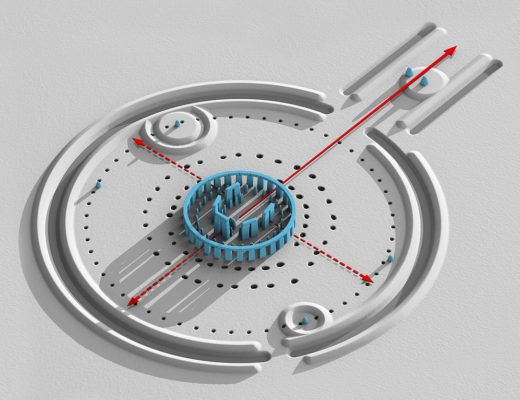
Computer rendering of Stonehenge – Wikipedia
Stonehenge was produced by a culture that left no written records. Many aspects of Stonehenge, such as how it was built and which purposes it was used for, remain subject to debate. A number of myths surround the stones. The site, specifically the great trilithon, the encompassing horseshoe arrangement of the five central trilithons, the heel stone, and the embanked avenue, are aligned to the sunset of the winter solstice and the opposing sunrise of the summer solstice. A natural landform at the monument’s location followed this line, and may have inspired its construction. The excavated remains of culled animal bones suggest that people may have gathered at the site for the winter rather than the summer. Further astronomical associations, and the precise astronomical significance of the site for its people, are a matter of speculation and debate.
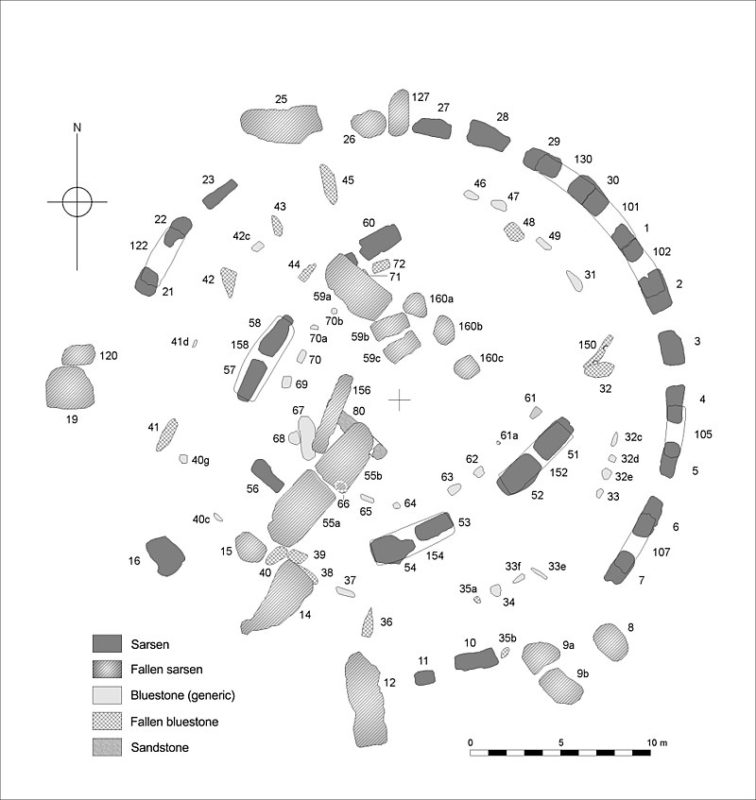
Plan of the central stone structure today; after Johnson 2008 – Wikipedia