The darker side of the human psyche … Serial killers: ‘Son of Sam’ Part III
Guitarist Scott Putesky used the stage name 'Daisy Berkowitz' while playing with Marilyn Manson in the 1990s, and the band's song 'Son of Man' conspicuously describes Berkowitz - several other rock musicians established a full ensemble named 'Son of Sam' during 2000.
Crimes continue
Alexander Esau and Valentina Suriani
At about 3am on April 17, 1977, Alexander Esau, 20, and Valentina Suriani, 18, were sitting in Suriani’s car near her home in the Bronx, only a few blocks from the scene of the Lauria–Valenti shooting, when each was shot twice. Suriani died at the scene, and Esau died in the hospital several hours later without being able to describe his attacker(s). Police said that the weapon used for the crime was the same as the one which they had suspected in the earlier shootings. During the days afterwards, they repeated their theory that only one man was responsible for the .44 murders. The chubby teenager in the Voskerichian case was still regarded as a witness, while the dark-haired man who shot Lauria and Valenti was considered the suspect.
Crime scene letters
Police discovered a handwritten letter near the bodies of Esau and Suriani, written mostly in block capitals with a few lower-case letters, and addressed to NYPD Captain Joseph Borrelli. With this letter, Berkowitz revealed the name ‘Son of Sam’ for the first time. The press had previously dubbed the killer ‘the .44 Calibre Killer’ because of his weapon of choice. The letter was initially withheld from the public, but some of its contents were revealed to the press, and the name ‘Son of Sam’ quickly replaced the old name.
The letter expressed the killer’s determination to continue his work, and taunted police for their fruitless efforts to capture him. In full, with misspellings intact, the letter read:
“I am deeply hurt by your calling me a wemon hater. I am not. But I am a monster. I am the ‘Son of Sam.’ I am a little ‘brat’. When father Sam gets drunk he gets mean. He beats his family. Sometimes he ties me up to the back of the house. Other times he locks me in the garage. Sam loves to drink blood. ‘Go out and kill’ commands father Sam. Behind our house some rest. Mostly young – raped and slaughtered – their blood drained – just bones now. Papa Sam keeps me locked in the attic, too. I can’t get out but I look out the attic window and watch the world go by. I feel like an outsider. I am on a different wave length then everybody else – programmed to kill. However, to stop me you must kill me. Attention all police: Shoot me first – shoot to kill or else. Keep out of my way or you will die! Papa Sam is old now. He needs some blood to preserve his youth. He has had too many heart attacks. Too many heart attacks. “Ugh, me hoot it urts sonny boy.” I miss my pretty princess most of all. She’s resting in our ladies house but I’ll see her soon. I am the ‘Monster’ – ‘Beelzebub’ – the ‘Chubby Behemouth’. I love to hunt. Prowling the streets looking for fair game – tasty meat. The wemon of Queens are z prettyist of all. I must be the water they drink. I live for the hunt – my life. Blood for papa. Mr Borrelli, sir, I don’t want to kill anymore no sir, no more but I must, ‘honour thy father.’ I want to make love to the world. I love people. I don’t belong on Earth. Return me to yahoos. To the people of Queens, I love you. And I want to wish all of you a happy Easter. May God bless you in this life and in the next and for now I say goodbye and goodnight. Police – Let me haunt you with these words; I’ll be back! I’ll be back! To be interpreted as – bang, bang, bang, bang, bang—ugh!! Yours in murder Mr Monster.”
At the time, police speculated that the letter-writer might be familiar with Scottish English. The phrase ‘me hoot it urts sonny boy’ was taken as a Scottish-accented version of ‘my heart, it hurts, sonny boy’; and the police also hypothesised that the shooter blamed a dark-haired nurse for his father’s death, due to the ‘too many heart attacks’ phrase, and the facts that Lauria was a medical technician and Valenti was studying to be a nurse. On July 28, New York Daily News columnist Jimmy Breslin alluded to the ‘wemon’ quirk and referred to the shooter watching the world from ‘his attic window’.
The killer’s unusual attitude towards the police and the media received widespread scrutiny. Psychologists observed that many serial killers gain gratification by eluding pursuers and observers. The feeling of control of media, law enforcement, and even entire populations provides a source of social power for them. After consulting with several psychiatrists, police released a psychological profile of their suspect on May 26, 1977. He was described as neurotic and probably suffering from paranoid schizophrenia, and believed himself to be a victim of demonic possession.
Letter to Jimmy Breslin
On May 30, 1977, ‘Daily News’ columnist Jimmy Breslin received a handwritten letter from someone who claimed to be the .44 calibre shooter. The letter was postmarked early that same day in Englewood, New Jersey. On the reverse of the envelope, neatly hand-printed in four precisely centred lines, were the words:
Blood and Family – Darkness and Death – Absolute Depravity – .44.
The letter inside read:
“Hello from the gutters of NYC which are filled with dog manure, vomit, stale wine, urine and blood. Hello from the sewers of NYC which swallow up these delicacies when they are washed away by the sweeper trucks. Hello from the cracks in the sidewalks of NYC and from the ants that dwell in these cracks and feed in the dried blood of the dead that has settled into the cracks. JB, I’m just dropping you a line to let you know that I appreciate your interest in those recent and horrendous .44 killings. I also want to tell you that I read your column daily and I find it quite informative. Tell me Jim, what will you have for July twenty-ninth? You can forget about me if you like because I don’t care for publicity. However you must not forget Donna Lauria and you cannot let the people forget her either. She was a very, very sweet girl but Sam’s a thirsty lad and he won’t let me stop killing until he gets his fill of blood. Mr Breslin, sir, don’t think that because you haven’t heard from me for a while that I went to sleep. No, rather, I am still here. Like a spirit roaming the night. Thirsty, hungry, seldom stopping to rest; anxious to please Sam. I love my work. Now, the void has been filled. Perhaps we shall meet face to face someday or perhaps I will be blown away by cops with smoking .38’s. Whatever, if I shall be fortunate enough to meet you I will tell you all about Sam if you like and I will introduce you to him. His name is ‘Sam the terrible.’ Not knowing what the future holds I shall say farewell and I will see you at the next job. Or should I say you will see my handiwork at the next job? Remember Ms Lauria. Thank you. In their blood and from the gutter ‘Sam’s creation’ .44 Here are some names to help you along. Forward them to the inspector for use by NCIC: [sic] ‘The Duke of Death’ ‘The Wicked King Wicker’ ‘The Twenty Two Disciples of Hell’ ‘John ‘Wheaties’ – Rapist and Suffocator of Young Girls. PS: Please inform all the detectives working the slaying to remain. PS: [sic] JB, Please inform all the detectives working the case that I wish them the best of luck. “Keep ’em digging, drive on, think positive, get off your butts, knock on coffins, etc.” Upon my capture I promise to buy all the guys working the case a new pair of shoes if I can get up the money. Son of Sam.”
Underneath the ‘Son of Sam’ was a logo or sketch that combined several symbols. The writer’s question ‘What will you have for July 29?’ was considered an ominous threat: July 29 would be the anniversary of the first .44 calibre shooting. Breslin notified police, who thought that the letter was probably from someone with knowledge of the shootings.
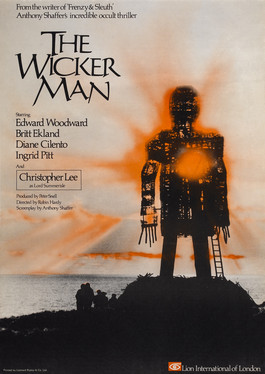
The Breslin letter was sophisticated in its wording and presentation, especially when compared to the crudely written first letter, and police suspected that it might have been created in an art studio or similar professional location by someone with expertise in printing, calligraphy, or graphic design. The unusual writing caused the police to speculate that the killer was a comic letterer, and they asked staff members of DC Comics whether they recognised the lettering. The ‘Wicked King Wicker’ reference caused police to arrange a private screening of ‘The Wicker Man’, a 1973 horror movie.
The New York Daily News published the letter a week later (after agreeing with police to withhold portions of the text) and Breslin urged the killer to surrender himself. The dramatic article made that day’s paper the highest-selling edition of the Daily News to date—more than 1.1 million copies were sold. Police received thousands of tips based on references in the publicised portions of the letter, all of which proved useless. All the shooting victims to date had long dark hair, and thousands of women in New York acquired short cuts or brightly coloured dyes, and beauty supply stores had trouble meeting the demand for wigs.
Sal Lupo and Judy Placido
On June 26, 1977, there was another shooting. Sal Lupo, 20, and Judy Placido, 17, had left the Elephas discotheque in Bayside, Queens, and were sitting in Lupo’s parked car at about 3:00 a.m. when three gunshots blasted through the vehicle. Lupo was wounded in the right forearm, while Placido was shot in the right temple, shoulder and back of the neck, but both victims survived their injuries. Lupo told police that the young couple had been discussing the Son of Sam case only moments before the shooting.
Neither Lupo nor Placido had seen their attacker, but two witnesses reported a tall, dark-haired man in a leisure suit fleeing from the area; one claimed to see him leave in a car and even supplied a partial license plate number. Another report described a blond man with a mustache who drove from the scene in a Chevy Nova without turning on its headlights. Police speculated that the dark-haired man was the shooter, and that the blond man had observed the crime.

Stacy Moskowitz and Robert Violante
The first anniversary of the initial .44 calibre shootings was approaching, and police established a sizable dragnet that emphasised past hunting grounds in Queens and the Bronx. However, the next and final .44 shooting occurred in Brooklyn.
Early on July 31, 1977, Stacy Moskowitz and Robert Violante, both 20, were in Violante’s car, which was parked under a streetlight near a city park in the neighbourhood of Bath Beach. They were kissing when a man approached within three feet of the passenger side of Violante’s car and fired four rounds into the car, striking both victims in the head before he escaped into the park. Moskowitz died several hours later in the hospital. Violante survived, although he lost vision in one eye and retained very limited vision in the other eye.
The Moskowitz–Violante crime produced more witnesses than any of the other Son of Sam murders; there was one direct eyewitness who was not an intended victim. During the shooting, 19-year-old Tommy Zaino was parked with his date three cars in front of Violante’s vehicle. Moments before the shooting, Zaino caught a peripheral glimpse of the shooter’s approach and happened to glance in his rear view mirror just in time to see the actual shooting. Zaino clearly saw the perpetrator for several seconds due to the bright street light and full moon and later described him as being 25 to 30 years old, of average height – 5ft, 7in (1.70m) to 5ft, 9in (1.75m) – with shaggy hair that was dark blond or light brown. Zaino said that the shooter’s hair ‘looked like a wig.’

About a minute after the shooting, a woman seated next to her boyfriend in his car on the other side of the city park saw a ‘white male (who was wearing) a light-coloured, cheap nylon wig’ sprint from the park and enter a ‘small, light-coloured’ auto, which drove away quickly. “He looks like he just robbed a bank.” said the woman, who wrote what she could see of the car’s license plate. She was unable to determine the first two characters, but was certain that the others were either 4-GUR or 4-GVR.
Other witnesses included a woman who saw a light car speed away from the park about 20 seconds after the gunshots and at least two witnesses who described a yellow Volkswagen driving quickly from the neighbourhood with its headlights off. A neighbourhood resident given the pseudonym Mary Lyons heard the gunshots and Violante’s calls for help, and glanced from her apartment window to see a man whom she later positively identified as Berkowitz, who was walking casually away from the crime scene as many others were rushing towards the scene to render aid.
Soon after 2.35am, a man who was later given the pseudonym Alan Masters was driving through an intersection a few blocks from the park. Masters was nearly struck by what he described as a yellow Volkswagen Beetle that sped through the intersection without its headlights activated as the driver ignored a red light. Angered and alarmed, Masters followed the Volkswagen at high speed for several minutes before losing sight of the vehicle. Masters described the driver as a white male in his late 20s or early 30s, with a narrow face, dark, long, stringy hair, several days’ growth of dark whiskers on his face, and wearing a blue jacket.
Masters was upset and he neglected to note the Volkswagen’s license plate number, but he thought that it might have been a New Jersey rather than a New York plate. Violante encountered a very similar man, because he and Moskowitz were in the park shortly before they were shot. Violante described him as a ‘grubby-looking hippy’ with whiskers, wiry hair over his forehead, dark eyes, and wearing a denim jacket. Thomas Scally stated that he was sitting in Alley Pond Park on Winchester Boulevard, in the borough of Queens, at dusk with a female friend when a yellow Volkswagen Beetle approached his car door to door and only three inches apart from his vehicle, which did not have its engine running. Scally kept an air gun under his seat and, as the VW approached his car, the VW driver was met with the gun pointed straight at him.
At first, he appeared to be a light-skinned black male, but he also appeared to be wearing a stocking over his face. The driver of the VW quickly started his car and gunned it in reverse out of the parking lot. Scally chased the car to a point in Glen Oaks, Queens, where the driver jumped out and ran. He did not want to leave his female passenger to give chase, so he telephoned the ‘Son of Sam Hot Line’. Detective Richard Carroll from the Son of Sam Task Force (and Scally’s former baseball coach) later told Scally that he had indeed seen the Son of Sam. Glen Oaks was later revealed to be the home of Berkowitz’s sister and was close to the site of the Donna DeMasi and Joanne Lomino shootings.
Police did not learn of the Moskowitz–Violante shooting until about 2.50am, and Dowd did not think that it was another Son of Sam shooting until an officer at the scene reported that large-calibre shells had been used. Police established a series of roadblocks about an hour after the shooting, stopping hundreds of cars to question drivers and inspect vehicles. During interviews, Masters and others described a Volkswagen speeding from the crime scene, and police now suspected that the shooter owned or drove such a vehicle. In subsequent days, police determined that there were more than 900 Volkswagens in New York or New Jersey, and they made plans to trace each of these cars and their owners. Detective John Falotico was awakened at home and told to report to the 10th Homicide Division at the 60th Precinct station house in Coney Island. He was told that Stacy Moskowitz and Robert Violante had been shot. Falotico was given two weeks to work on the case as a normal murder investigation; it was then given to a special Son of Sam task force.
Don’t miss ‘Son of Sam’ Part IV: Suspicion and capture – Arrest in Yonkers
Sourced from Wikipedia
HAVE YOUR SAY
Like our Facebook page, follow us on Twitter and Instagram