October 9: On This Day in World History … briefly
Immediately after the disaster, the government (which at the time owned the dam), politicians and public authorities insisted on attributing the tragedy to an unexpected and unavoidable natural event.
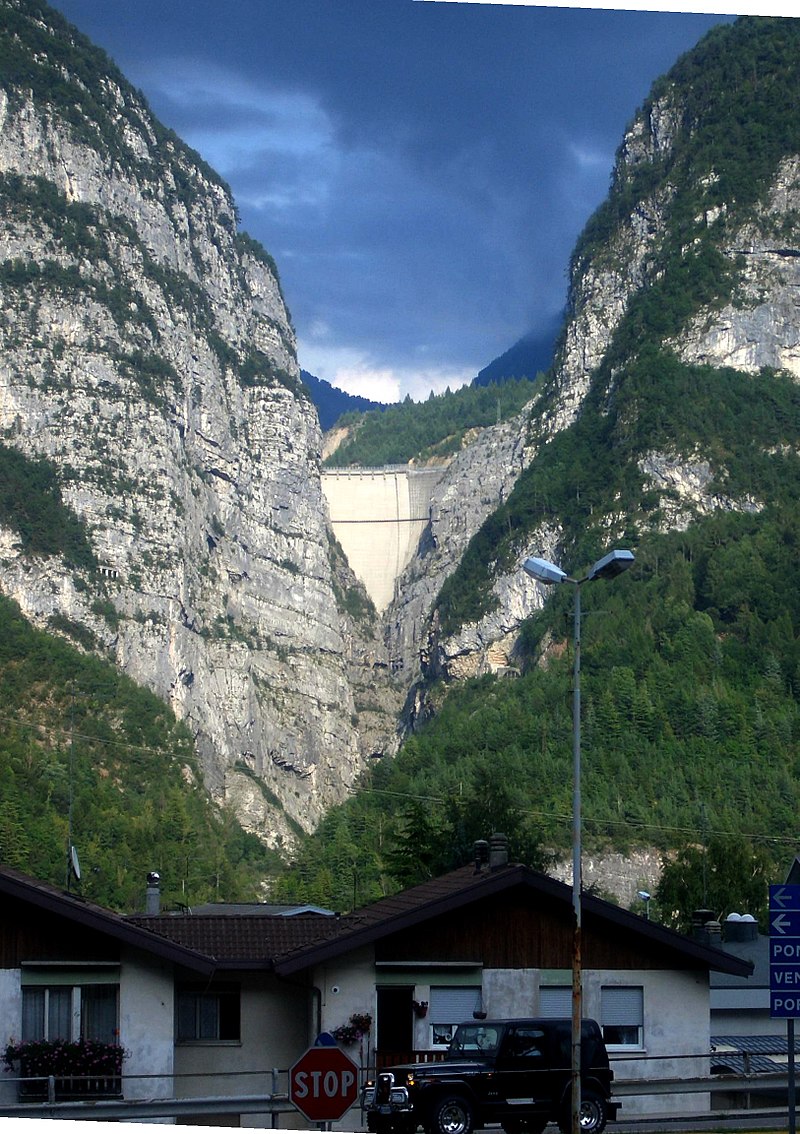
1963: Thousands die in Italian rockslide
The Vajont Dam (or Vaiont Dam) is a disused dam, completed in 1959 in the valley of the Vajont River under Monte Toc, in the municipality of Erto and Casso, 100km (60 miles) north of Venice, Italy. One of the tallest dams in the world, it is 262 metres (860 ft) high, 27 metres (89 ft) wide and 22.11 metres (72 ft 6 in) thick at the base and 191 metres (627 ft) wide and 3.4 metres (11 ft 2 in) thick at the top. The dam was conceived in the 1920s, designed by Carlo Semenza, and eventually built between 1957 and 1960 by Società Adriatica di Elettricità (SADE or EDIS) (English: Adriatic Energy Corporation), the electricity supply and distribution monopoly in northeastern Italy, which was owned by Giuseppe Volpi di Misurata. In 1962 the dam was nationalised and came under the control of ENEL as part of the Italian Ministry for Public Works. It was described as ‘the tallest dam in the world’, intended to meet the growing demands of industrialisation, and as of 2010 is still one of the tallest in the world.
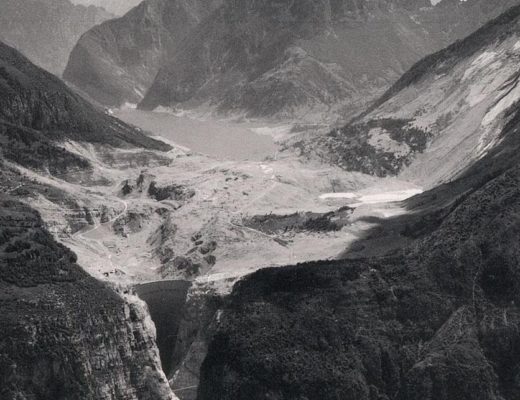
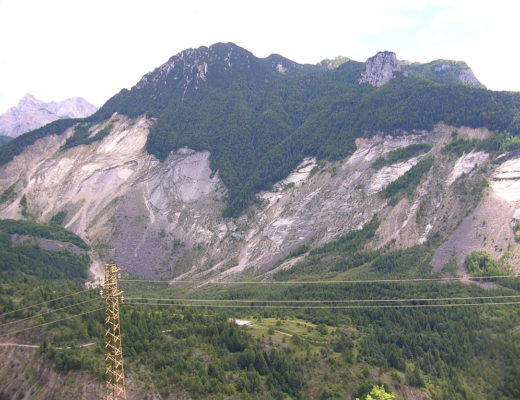
On 9 October 1963, during initial filling, a massive landslide caused a man-made mega-tsunami in the lake in which 50 million cubic metres of water overtopped the dam in a 250 metres (820 ft) wave, leading to the complete destruction of several villages and towns, and 1,917 deaths. This event occurred when the company and the Italian government dismissed evidence and concealed reports describing the geological instability of Monte Toc on the southern side of the basin, and other early warning signs reported prior to the disaster. Numerous warnings, signs of danger, and negative appraisals had been disregarded, and the eventual attempt to safely control the landslide into the lake by lowering its level came when the landslide was almost imminent and was too late to prevent it. Although the dam itself remained almost intact, and two thirds of the water was retained behind it, the landslide was much larger than expected and the impact brought massive flooding and destruction to the Piave valley below. Although the wave only contained a third of the dam’s contents, it was still ten times higher than calculations had predicted.
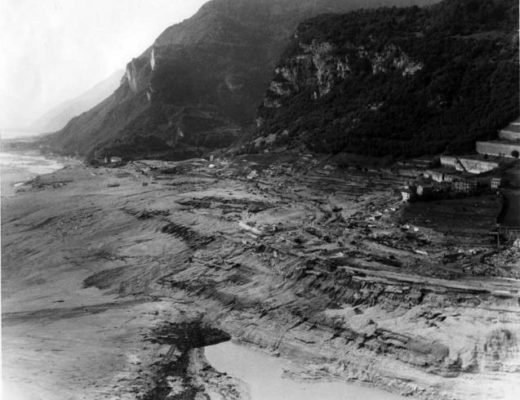
On 9 October 1963, engineers saw trees falling and rocks rolling down into the lake where the predicted landslide would take place. Before this, the alarming rate of movement of the landslide had not slowed as a result of lowering the water, although the water had been lowered to what SADE believed was a safe level to contain the displacement wave should a catastrophic landslide occur. With a major landslide now imminent, engineers gathered on top of the dam that evening to witness the tsunami. At 10:39 p.m., a massive landslide of about 260 000 000 cubic metres (340 000 000 cu yd) of forest, earth, and rock fell into the reservoir at up to 110 kilometres per hour (68 mph), completely filling the narrow reservoir behind the dam. The landslide was complete in just 45 seconds, much faster than predicted, and the resulting displacement of water caused 50 000 000 cubic metres (65 000 000 cu yd) of water to overtop the dam in a 250-metre (820 ft) high wave.
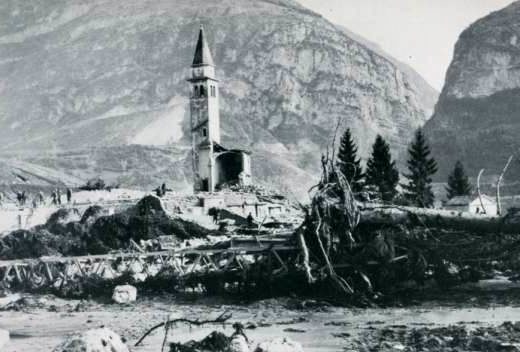
The flooding from the huge wave in the Piave valley destroyed the villages of Longarone, Pirago, Rivalta, Villanova and Faè, killing around 2,000 people and turning the land below the dam into a flat plain of mud with an impact crater 60 metres (200 ft) deep and 80 metres (260 ft) wide. Many small villages near the landslide along the lakefront also suffered damage from a giant displacement wave. Villages in the territory of Erto e Casso and the village of Codissago, near Castellavazzo, were largely wrecked. Estimates of the dead range from 1,900 to 2,500 people, and about 350 families lost all members. Most of the survivors had lost relatives and friends along with their homes and belongings. The dam was largely undamaged. The top 1 metre (3.3 ft) or so of masonry was washed away, but the basic structure remained intact and still exists today.
Most notable historic snippets or facts extracted from the book ‘On This Day’ first published in 1992 by Octopus Publishing Group Ltd, London, as well as additional supplementary information extracted from Wikipedia.
HAVE YOUR SAY
Like the South Coast Herald’s Facebook page, follow us on Twitter and Instagram
To receive our FREE email newsletter, click HERE