
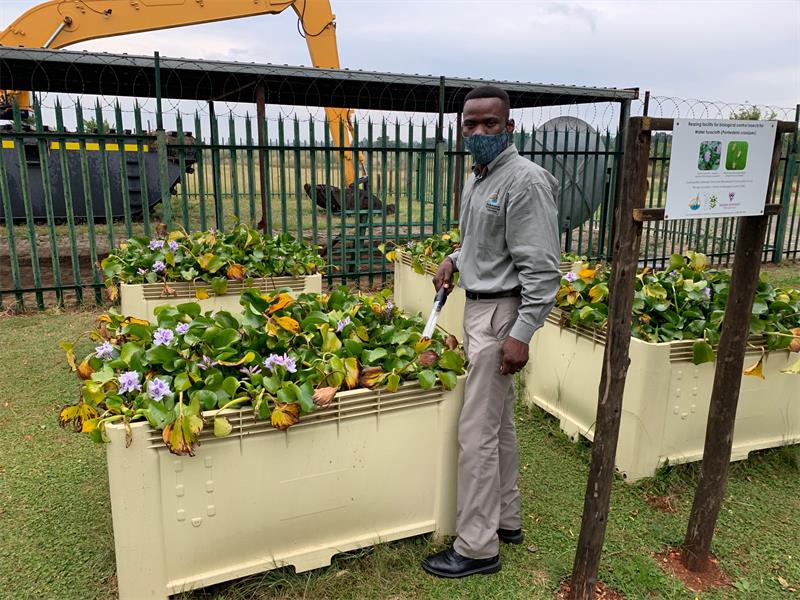
The Grootvaly Bleskopspruit Trust has partnered with Rhodes University to combat the devastating and ongoing hyacinth issue that has plagued the wetland for more than a year.
The invasive plant species spread at a rapid rate and has covered the majority of the Blesbokspruit’s water surface.
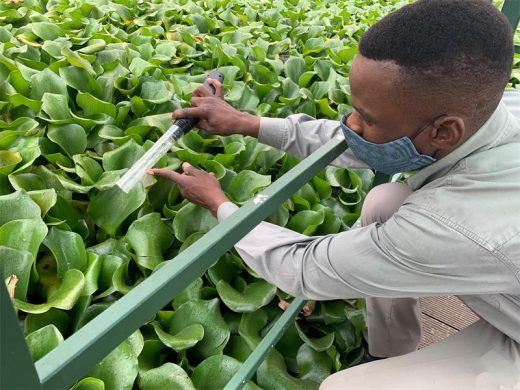
On Wednesday, a new project was launched, which involves a special specie of beetle that will devour the hyacinth and clear the spruit.
The beetle is called megamelus, a water hyacinth hopper. According to Rhodes University Media, the water hyacinth hopper can feed on the plant’s sap.
“They also pierce the plant tissue, damaging cells. Damage in the petiole leads to water logging, which reduces plant buoyancy and causes the tissue to rot.”
The Blesbokspruit is an important wetland and was recognised as a Ramsar site in 1986 for the essential role it plays in the ecology of the environment.
Also read: Piles of hyacinth left to rot at the dam
A Ramsar site is a wetland that is considered important under the Ramsar Convention, an international treaty established by Unesco that aims at wetland conservation.
Among its many uses, the wetland slows down the flow of floodwaters, reducing flood damage, stores water during periods of heavy rainfall and slowly releases the water back into the stream.
The wetland also filters and cleans water passing through it.
Most importantly, the wetland provides a habitat to many organisms, where they can find food, shelter and a place to breed in the wetlands.
Various species of fish, crab, birds, small mammals and many others live in this wetland.
Water hyacinth is widely considered to be one of the most damaging aquatic weeds in the world.
According to a study titled Management of Problematic Aquatic Weeds in Africa by L Labrada and L Fornasari, “The main problems arising from the growth of water hyacinth in thick mats are (a) an enormous water loss through evapotranspiration that alters the water balance of entire regions; (b) the impediment to water flow, that increases sedimentation, causing flooding and soil erosion; (c) the obstruction of navigation; (d) hampering fishing and dramatically reducing the catch and the source of food and income for local populations; (e) a drastic change in the physical and chemical properties of water and in the environment in the water bodies invaded, with detrimental effects on plants and animals; (f) the reduction of the activity of electrical power stations, jeopardising the power supply of the country; and (g) a serious threat to agricultural production, following the blockage of irrigation canals and drainage systems.
Also read: Urgent action needed to tackle hyacinth problem
The Blesbokpsruit Trust and Rhodes University hope this new solution will bring about satisfying results.
Previous efforts such as removing them by hand and using a dredger failed to achieve success.
According to a 2019 study on the effectiveness of megamelus conducted by Rhodes University, “The results showed that megamuls scutellaris is able to establish successfully in South Africa, and that the agents are capable of causing significant damage to water hyacinth, making it a promising addition to the biological control programme.”
Megamelus will work in combination with another hyacinth devouring insect called a water hyacinth weevil.
Members of the trust and Rhodes University hope megamelus and weevil will solve the hyacinth issue once and for all.
Follow us on our social media platforms: