
Coffee with Reverend Maans – every community eventually learns that time is never ‘just time’
Faithful leadership is not dramatic – it is dependable; keeping promises, however small, is an act of service, and punctuality is reliability made visible.
Punctuality is often dismissed as a minor concern in a country facing major challenges such as infrastructure failure, unemployment, and service delivery backlogs.
Yet research and lived experience point to a deeper truth: reliability is the foundation of trust.
When municipal leaders arrive late, miss deadlines, or postpone decisions, citizens do not merely feel irritated – they lose confidence.
READ MORE HERE: Coffee with Reverend Maans – the moral compass for a nation in need
Over time, lateness becomes symbolic of broken promises and weak accountability.
This is why punctuality is not about an obsession with clocks, but about honouring commitments, reducing waste, and restoring public confidence. In local government, time is not private.
It is public.
Every community eventually learns that time is never ‘just time.’
In municipalities, time translates directly into water pressure, electricity uptime, pothole repairs, billing accuracy, permit approvals, and whether clinics function or fail. When public leadership treats time casually, citizens do not simply experience inconvenience.
READ MORE HERE: Coffee with Reverend Maans – Why showing up on time matters more than we think
They experience real losses in money, health, safety, and dignity. Missed timelines ripple outward, turning manageable problems into crises.
In local government, saying “I’m running late” is rarely a neutral statement.
It often signals something deeper: an administration that struggles to keep commitments, coordinate teams, and execute plans.
When appointments are repeatedly shifted, projects drift without closure, and decisions stall, people begin to assume the worst.
They conclude that leaders do not care, lack competence, or are benefiting from delays. Such perceptions are devastating because trust is the currency of public service, and trust depends on reliability.
Leadership research consistently confirms that reliability is not “small stuff”
It is a core driver of morale, accountability, and performance. When leaders keep time-based commitments – starting meetings on time, meeting deadlines, and closing decision loops – teams coordinate better, conflict decreases, and service delivery improves.
When leaders fail to do so, employees compensate by firefighting, duplicating work, and creating defensive bureaucracy.
Over a cup of coffee, Reverend Maans van Zyl looks into how important it is to show up on time
— WitbankNews (@WitbankN) March 16, 2026
Read more here: https://t.co/0iApukq6iE pic.twitter.com/7CVRplSBWx
These behaviours feel busy, but they quietly destroy productivity and citizen confidence.
Marilyn Paul and David Peter Stroh describe this dynamic as “phantom workload”: work created by avoiding or delaying essential tasks such as clear decision-making, conflict resolution, honest feedback, and realistic planning.
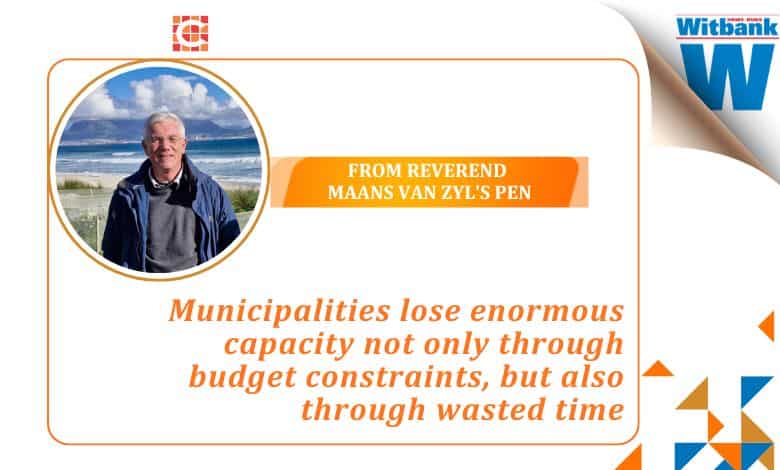
Municipalities lose enormous capacity not only through budget constraints, but also through wasted time
Repeated rework, vague decision processes, endless unproductive meetings, and delayed sign-offs drain energy without producing progress.
The consequences are familiar across many towns: projects restart repeatedly, contractors arrive without clarity, procurement stalls, urgent failures crowd out preventive maintenance, and officials become reactive rather than strategic.
Over time, citizens stop believing announcements because deadlines are no longer trusted.
It is important to say this carefully: punctuality is not legalism, nor is it about imposing rigid or foreign cultural standards.
It is about compassion and fairness. In municipal life, delayed water repairs force families to fetch water.
Delayed payments cause contractors to abandon sites
Deferred maintenance leads to infrastructure collapse. The costs of lateness are not evenly shared; they fall hardest on the poor and vulnerable.
Time stewardship, therefore, becomes an ethical practice – the disciplined use of limited hours for the common good.
There are practical steps municipal leaders can take immediately. One place to begin is with public-facing time.
Leaders can identify a few critical services where delays cause the greatest harm – such as water, sanitation, electricity, billing, or clinic support – and set short, visible time standards.
Another step is to reduce phantom workload by eliminating at least one unproductive meeting and replacing it with a focused decision session that ends with clear responsibility and deadlines.
Finally, leaders can establish a weekly reliability rhythm: a brief delivery review that tracks deadlines, bottlenecks, and handovers, not to assign blame, but to restore clarity and momentum.
Municipal action box
Start meetings on time, regardless of attendance. Publish response-time commitments for key services so expectations are clear.
Track missed deadlines weekly and review them openly, focusing on learning and improvement rather than punishment.
The deeper point is simple. Citizens do not demand perfection.
They demand truth, reliability, and visible progress. Municipalities rebuild trust when leaders consistently demonstrate, in small but concrete ways, that time commitments matter – because people matter.
Optional reflection box
Many faith traditions teach that time is a gift entrusted to human care.
A Christian framing expresses this simply: love is not only emotion, but responsibility — showing up, telling the truth, keeping promises, and serving the vulnerable. In this sense, punctuality is not pride or control; it is neighbour-love expressed as reliability, a lived “yes” that can be trusted.
This column is the opinion of the writer and does not represent the views of Witbank News.
Your city, your story, as it happens. Stay in the loop with WITBANK NEWS.
Find us on our website, Facebook, X, Instagram or TikTok
Got a tip? Email: info@witbanknews.co.za