
Why Christian leadership matters in South Africa
What must change if leadership is to truly serve people and not itself?
Every election season, leadership becomes the language of hope. Promises are made, visions are painted, and expectations rise.
Yet, over time, disappointment often follows.
Across communities, businesses, churches, and government structures, a recurring question emerges: Why do leaders fail?
And perhaps more importantly, what must change if leadership is to truly serve people and not itself? Leadership doesn’t usually fail because someone isn’t smart or educated enough.
READ MORE Over a cup of coffee, Reverend Maans van Zyl digs into time management failures
Lots of leaders are capable – they’ve been trained, have plenty of experience, and can express themselves well.
But if you look at history, both worldwide and in South Africa, you’ll see that leadership often falls apart because of problems with character, mindset, and purpose, not because someone isn’t good at their job.
One of the most fundamental reasons leaders fail is the misuse of power. Leadership is often seen as a position to be acquired, protected, and leveraged for personal gain.
The higher the position, the greater the temptation to control, dominate, and secure advantage.
This dynamic is not new
Across time, leadership has frequently been distorted into a pursuit of status rather than a responsibility of service.
Yet research on leadership consistently points in a different direction: effective leadership is not about self-interest, but about serving others and enabling their growth.
READ MORE Over a cup of coffee, Reverend Maans van Zyl looks into how important it is to show up on time
Leadership becomes destructive when it shifts from responsibility for people to control over people. When leaders see followers as instruments rather than individuals, trust begins to erode.
Closely linked to this is the problem of self-preservation. Many leaders fail because their primary goal becomes staying in power rather than fulfilling their purpose.
Decisions are made not based on what is right, but on what is safe, popular, or politically advantageous. This results in short-term thinking—policies that look good in the moment but fail to address deeper structural issues.
READ MORE Over a cup of coffee, Reverend Maans van Zyl says being a great leader is not about what you get, but about what you give
We can see this problem clearly in places where people don’t trust their leaders.
In South Africa, for example, there are many major issues, such as corruption, poor services, and an unfair economy. But these problems aren’t just because of a lack of money or good ideas.
They happen because leaders aren’t doing their jobs properly and don’t think about the long-term effects of their actions.
When leaders care more about staying in power than helping people, the whole system starts to fall apart.
Over a cup of coffee, Reverend Maans van Zyl ties up leadership with Good Friday
— WitbankNews (@WitbankN) April 4, 2026
Read more here: https://t.co/04qF0SQvlq pic.twitter.com/Ry3IEPkATh
Another important thing to consider when leaders don’t do well is that they often lack a strong sense of right and wrong.
Being a good leader is not just about making smart plans; it’s also about doing what’s right.
If leaders don’t have a clear idea of what’s good and what’s bad, they can easily get caught up in making unethical decisions.
At first, these decisions might seem small, but over time, they can add up and create big problems.
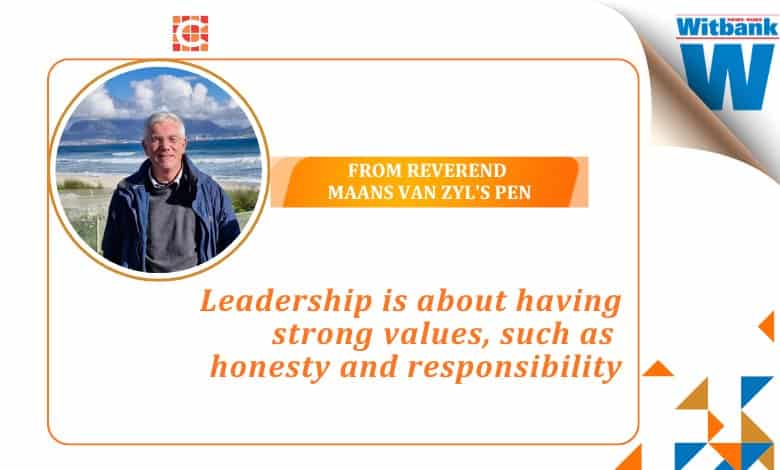
Leadership is about having strong values, such as honesty and responsibility
If you don’t have these values, it doesn’t matter how good your leadership skills are; you will still fail.
People need to trust their leaders, and if they don’t, everything falls apart.
Even if a leader seems successful at first, they will eventually lose their team’s trust and respect if they aren’t genuine and humble.
Equally important is the failure of relational leadership.
Over a cup of coffee, Reverend Maans van Zyl ties up leadership with Good Friday
— WitbankNews (@WitbankN) April 3, 2026
Read more here: https://t.co/04qF0SQvlq pic.twitter.com/SfvxNklrUq
Leadership is not a technical exercise; it is a relational process. It involves people—complex, emotional, and interconnected.
When leaders become distant, inaccessible, or disconnected from the realities of those they serve, leadership loses its grounding.
We see this when decisions are made without listening, when policies are implemented without understanding, and when leaders speak more than they hear.
In such contexts, leadership becomes abstract and ineffective.
People feel unseen, unheard, and ultimately, unsupported.
Good leadership is all about connecting with people
It’s about really listening to them, understanding how they feel, and working together as a team.
When you lead, you’re not bossing people around; you’re working with them to get things done.
This way of leading, where you focus on building strong relationships, is crucial – it’s not something you can skip. Another reason leaders fail is neglecting the development of others.
Leadership is often treated as an individual achievement rather than a collective process.
Leaders hold onto authority instead of sharing it.
They centralise power rather than build capacity.
Yet one of the most important indicators of effective leadership is not how much a leader accomplishes alone, but how many others are empowered to lead.
Research on servant leadership highlights that the true measure of leadership is whether followers grow—becoming more capable, more responsible, and more able to contribute meaningfully to society.
When leaders don’t take the time to help their team members grow, they can create a situation in which everyone relies too heavily on just a few people.
This makes the whole system weak rather than strong, supported by many capable individuals. So, what must change?
Leaders need to change their way of thinking, from focusing on power to focusing on purpose.
They must remember why they wanted to lead in the first place.
Being a leader is not just about having a title; it’s about using your position to make a positive impact.
When leaders focus on their purpose, they make decisions based on what’s right, not just on what they want or what they’re afraid of.
This helps them take responsibility for their actions and make choices that benefit everyone, not just themselves.
By doing so, leaders can become a force for good and create meaningful change.
Over a cup of coffee, Reverend Maans van Zyl looks at punctuality
— WitbankNews (@WitbankN) April 1, 2026
https://t.co/9I8o8cxLwC #reverendmaans #witbanknews #opinion pic.twitter.com/KJ9ZhpJ0be
To really lead, you need to have a strong character
You can learn skills, but your character is what makes you who you are. Being honest, humble, and responsible are not just nice to have; they’re essential.
Leaders should be judged not just on what they get done, but on how they do it.
Third, leadership must become relational again.
Leaders must move closer to people, not further away. This means listening actively, engaging honestly, and responding compassionately. It requires presence, not just performance.
To really make a difference, leaders need to help others grow and become leaders too.
A country’s future isn’t just about having a few strong leaders; it’s about having many capable people who can make a difference.
Leaders should create spaces where others can thrive, contribute, and take on leadership roles.
This means trusting people, giving them responsibilities, and making a conscious effort to invest in them.
By doing so, leaders can build a strong foundation for the future.
Leaders need to take responsibility for their actions.
If they don’t, power can be misused.
A good leader should be willing to explain their decisions, apologise when they’re wrong, and change their approach when needed.
Being accountable isn’t a weakness; it’s what makes leadership strong. It’s what keeps leaders in check and makes sure they’re doing what’s right.
Finally, leadership must be guided by a vision that extends beyond the present moment.
Short-term success cannot come at the expense of long-term sustainability.
Leaders must think beyond immediate gains and consider the future impact of their actions.
South Africa is at a turning point, and the problems it’s facing are very real. But there’s also significant potential for growth and change.
What’s needed now is not just new rules or ways of doing things, but a fresh look at what it means to be a leader. We need to rethink what leadership is all about.
- Leadership that serves rather than exploits.
- Leadership that builds rather than breaks.
- Leadership that listens, learns, and leads with integrity.
The big question now is not if leaders make a difference – we already know they do.
What we’re really wondering is whether they’re open to change and growth. Because when leadership changes, everything else can follow.
This column is the opinion of the writer and does not represent the views of Witbank News.
Your city, your story, as it happens. Stay in the loop with WITBANK NEWS.
Find us on our website, Facebook, X, Instagram or TikTok
Got a tip? Email: info@witbanknews.co.za