
Judge leaders by results, not history or slogans
Do not ask only what a leader says about the past. Ask what that leader has done with the responsibility already entrusted to him or her.
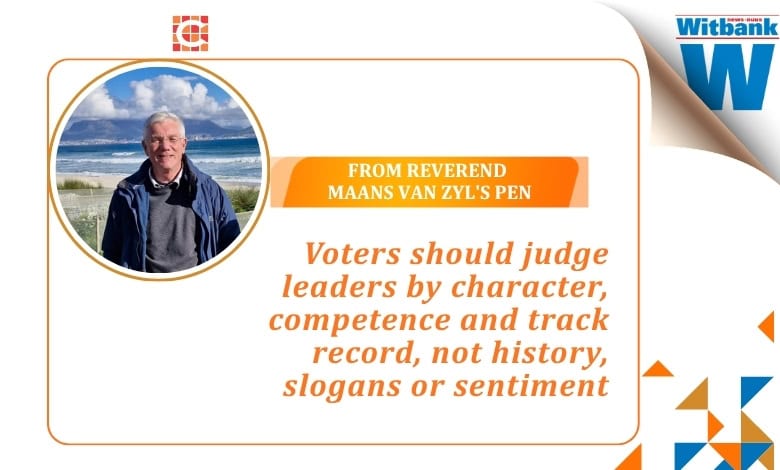
On 4 November 2026, South Africans will go to the polls to choose the men and women who will govern the areas where they live and where daily life happens: local government, water in the tap, electricity that works, refuse removal, tarred roads without potholes, functional sewerage systems, accurate and up-to-date municipal accounts, and the opportunity for communities to grow.
The central question these elections should pose to South Africans is not simply, “Which party do I support?” That question can often be answered in an instant. Rather, it should be: “Who can I trust with the governance of my community?”
A politician’s greatest asset is the trust of the public. Political trust cannot be demanded, inherited or manufactured through slogans. It can only be earned.
History certainly matters. We remember the sacrifices of previous generations. We acknowledge liberation histories and the different traditions of our communities. We continue to recognise and respect the relationships forged between former “comrades”. But history should not be used as a blank cheque for current leaders.
Trust is one of the most valuable forms of capital any leader possesses. Yet political trust cannot simply be demanded, inherited or manufactured through slogans. Trust must be earned.
Trust is one of the most valuable forms of capital any leader possesses. No political party is entitled to someone’s vote merely because: “We have always been together,” “We liberated you,” “Your parents voted for us,” or “We are your true political home.”
Gratitude for yesterday cannot replace accountability today.
Much of the material in this leadership series is intended to challenge voters to look beyond the most recent campaign speeches of political leaders and parties. How have candidates and political parties actually performed? What happened to their funding promises? Were projects implemented? Were deadlines met? What has been achieved during their time in office?
Citizens should examine what politicians and parties have actually done rather than simply accepting their latest rhetoric. Voters should ask about funding, implementation, timelines and previous performance.
The same standard must apply to challengers.
The fact that an opposition party has failed in the past does not mean voters should automatically trust it now. Every politician, whether an incumbent or a challenger, must prove himself or herself worthy of trust.
So the question remains: Are you competent? Are you honest? Do you understand local government?
Can you manage public money? Have you governed successfully before? Do you appoint capable people? Can you back your promises with proper financing? Most importantly, can you implement what you promise?
Only 26% of South Africans trust their local government ‘somewhat’ or ‘a lot’, according to Afrobarometer’s June 2026 survey, down from 42% in 2011. Overall, 70% of citizens have a negative assessment of local councillors, while a resounding 95% believe that some or most local government representatives are corrupt.
These perceptions deserve to be taken seriously. They reveal a deep-seated crisis of trust that cannot simply be dismissed.
Read more We need leaders of great character
Why does trust disappear?
Because eventually, promises collide with evidence.
The fact that a promise is not kept does not necessarily mean corruption. Circumstances change. Budgets can shrink. Decision-making can become complicated by coalition politics. By the time a councillor is able to act on a promise, unexpected crises may have emerged.
The mature voter understands that government is not a simple entity and that not every failure is evidence of dishonesty.
But when promises to ‘fix the potholes’ are made election after election and repeatedly broken; when promises to repair sewerage systems are repeatedly made and broken; and when other services continue to deteriorate rather than improve, voters are entitled to ask whether a candidate is serious about fixing the problem or simply repeating campaign promises in the hope of being re-elected.
There is also a psychological consequence to repeated disappointment.
Research into disappointed expectations has shown how trust can be betrayed in ways that are not immediately apparent. Perhaps the greatest danger is what happens after the first disappointment. Once people have been let down by a politician or government institution, they may begin to suspect that all politicians and government institutions are the same.
That is particularly damaging to democracy.
Another danger in leadership is the ‘ignoramus’ – the person who does not know that he does not know.
Confidence and charisma are not the same as competence.
A good leader can be confident while also admitting when he or she does not know something. Such a leader knows when to seek out people with the necessary expertise and allows competent individuals to deal with the problem at hand.
The incompetent leader, by contrast, pretends to know everything. He or she makes promises that cannot be kept, blames everyone else for failures and returns five years later with a new slogan.
Read more What Mamphela Ramphele can still teach us
Moral gridlock in South Africa
It is well known that 85.3% of South Africans profess to be Christians, according to Census 2022. So what does the Bible say to those entrusted with positions of power?
The answer is strikingly clear.
When it became necessary to appoint leaders, Moses was instructed to choose people who were capable, feared God, were trustworthy and hated dishonest gain (Exodus 18:21).
Proverbs 12:22 reminds us that God detests lying lips but delights in those who are trustworthy. Luke 16:10 teaches that whoever is faithful with little can also be trusted with much. And 1 Corinthians 4:2 states a fundamental principle of responsible leadership: “It is required that those who have been given a trust must prove faithful”.
Leadership, whether in the church or the state, is not an opportunity to line one’s own pockets while neglecting the responsibility owed to those being served. Scripture repeatedly condemns leaders who feed themselves rather than the flock.
Leadership is not a right, but a stewardship.
That principle should follow us into the voting booth.
Do not ask only what a leader says about the past. Ask what that leader has done with the responsibility already entrusted to him or her.
Do not measure leadership by rallies, struggle songs, T-shirts, social media clips, charismatic speeches or spectacular promises.
Measure it by truthfulness, competence, integrity, accessibility, accountability, stewardship and results.
No political party should be exempt from that examination.
No historical name should silence legitimate questions. And no new party should automatically receive untested trust simply because voters are angry with an old one.
History deserves remembrance.
Trust requires evidence.
On November 4, perhaps that should be one of our most important principles:
My vote is not a reward for what you once were. It is a trust placed in what you have demonstrated you are – and what you have proved you can responsibly do.
*This column is the opinion of the writer and does not represent the views of Witbank News.
Over a cup of coffee, Reverend Maans van Zyl looks at how good government requires morally awake citizens who practise integrity
— WitbankNews (@WitbankN) August 24, 2026
Read more here:https://t.co/Sxx5YGIYkc
Your city, your story, as it happens. Stay in the loop with WITBANK NEWS.
Find us on our website, Facebook, X, Instagram or TikTok
Got a tip? Email: info@witbanknews.co.za