Opinion | Our community needs true leadership
A wise leader will ask whose interests a decision will serve.
The 2022 Census for South Africa found that 85.3% of the population identified as Christian. However, the apparent prominence of Christian identity in South Africa presents a searching question to the electorate: To what extent do the values of Christianity, which are apparently held by so many, shape public life?
The fact that religious affiliation does not guarantee honesty, competence, or compassion in serving makes it important to determine whether candidates for public office live out their professed faith. Do the principles they proclaim remain apparent when large sums of money, powerful friends, and self-interest are at stake?
Accountability to God is the core of Christian leadership
Leadership by faith reminds leaders that the authority granted to them and the persons affected by their decisions are of infinite value and deserve dignity. A public position carries responsibility for assets, opportunities and services which belong to the community. These must not be diverted into the leader’s private assets.
A wise leader will ask whose interests a decision will serve, who might suffer because of a decision, and whether the decision can stand up to scrutiny. The leader’s sense of reverence for God must increase their sense of responsibility to people.
Leadership is defined by Jesus in Mark 10:42–45. Here, He overturns the way of the rulers and proclaims that true greatness lies in serving others. In John 13, He paints a picture of what this looks like as He washes the disciples’ feet. So, in public life, the leader’s authority is to attend to the people’s needs.
A resident reporting a sewage leak, a small business owner waiting to hear from someone, a family depending on services that do not always work – all these people deserve respect and attention as the leader serves patiently, makes fair decisions and follows through.
Integrity is important. The Christian understanding of character includes truthfulness, including in circumstances where it would be embarrassing to admit the truth, and that is hard in politics. So, I look for people whose explanations of policy at election time are consistent, who admit mistakes, and who distinguish between what they can deliver and what they would like to deliver.
No one is perfect, but a politician who cannot admit the uncertainty that exists is dangerous – he or she may offer confidence but is unlikely to offer sound judgment. A trustworthy politician can explain what more needs to be found out, what resources are available and the limits of what can be done. No vote should be bought with promises that will not withstand practical scrutiny. They should not be hidden behind religious words or election rhetoric.
Additionally, he must have a good report of financial integrity, for it is said in 1 Timothy 3:3 that the love of money is a root of all kinds of evil. Therefore, in whatever public role he serves, the resources of the public must be used for the public good. The voter should test how a candidate handles public funds, how he responds to accusations of misusing them, and whether he makes decisions transparently. Voters must also test a candidate for nepotism.
Read more: TUT campus voting station moved to Methodist Church
Do relatives, friends, or political allies of the candidate receive favours that others do not? Treating others’ opportunities as if they were trash is not faithful. Fair treatment of those with no pull is required of the faithful.
A mark of effective leadership is humility, different from conceit. A man of humility listens much, seeks wise counsel, and acknowledges error. Decisive action is not precluded by these traits, for wise decisions are taken with the best information, not with ego. Such a leader needs people around him who have the courage to disagree with him.
If everyone around a leader is constantly agreeable, important information can disappear. When voting for a candidate, pay attention to how he treats the press, his employees, the residents of a city or town, and his political opponents. How he responds to difficult and even uncomfortable questions can reveal more about a candidate than how he reacts to adoration.
Good character must be joined to competence. A good intention to distribute welfare to believers requires responsible organisation of distribution. The distribution of welfare and the leadership of a municipality require preparation, insight, and collaboration with experts. The candidates must be able to explain their priorities, their implementation and their real progress.
Good intentions are not sufficient to manage a complex organisation. Sincere leadership also requires professional skills. The Christian commitment enables careful learning and responsible preparation.
As pressure increases, the leader’s emotional maturity is critical. Galatians 5:22–23 lists the qualities of the Spirit’s fruit, beginning with patience, kindness, faithfulness, gentleness, and self-control. These qualities are not only good for individual leaders, but their public expression affects the community as well.
An impatient leader will brush off legitimate concerns, and an out-of-control leader will stoke the fires of fear and even intimidate others. The leader must express gentleness while maintaining respect in the face of anger and bring closure to repeated failures while insisting that the agreed-upon standards be upheld.
Read more: AHF Mpumalanga launches syphilis awareness campaign across eMalahleni
Compassion in public duty
To add a human dimension to leadership is to bring compassion into the decision-making process for public duties; according to Micah 6:8, justice, mercy, and humility are all connected and practised before God. So, in looking at public decisions, we must consider the needs of the children, the seniors, people with disabilities, and the poor.
When examining a policy or decision, we need to consider what it would mean to various individuals in their daily lives. Can people get the information they need? Are complaints dealt with? Who pays the price for delays? The leader’s concern needs to translate into the organisation’s planning, spending and implementation, and not only surface during election campaigns.
Organisational culture is also shaped by leaders. What leaders reward, tolerate and show daily is what employees learn from. If connections get you promoted and honesty gets you punished, then a very unhealthy culture will develop. But if good service is recognised and fairly investigated when wrongdoing is suspected, healthy expectations are developed. Look at the teams of potential voters and the way of working they are employed in.
No matter how impressive one person is, they are not a substitute for reliable structures and institutions. The leader needs to build systems that hold people to account while they are away from the organisation as well as enabling them to function effectively when they are no longer in post.
Demanding consistent standards
When choosing between candidates from different parties, Christians should look for evidence of conduct that reflects integrity, competence, humility and a service mentality. Being labelled ‘Christian’ is not sufficient to earn the votes of Christian citizens. Such citizens need to be treated by their elected representatives with the same justice and respect as representatives’ other neighbours, whether they are from other faith groups.
All favoured candidates and opposing candidates must be held to consistent standards. We must demand evidence and verify accusations before accepting them as true. Churches can play a positive role by facilitating the informed participation of their members and holding their leaders to the same high standards of accountability that the church commends to the public. Our public Christian witness will be eroded if we make excuses for the misbehaviour of our allies.
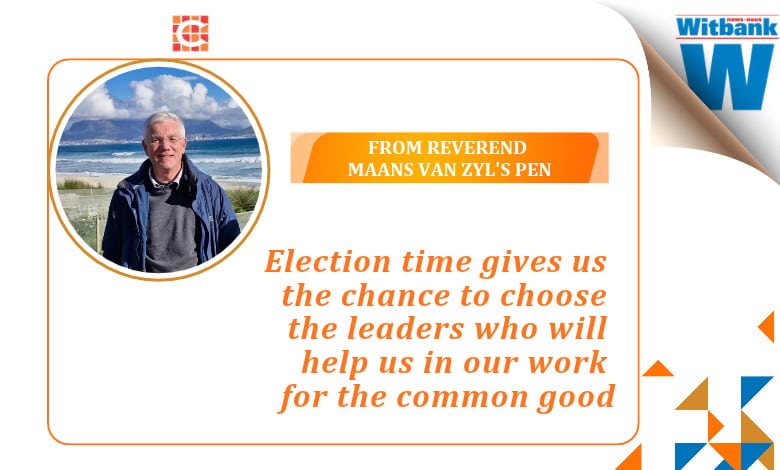
Leaders of good character who can put their words into action are needed in our communities. Solid institutions and good administration create conditions for investment, jobs and safe neighbourhoods. But the work of developing institutions and good administration in all sectors is ongoing and needs to be supported. Election time gives us the chance to choose the leaders who will help us in our work for the common good.
Look at a leader’s life and look at the pattern that emerges. Support the person of good character who is stewarding resources honestly, treating people fairly and serving them well. Keep the leader who is serving faithfully well and hold them accountable for their work.
*This column is the opinion of the writer and does not represent the views of Witbank News.
Over a cup of coffee, Rev Maans van Zyl compares the upcoming local government elections to hiking up Mount Everest. Read more here: https://t.co/Y8RukWEFl1
— WitbankNews (@WitbankN) October 20, 2026
Your city, your story, as it happens. Stay in the loop with WITBANK NEWS.
Find us on our website, Facebook, X, Instagram or TikTok
Got a tip? Email: info@witbanknews.co.za