
Coffee with Reverend Maans – the Easter weekend is the perfect example of leadership
The resurrection offers a clear answer: yes – but it begins with a different kind of leadership.
Easter Sunday is a powerful reminder of leadership through hope.
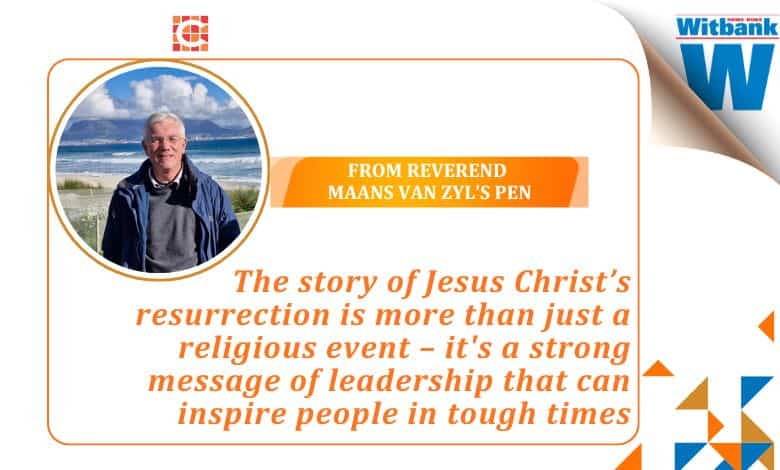
The story of Jesus Christ’s resurrection is more than just a religious event – it’s a strong message of leadership that can inspire people in tough times.
In places like South Africa, where many are struggling with difficult situations, uncertainty, and broken systems, this message of hope can be powerful.
It shows that even in the darkest moments, there is always a way forward and that leaders can bring light and hope to those around them.
Good Friday teaches us about leadership through sacrifice, but Easter Sunday teaches us that true leadership is also about giving people hope for a better future.
Immediate outcomes often judge leadership.
Success is measured in visible results, public approval, and tangible achievements.
Yet the resurrection challenges this framework.
It reveals that leadership impact is not always visible in the moment. Sometimes, what appears to be failure becomes the foundation of transformation.
When a leader falls, it can be tough on the people who believed in them
After Jesus was crucified, his followers were all over the place, feeling scared and unsure of what to do next.
They had put all their hopes in him, and now he was gone.
This kind of thing happens a lot when leaders let people down – it’s not just the leader that people lose faith in, but the whole idea that things can get better.
It’s like, if the person who was supposed to make a difference couldn’t do it, then what’s the point?
People start to feel like nothing is ever going to change, and that can be a hard feeling to shake.
It is into this context that the resurrection occurs
Jesus appears to His followers not with condemnation but with peace.
“Peace be with you” becomes His first message. Leadership here is restorative. It does not exploit failure but heals it. This introduces a critical leadership principle: true leaders restore rather than punish.
They rebuild trust where it has been broken.
They create space for renewal rather than reinforcing despair.
One of the most amazing stories of Jesus’ resurrection is when he meets Peter again, the same disciple who had denied knowing him. But instead of turning his back on Peter, Jesus welcomes him back with open arms.
This shows us that true leadership is about helping people heal and start anew.
Just because someone makes a mistake, it doesn’t mean they’re done for. It’s all part of the journey to becoming a better person.
And that’s an important lesson for anyone who wants to be a good leader: it’s not about being perfect; it’s about learning from your mistakes and keeping moving forward.
People shouldn’t be judged by their worst moments, but by how they can change and grow from them.
When we examine leadership theories, we see that good leaders help their followers grow and mature, giving them a new sense of purpose.
This is exactly what Jesus does, but He takes it a step further
Instead of just taking back the reins of leadership, He shares it with others, empowering them to carry on His work.
By doing so, He creates a ripple effect, inspiring His followers to continue His mission and spread His message and values to even more people.
This leads us to another important part of being a leader like Jesus: giving people the power to act.
Jesus doesn’t keep all the power to himself; instead, he shares it with his followers. He trusts them to get things done and make decisions. When leaders do this, it creates a ripple effect – more people become leaders, and the impact just grows.
In South Africa, this issue matters a great deal
The country is dealing with some big problems, like too much power being held by a few people and not enough leaders being developed in local communities.
But there’s another way to think about leadership: the resurrection model.
It says that good leadership isn’t about being in control, it’s about giving people the power to make things happen.
Furthermore, the resurrection introduces a leadership of vision. Jesus reorients His followers from fear to mission.
He expands their perspective beyond immediate circumstances to a broader purpose. Leadership, therefore, involves helping people see beyond their current struggles to a future of possibilities.
This is where hope becomes a leadership resource.
Not a vague optimism, but a grounded confidence that transformation is possible.
Hope enables people to act, to rebuild, and to persevere.
This hope is connected to what’s real. Even after coming back to life, Jesus still has the scars from being crucified.
Being a leader doesn’t mean you pretend bad things didn’t happen – it means you deal with them.
You face the pain, but you also show people that there’s something better ahead. This is especially important in a place like South Africa, where the country’s tough past and present can’t be ignored, but can be changed for the better.
Leaders must find a way to make that happen.
Another dimension of resurrection leadership is presence.
Jesus meets people where they are – in fear, confusion, and doubt. He does not wait for them to be ready; He enters their reality.
Leadership, therefore, is incarnational – it engages with people’s lived experiences.
In contemporary leadership discourse, this aligns with relational and participatory leadership models, where influence is built through connection rather than distance.
The resurrection also reframes authority
Authority is no longer rooted in coercion or position but in credibility and trust.
The followers respond not because they are forced to, but because they are transformed.
What South Africa really needs is a different kind of leader.
Someone who can inspire people, not just boss them around. A leader who helps others become stronger, rather than trying to control everything.
And a leader who wants to make things better, not just use their power to get what they want. This kind of leadership is important, and South Africa is currently missing it.
Finally, the resurrection reminds us that leadership is ultimately about legacy. Jesus’ physical presence ends, but His influence multiplies.
The measure of leadership is not how long one leads, but what remains after one is gone.
Leadership that builds people, empowers communities, and instils hope, creates a legacy that outlives the leader.
In a time where many are asking whether change is possible, the resurrection offers a clear answer: yes – but it begins with a different kind of leadership.
A leadership that believes that even after the darkest Friday, Sunday can still come.
This column is the opinion of the writer and does not represent the views of Witbank News.
Your city, your story, as it happens. Stay in the loop with WITBANK NEWS.
Find us on our website, Facebook, X, Instagram or TikTok
Got a tip? Email: info@witbanknews.co.za