
What Mamphela Ramphele can still teach us
Mamphela Ramphele’s deeper message is harder: democracy improves when citizens stop outsourcing responsibility for their future.
This article will focus on leadership as offered by Mamphela Ramphele in her Deep Transformation interviews of 2023, and how she as a medical doctor, academic, former Vice-Chancellor of the University of Cape Town and Managing Director of the World Bank, connects leadership to citizenship, integrity and responsibility.
Ramphele explained in the Deep Transformation interview from 2023 how she had been working with leadership over the years and what she believed to be the core lessons for leadership. In a 2023 Deep Transformation interview, Ramphele reflected on an early leadership lesson: “We have to practise what we preach.” She spoke of translating conviction into “practical manifestations.”
That is a powerful municipal test. Candidates may promise clean government, accountability and service delivery—but what does their record show? Leadership begins when values become behaviour.
In the same conversation, Ramphele warned against asking only, “Who will be in power?” and spoke instead of refocusing politics on “citizens as the sovereigns of democracy.”
That changes the relationship between councillors and communities. Public representatives do not own municipalities; authority is entrusted to them temporarily. Citizens are not spectators or clients waiting for favours.
Accountable leaders and courageous citizens – this is what South Africa needs. Ramphele made the point even more sharply in a 2012 Berkley Center discussion in Cape Town during the Mining Indaba. Asked how authoritarian habits could be overcome, she said that people must stop respecting authority to the point where they “dare not question” wrongdoing. Democracy therefore requires courageous citizens as much as accountable leaders.
Ahead of an eLearning Africa conference in Kigali, Ramphele urged young Africans to elect “leaders of vision and integrity.”
She immediately added another uncomfortable truth: citizens must “claim their basic rights and exercise their responsibilities,” because “we get the leaders we deserve.”
Her attempt to form a political party, Agang SA, under her leadership failed not only because of her lack of intelligence, reputation, charisma and experience of leadership. Sustainable leadership also requires consultation, good judgment, team work and institutions that can survive the individual’s lifetime.
So, in 2026, perhaps our questions should become more demanding: Does this candidate practise what he or she preaches? Can this person be questioned? Can they work with others? Do they possess both vision and integrity?
Voting is important. But Ramphele’s deeper message is harder: democracy improves when citizens stop outsourcing responsibility for their future.
Christians need not claim that Ramphele’s political philosophy is “biblical” in every respect. Rather, several of her leadership convictions echo truths Scripture already teaches about integrity, accountability, service, responsible citizenship and the moral use of authority. Her insistence that convictions must become “practical manifestations,” her call for citizens to question wrongdoing, and her emphasis on “vision and integrity” provide particularly fruitful points of contact.
Perhaps the strongest biblical parallel is her statement, “We have to practise what we preach.” James says almost exactly this in theological language: “Do not merely listen to the word … Do what it says” (James 1:22). Jesus likewise warns against leaders who “do not practise what they preach” (Matthew 23:3).
Christian leadership therefore cannot be measured by speeches, slogans, manifestos or even religious language. Character must become conduct. Conviction must become practice. A politician who speaks about honesty while misusing public money contradicts the very nature of biblical leadership.
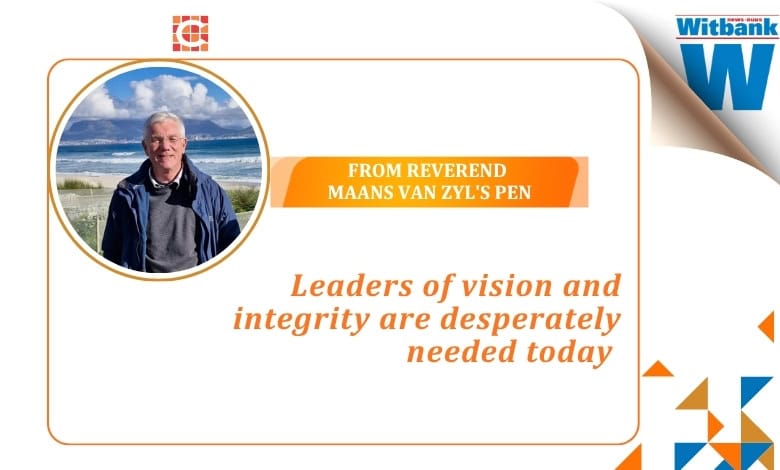
Leaders of vision and integrity are desperately needed today. The greatest period in the history of God’s people was when God raised up David to lead them “with integrity of heart and skilful hands” (Psalm 78:72). The leader of God’s people today must combine character with ability to bring about positive change for God’s people. He or she must be “capable” and “trustworthy and of good integrity so that they will not turn and do wrong all through taking bribes” (Exodus 18:21).
Finally, questioning those in authority who are doing wrong is a very biblical thing to do. Nathan’s rebuke of King David over his affair with Bathsheba and subsequent murder of her husband is a great example of this (2 Samuel 12:1–13). Similarly, Elijah’s confrontation with Ahab over his worship of Baal is another example (1 Kings 18:17–18). John the Baptist challenged Herod’s marriage to Herodias (Mark 6:17–20) and Peter and the early church said they must obey God rather than human beings in their encounter with the authorities in Acts 5:29.
Respect for authority is biblical; blind obedience is not. Christians should therefore neither idolise political leaders nor demonise them. We honour office, pray for leaders (1 Timothy 2:1–2), but retain the moral courage to call wrongdoing by its name.
There is, however, one Christian qualification to Ramphele’s phrase “citizens as the sovereigns of democracy.” In constitutional democracy, citizens may indeed be politically sovereign in the sense that government receives its mandate from the people.
But Christianity makes a deeper theological claim: God alone is ultimately sovereign. Political leaders and citizens alike stand under God’s moral authority. Power is therefore never absolute possession; it is stewardship. Jesus radically redefines it: “Whoever wants to become great among you must be your servant” (Mark 10:42–45).
Read more here:Makua celebrates 10 years of empowering women
[Gallery] See the ladies in their bright colours at Masechaba’s “Let Her Grow” event
— WitbankNews (@WitbankN) August 24, 2026
Read more⬇️https://t.co/GEe9x6iHRw
While “We get the leaders we deserve” is not necessarily an absolute biblical truth (there have been many righteous people who have suffered under wicked rulers), it is a deeply relevant moral truth for democracy.
If citizens of a democracy tolerate, reward and continually vote for the corrupt, greedy, inefficient and power-hungry into positions of power, then that is precisely what they will get. In a democracy it contains an important moral truth: citizens bear responsibility for what they tolerate, reward and repeatedly elect.
Christians cannot complain about corruption while voting only from tribal, racial, ideological or party loyalty.
Proverbs 29:2 reminds us that the character of rulers has consequences for ordinary people.
For Christians approaching the 2026 elections, Ramphele’s questions can therefore become even deeper biblical questions:
Does this person practise what he or she preaches? Are integrity and competence found together? Can this leader accept correction and accountability? Does this person understand power as service rather than entitlement? Will this leader protect public resources as a sacred trust rather than personal opportunity?
And Christians must ask one more question—not only about the candidates, but about ourselves: What kind of citizenship does our faith require of us? Micah 6:8 offers a compelling answer: “Act justly, love mercy and walk humbly with your God.”
That may be the deepest Christian contribution to Ramphele’s leadership message: good government requires more than better politicians. It requires morally awake citizens who demand integrity from leaders—and practise integrity themselves.
This column is the opinion of the writer and does not represent the views of Witbank News.
Your city, your story, as it happens. Stay in the loop with WITBANK NEWS.
Find us on our website, Facebook, X, Instagram or TikTok
Got a tip? Email: info@witbanknews.co.za