
Hawksbill turtle rescued at Bhanga Nek gets second chance at life
The NSRI team drove her to Durban, covering more than 500km.
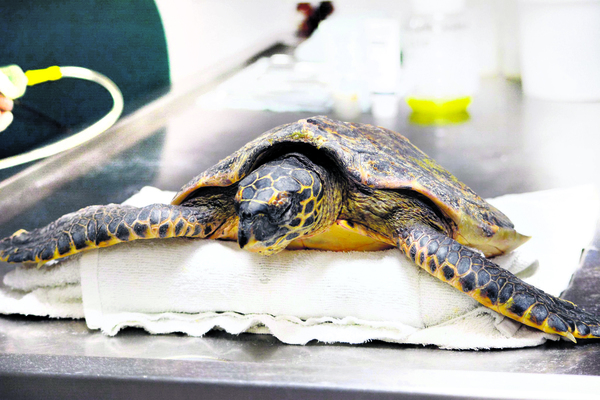
AFTER washing ashore at Bhanga Nek in KZN’s far northern reaches, a hawksbill turtle is in a stable condition at uShaka Sea World.
The turtle was found on 19 December and transported to Hluhluwe by an Ezemvelo KZN Wildlife staff member, who then handed her over to the NSRI.
The NSRI team drove her to Durban, covering more than 500km.
‘uShaka Sea World staff were prepared for her arrival and had been warned that her condition was poor.
‘She appeared emaciated and understandably lethargic. She was given a Hindu name, Dhiya, which signifies light, goodness and purity,’ said SAAMBR (SA Association of Marine Biological Research) in a statement.
‘Dhiya was given fluids and left to rest in a shallow bath. She remained almost motionless for the next few days and hardly stirred while the team took blood samples, performed X-rays and administered fluids.
‘Over the past two weeks, although she has not regained her strength, she has not deteriorated, which is a good sign. She is clearly a fighter.’
The association said radiographs indicated she had been feeding and her bloods showed good glucose levels. She was therefore not starving.
She was put on a course of antibiotics.
‘We are very grateful to the staff of both Ezemvelo KZN Wildlife and the NSRI for their continued dedication to caring for stranded marine animals and for giving Dhiya the best possible chance of recovery.
‘Although any prediction regarding her survival is guarded, we are continuing to do whatever we can to give her a second chance, and trust she has the capacity to recover,’ said senior aquarist, Malini Pather.
Hawksbill turtles are listed by the IUCN as critically endangered. Their shells were the primary source of tortoiseshell material used for decorative purposes.
It is easily distinguished from other turtles by its sharp, curving beak and the saw-like appearance of its shell margins.
It has a worldwide distribution, with Atlantic and Indo-Pacific sub-species.
They typically grow to one metre in length and weigh around 80kg, although the heaviest hawksbill ever captured weighed 127kg.