Is Richards Bay’s air quality a cause for concern?
The RBCAA monitors air quality across uMhlathuze, providing independent data and expert analysis to support environmental management and compliance with national standards.
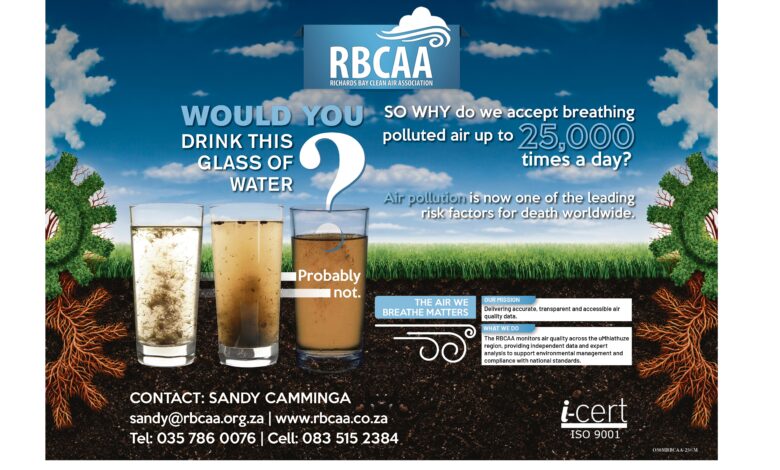
Would you drink a glass of dirty water? Probably not. Yet, every day Richards Bay residents inhale polluted air more than 25 000 times.
According to the World Health Organisation, fine dust particles (PM2.5) are among the biggest health risks worldwide, and South Africa’s average exposure is still about three times higher than the safe limit.
Data shows chronic problem
Richards Bay Clean Air Assocation (RBCAA) monitors air quality across uMhlathuze, providing independent data and expert analysis to support environmental management and compliance with national standards.
Data collected shows that the problem is not occasional. In March 2026, Richards Bay recorded 31 daily exceedances of WHO’s PM2.5 guideline, along with sulphur dioxide spikes at the Scorpio station near the Alton industrial area.
Unfortunately, this was not an isolated incident. RBCAA’s annual 2025 report documented consistent dust fallout across several sites, with levels above national standards.
In February 2026, daily exceedances were also recorded, and by May 2026, residents’ complaints about odours and dust were backed up by elevated particulate readings.
These findings confirm that poor air quality is not a once-off spike, but a chronic issue.
Impact on people’s health
Air pollution in Richards Bay is not just an environmental issue, it’s a public health crisis too.
The air residents breathe each day is directly shaping community health outcomes, from higher hospital admissions to shorter lifespans.
Elevated levels of pollutants such as fine particulate matter (PM2.5) and sulphur dioxid are linked to asthma, bronchitis, heart disease, strokes and reduced life expectancy.
What are the solutions?
RBCAA points to three clear steps forward:
1. Cleaner industry practices: adopting stricter emission controls.
2. Law enforcement: ensuring industries comply with national standards.
3. Community awareness: empowering residents with transparent data.
What can residents do?
As a resident, you can help by:
– Reporting odours, smoke or dust directly to RBCAA: sandy@rbcaa.org.za | 035 786 0076 | 083 515 2384
– Supporting RBCAA initiatives that push for cleaner practices.
– Demanding accountability from industries and authorities.
With collective action, Richards Bay can move towards cleaner air and healthier living conditions.