Load-shedding: The long, grim tale of SA’s rolling blackouts (2007– )
Load-shedding in South Africa is like a children’s fairy tale – full of fables but with no happy ending.
Load-shedding is leaving a pall of gloom over South Africa and the statements made by government explaining how the power crisis is being urgently addressed only add to the darkness.
Why? Because of the sense of déjà vu people experience when government yet again spells out what is being done to stabilise the electricity grid. Because of the empty promises and because for 15 years, the nation has been waiting for the promised light at the end of the tunnel to show itself.
A video doing the rounds on social media at the moment, from September 2015 – eight years into load-shedding – shows then deputy president Cyril Ramaphosa saying: “In another 18 months to two years, you will forget that the challenges that we had with relation to power or energy and Eskom ever existed.”
Say what!
There are many questions about South Africa’s disastrous power predicament, starting with where it went wrong, especially considering that just over 20 years ago, in December 2001, Eskom was named the ‘Best Power Company’ at the Global Energy Awards.
Caxton Local Media breaks down South Africa’s load-shedding nightmare:
Background
1961–1991: 14 power stations were commissioned and completed by Eskom, adding more than 35 000 megawatts of power to the national grid.
1991–2021: 3 power stations were commissioned, with Eskom only completing the Majuba station.
1994: Eskom’s reserve margin was more than double the international norm of 15%.
1998: A White Paper, Energy Policy of the Republic of South Africa, was approved by Cabinet. It contained a stark warning that a decision needed to be made on major investment to increase the country’s electricity generation capacity. If not, South Africa would run out of sufficient capacity by 2007.
Timeline
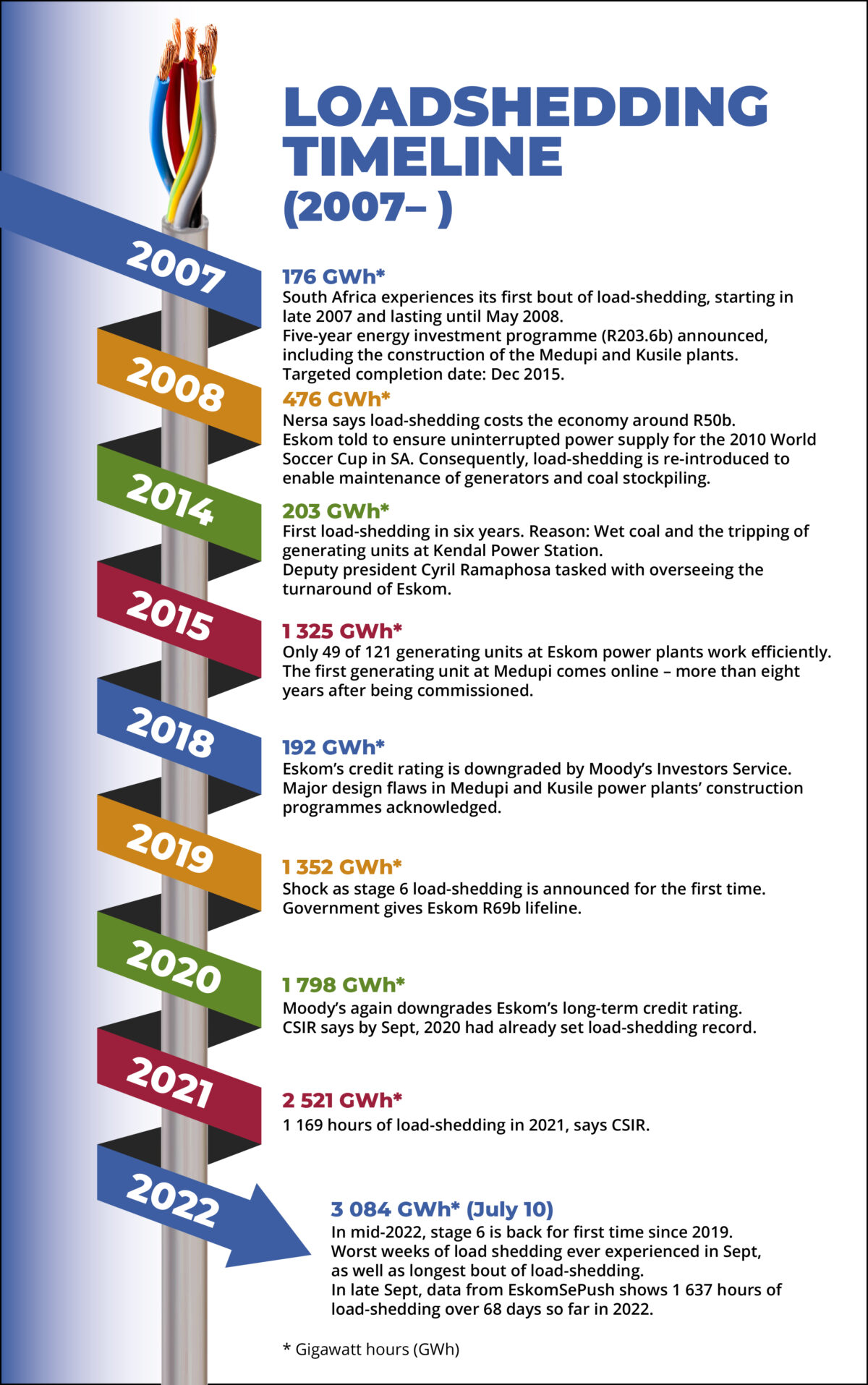
2007 – 176 Gigawatt hours (GWh)
Eskom CEO: Jacob Maroga
South Africa experiences its first bout of load-shedding, starting in late 2007 and lasting until May 2008.
Eskom gives the green light for a five-year investment programme worth R203.6b, including the construction of the Medupi and Kusile plants, with a targeted completion date of December 2015. This, says government, will significantly address the power challenges.
“When Eskom said to the government: ‘We think we must invest more in terms of electricity generation’, we said no… all you will be doing is just to build excess capacity. We said not now, later. We were wrong. Eskom was right. We were wrong.” – President Thabo Mbeki, December 2007
“When Eskom said to government, ‘We think we must invest more in terms of electricity generation,’ we said, ‘no, but all you will be doing is just to build excess capacity. We said, ‘not now, later.’ We were wrong. Eskom was right. We were wrong.” Thabo Mbeki, 12 December 2007
— ANC Quotes (@QuotesAnc) December 12, 2019
2008 – 476 GWh
Eskom CEO: Jacob Maroga
The National Energy Regulator of South Africa (Nersa) estimates that load-shedding costs the economy R50b.
Government instructs Eskom to ensure uninterrupted power supply for the 2010 World Cup Soccer in South Africa. Load-shedding is subsequently introduced for the maintenance of power generators and the recovery of coal stockpiles.
“We are going to be in this [crisis] for years. The threat of load-shedding is with us for some time.” – Eskom CEO Jacob Maroga, February 2008
2014 – 203 GWh
Eskom CEO: Brian Dames / Collin Matjila (acting) / Tshediso Matona
The depletion of dry coal stockpiles and the tripping of generating units at the Kendal Power Station in Mpumalanga are given as the reasons for the first load-shedding in six years.
President Jacob Zuma appoints deputy president Cyril Ramaphosa to oversee the turnaround of three state-owned companies, including Eskom.
“Although this is the first time load has been shed since 2008, Eskom is in a much better position to manage the situation than they were then … Load-shedding is done as a last resort to protect the national system from a total blackout, which would have a significant impact on the economic developments of South Africa.” – Minister of Public Enterprises Malusi Gigaba, March 2014
“I don’t think there’s a crisis at Eskom. I think sometimes the reporting on the company creates the perception of a crisis.” – Eskom CEO Tshediso Matona, December 2014
2015 – 1 325 GWh
Eskom CEO: Tshediso Matona / Brian Molefe
Only 49 of 121 generating units at Eskom power plants are in good working order, while 32 are in poor condition.
The first generating unit at Medupi comes online, more than eight years after the power station was commissioned. The budget to complete Medupi, Ingula and Kusile blows up to R300b.
“It’s spilt milk. We are in the situation that we are in. We have to build the power stations that are going to take us into the future… We have been delinquent with maintenance. We have to catch up. It’s not a permanent situation.” – Eskom CEO Brian Molefe, April 2015
2016
2018 – 192 GWh
Eskom CEO: Phakamani Hadebe
Eskom’s credit rating is downgraded by Moody’s Investors Service due to concern over ‘the lack of any tangible financial support for the company’.
The festive season leave of senior Eskom managers is cancelled by the Minister of Public Enterprises, Pravin Gordhan. He acknowledges major design flaws in the construction programmes for the Medupi and Kusile power plants.
“It doesn’t matter what you do, the mismanagement of the utility is going to be consequential to economic growth. No one will invest in a climate where you can’t secure energy, where you can’t create the necessary work, where you can’t set up plants and infrastructure.” – DA leader Mmusi Maimane, June 2018
2019 – 1 352 GWh
Eskom CEO: Phakamani Hadebe / Jabu Mabuza
Stage 6 load-shedding is implemented for the first time as Finance Minister Tito Mboweni announces plans for a R69b lifeline to the power utility.
The Zondo Commission of Inquiry hears allegations of the influence of state capture on Eskom. Minister of Public Enterprises Pravin Gordhan responds by saying, “When you capture an entity like this [Eskom], you don’t do it for fun. You capture it because you can extract resources from it.”
“Eskom is in crisis and the risks it poses to South Africa are great. It could severely damage our economic and social development ambitions. We need to take bold decisions and decisive action. The consequences may be painful, but they will be even more devastating if we delay.” – President Cyril Ramaphosa, February 2019
2020 – 1 798 GWh
Eskom CEO: André de Ruyter
Eskom’s long-term credit rating is downgraded once again by Moody’s, which labels it a ‘very high credit risk’.
Eskom COO Jan Oberholzer says the primary reason for load-shedding is the result of a lack of maintenance and neglect over the previous 12 years, resulting in an unpredictable and unreliable system.
“We are pleased by the progress we are making towards better transforming the performance of Eskom under the leadership of the new CEO. Therefore, the reorganisation of Eskom along the lines of a new distinct yet complementary business and operational model has begun.” – Deputy President David Mabuza, September 2020
2021 – 2 521 GWh
Eskom CEO: André de Ruyter
An Eskom commissioned study by Nova Economics calculates the costs of a day of load-shedding as follows: R235.5m (stage 1), R471.3m (stage 2), R706.7m (stage 3), R942.4m (stage 4).
Ramaphosa announces that the Electricity Regulation Act will be amended to increase the threshold for exemption from applying for a licence from Nersa to generate electricity.
“If this is the outlook for 2021, it will be the worst performance by Eskom ever and I expect the start of major disinvestment by energy-intensive consumers, and further loss of jobs and GDP.” – Energy expert Ted Blom, January 2021
2022 – 3 084 GWh (July 10)
Eskom CEO: André de Ruyter
Eskom’s research, testing and development senior engineer Ulrich Minnaar tells Nersa load-shedding has cost the South African economy R67b since 2007 (based on 2020 prices).
Kusile and Medupi are still not fully operational; Mabuza announces in May that design defects at Medupi will be fixed by 2027.
A presentation to the Presidential Climate Change Co-ordinating Commission states that R500b in private investment is needed by the start of 2025 to end power cuts in South Africa.
“Personally, I am sick and tired of walking into any social gathering and hearing 10 minutes of load-shedding jokes before people move on to the performance of various international sports teams. I take no pleasure in it.” – Eskom CEO André de Ruyter, May 2022
Read original story on albertonrecord.co.za