‘War of the East’ shows the beauty of battle scars
The Johannesburg East area is the home to the most interesting and important monuments to the victims of war.
The Johannesburg Heritage Foundation hosted a breathtaking tour ‘War of the East’ of the Eastern suburbs of Joburg on June 2.
The tour guide for the day was Eric Itzkin, City of Joburg head of Heritage.
The Johannesburg East area is the home to the most interesting and important monuments to the victims of war.
The first stop of the tour was Johannesburg’s highest point, Observatory Ridge, which is 1 808m above sea level.

Indian monument
In this ridge stands the Indian monument as a memorial to Indians who fell in the Anglo-Boer War of 1899-1902.
The monument overlooks the valley where these men of the Indian Army served at a remount camp during the War.
This valley is now your Bertrams, Bez Valley and Troyville areas.
Also read: War memorial to move to Bez Valley park
The main plaque on the east side bears the inscription: “To the memory of British Officers, Natives, NCOs and Men, Veterinary Assistants, Nalbands, and Followers of the Indian Army”. On the other three sides of the sandstone obelisk are small tablets inscribed with the designations of the main religious groups involved Mussulman, christian-Zorbastrian and Hindu-Sikh.

According to records over 9 000 men were brought from India to serve during the Anglo-Boer War.
Although fully-fledged troops of the Indian army, they were ordered to serve in non-combative roles, serving as “auxiliaries” or “followers”.
They served in such supportive roles as veterinary assistants, farriers (Nalbands) grooms for horses, stretcher-bearers, ammunition-carriers, orderlies and washer-men.
Bezuidenhout Park
After the uphill and downhill climb the second stop was Bezuidenhout Park which dates back to 1949.
Also read: Jeppe Boys remember heroes of two world wars
In its early life the park was the farmstead and farm of the pioneering Voortrekker Bezuidenhout family.
The farmhouse is one of the oldest buildings in Johannesburg.

The simple rectangle part of the house was built in 1863 by Frederik Jacobus Bezuidenhout.
In the 1890s a wing with attractive bay windows was added on the south side and a north wing in 1910.
The farmstead was declared a National Monument in 1995. There is a blue plaque on the original farmhouse.
Not far away from the house is the Bezuidenhout family graveyard.
You can still see the beautiful original work of the house.

There are features like the shiny wooden floors and slatted wooden or pressed steel ceiling and iron fireplace that gives you an idea of how old the house is.
During the Anglo-Boer War, the farmhouse was used as a base by the British, after they took over Johannesburg in May 1900.
The farm was used as a central remount depot which was maintained by Indian soldiers, many of them Sikhs, who were among the British forces which had occupied Johannesburg in 1900.
Also read: Desecration of memorial continues
It is said as many as 4 000 horses could be accommodated, sheltered under corrugated iron roofs, and fed from good grazing in the surrounding fields.
If you look around the park you can almost imagine horses grazing because of the beautiful green grass.

Scottish Horse Memorial
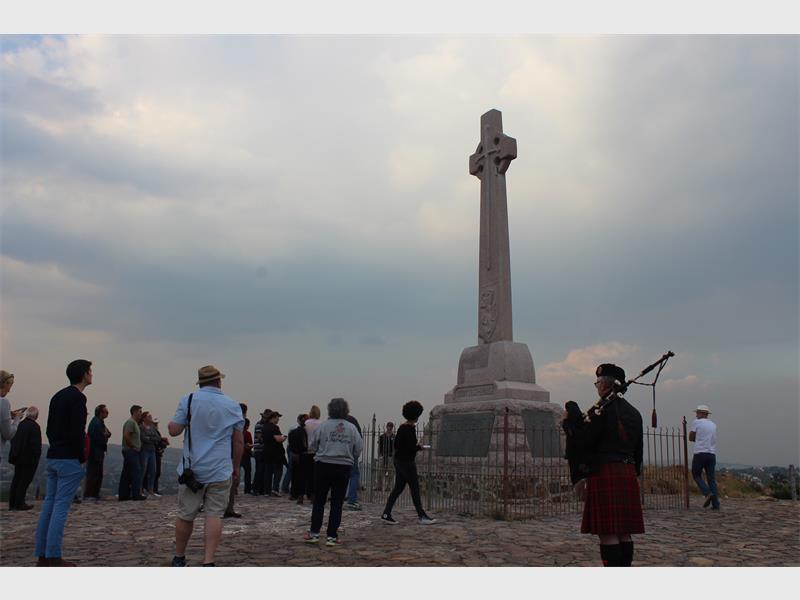
Our last stop was the breathtaking Scottish Horse Memorial on top of Caledonia Koppie in Kensington.
The group was welcomed by two members of the Jeppe pipe band who played war songs.
This monument commemorates officers and men killed in action and who died of wounds, disease and accident, who were members of the Scottish Horse Regiment, a mounted infantry regiment during the Anglo-Boer War.
A volunteer regiment, these were not regular soldiers but were Scots, or men of Scots decent, who could handle a horse or could ride.
Recruitment was extended to Scotland and Australia, the Scottish Horse was expanded to two regiments, and altogether 3 500 men served in the Scottish Horse.
Also read: Unique memorial, ceramic poppies to mark end of devastating WWI
The beauty of this monument is the 26ft high Celtic cross, that stand tall and strong on top of the hill.
When you reach the top of the hill you are captured by the beauty of the Kensington area and Johannesburg.
The military heritage of Scotland is remembered in the Celtic Cross, and in the Claymore or broadsword, and in the emblem of the Lion rampant.
This memorial was erected in 1905 and is a duplicate of that erected on the esplanade of Edinburgh Castle in Scotland.
The Kensington memorial was made by a firm of monumental sculptors based in Edinburgh, S. McGlashen and Son, and then imported to South Africa.