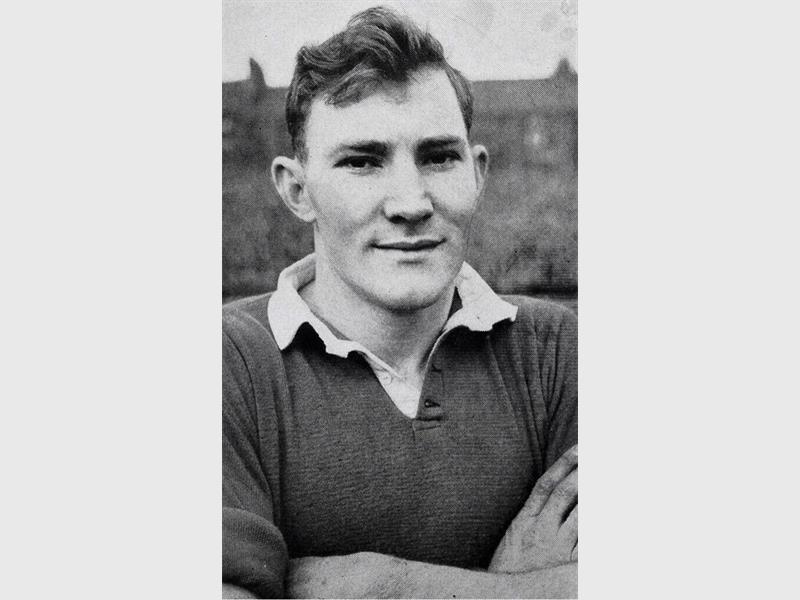
Bluegum tree helped former Rangers forward score goals
In this modern era of football where huge sums of money do the talking, it is important to recall and retell the stories of local pioneers who played the sport purely out of love and passion.
It is also extremely vital to pay homage to some of the early South African football jetsetters who headed out to Europe to showcase their skills.
Just speak to Rynpark 2 resident Donald Kitchenbrand (83), a talismanic, goal-scoring forward, who donned the famous royal blue jersey of Glasgow Rangers in Scotland between 1955 and 1958 as well as the familiar red and white stripes of England’s Sunderland from 1958 to 1960.
He came back to South Africa and played for Johannesburg Wanderers from 1960 to 1962, followed by a return to Scotland for a brief spell with Forfar Athletic between 1962 and 1963.
He also earned one lone cap for South Africa.
The City Times visited Kitchenbrand, nicknamed “Rhino” by Rangers supporters, at his Rynpark 2 home recently and indulged in some of his numerous yet fascinating anecdotes from a period in football history totally incomparable to the current modern mayhem of TV deals, sponsorships and £89-million transfer deals (Kitchenbrand’s transfer to Sunderland in 1958 cost a mere £8 000 in comparison).
In his first season in British football Kitchenbrand (who grew up in Boksburg) scored 24 goals in 25 league appearances to help Rangers win the Scottish League title (a gorgeous gold championship-winning medal is still a prized possession of his).
That season’s goal tally included a five-goal haul in an 8-0 rout of Queen of the South at Ibrox in March 1956 in the league.
That particular goal-scoring display is still firmly etched in the octogenarian’s mind after he endured pre-match abuse from the Queen of the South supporters.
“A story leaked to the press about me receiving some biltong from South Africa after a training session.
“There was some backlash from the Queen of the South supporters with some sending me notes to ‘go back to your jungle country and eat your dried meat’.”
He replied by sticking five goals past their goalkeeper when the teams met.

Even though he always dreamed of playing for Glasgow Rangers, the forward had to remain quiet about his Roman Catholic religion.
Between the 1920s and 1989, Rangers had an unwritten rule whereby the club would not sign any player who was a known Roman Catholic.
This was because Rangers were viewed as a “Protestant club”, as a deliberate contrast to their Old Firm rivals, Celtic, who were viewed as a “Catholic club”.
He held on to this secret for a long time.
“I played there for four years and didn’t say a word about it.
“They probably would have killed me,” he said.
At Sunderland, Kitchenbrand spent two years on Wearside, scoring 28 goals in 54 games.
Despite his best efforts, Sunderland were relegated from the top-flight at the end of the 1957/1958 season.
The forward had scored on his debut in a 3-3 draw with Sheffield Wednesday before notching a further five goals in his next nine appearances at the end of the campaign.
Sunderland failed in their attempts for an immediate top-flight return, though Kitchenbrand did return an impressive 21 goals in 41 games in the second tier.
Hat-tricks in wins over Rotherham United and Brighton and Hove Albion had followed a winner in the first month of the season in a 2-1 home success over Liverpool.
His partnership with Don Revie and John Goodchild made “the Black Cats” one of the most prolific sides in the division, though their leaky defence resulted in only a mid-table finish.
At his home he proudly displays photographs of matches from his bygone career.
He also has countless archives of newspaper clippings stored away.
One image that caught the City Times’ eye was a photograph of the striker colliding with legendary Manchester United goalkeeper Harry Gregg, who survived the infamous Munich Air Disaster and who helped pull survivors from the plane wreckage.
Reflecting on his numerous goal-scoring exploits Kitchenbrand spoke about how he, as a nine-year-old schoolboy, first started learning to hit the target.
“I had a coach called Botha who had a big snow-white moustache and white hair.
“He would get six of us boys on each side of a bluegum tree.
“We took turns shooting at this tree and if we missed we would get a wallop on the backside with a bendable plum tree branch.
“When he hit you it was extremely sore – that was discipline.
“Whenever I scored goals in my career I would think of that old blue gum tree.”
Despite his interesting career Kitchenbrand doesn’t see himself as a legend.
“I don’t believe in legend or icon status.
“I think it makes you way too big-headed.
“Football is, and will always be a game of passion, not ego.”
Follow us on these platforms:
Like our Facebook page and follow us on Twitter.
For news straight to your phone invite us:
WhatsApp: 079 431 2006
Instagram: benonicitytimes.co.za