
Students take on solar car challenge
UKZN students will take on the Sasol Solar Car Challenge in a car they designed and built.
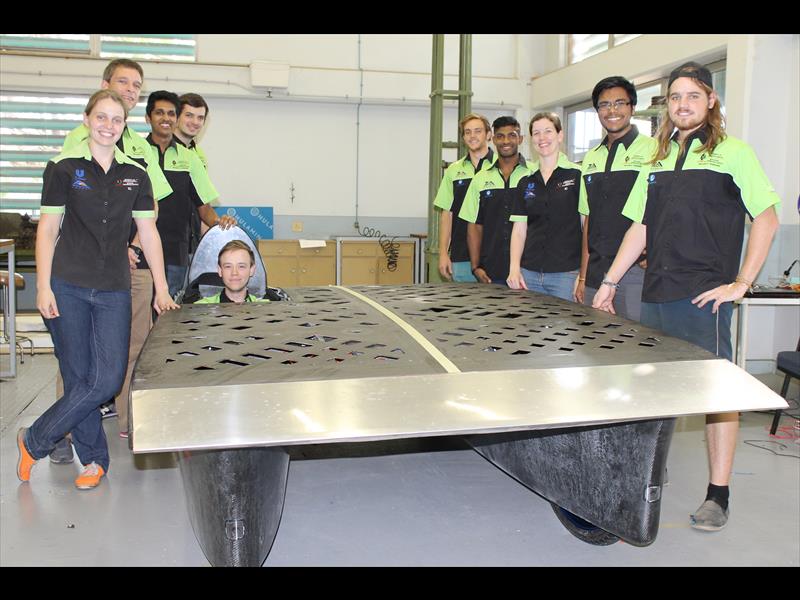
FINAL year mechanical engineering students at UKZN and their supervisors, will be taking part in the 2014 Sasol Solar Car Challenge, which starts on 27 September.
The six students, supervised by Dr Clinton Bemont and Kirsty Veale, have designed and built Hulamin iKlwa, a solar powered car that will be participating in the solar car challenge. The team is getting ready to take the show on the road once again with their innovative and modified solar car, iKlwa, which means ‘a short and agile spear’.
iKlwa will be entered in the Olympia class (four wheels) of the Sasol Solar Challenge. The challenge is an eight-day race from Pretoria to Cape Town, which starts on 27 September. The UKZN team left on 20 September to prepare for the race, which ends on 4 October. The team will do two days of road worthy testing during before the event. There will be three drivers and the others will provide strategy and support.
According to Bemont, a solar car was built in 2012, which did 2000km over the course of the race that year, doubling the next South African entrant by 1000km.
He said the team hoped to do 5000km to 6000km in the event this year.
“There was a huge amount of work involved in building this car. It is designed to top out at 130km/hour and we hope to average 80km in the course of the race,” said Bemont.
“Our car is super awesome and we are going to win!” said Veale.
The new car, which was designed from February 2013 and built in December last year completely by the students, has an asymmetrical design, with a highly aerodynamic profile that has a small frontal area to improve the aerodynamic drag. The theoretical drag of the car is very low, which means that lesser energy will be used which enables the car to go faster.
According to Bemont, the car has an aerodynamic design and is light, nimble and agile. It represents an innovative and efficient design promoting green energy for the future that is rich in local skill and creativity. The car is lightweight yet rigid and safe, with fully carbon-composite monocoque chassis, weighing around 60kg. It has two times 2.5 kilowatt hub to hub high efficiency motors, inside the wheels.
“We have improved the aerodynamic drag coefficience from the last car, which means it goes through the air more efficiently. We are also using fancy tyres which are pumped up to eight barrs, which improves rolling resistance, which is the energy lost as the tyre rolls on the road. The car's shell has holes in it, which allows cooling of photo voltaic cells, which improves energy absorption ability as well,” said Bemont.
The car has 6m2 of silicon solar panels that will be used to harness energy from the sun to power the car. This energy will be stored in 21kg lithium ion batteries. iKlwa conforms to FIA and World Solar Challenge regulations, and the team plans to enter the 2015 World Solar Challenge in Australia.