
Remarkable raptors spotted in the suburbs
The crowned eagle is an apex predator, it plays an important role in maintaining this ecological balance within our environment.
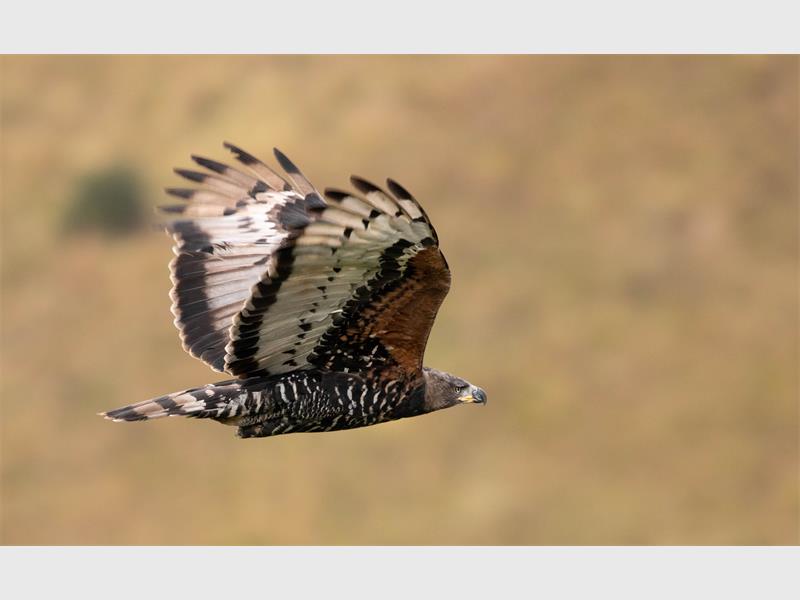
ONE of Southern Africa’s largest raptors, the African Crowned Eagle, has taken up residence in Durban’s urban environment.
Several individuals of this extraordinary species have been spotted by bird enthusiasts and members of the public in Manor Gardens and Glenwood on the Berea.
ALSO READ: Exploring Pigeon Valley: The Juvenile African Crowned Eagle
Several eagles have moved into these suburbs from a site in the Kranskloof Nature Reserve where they have been nesting in the same tree for over forty years.
This rare bird of prey is a forest eagle and has distinctive markings on its body and wings that blend in with the freckled light of its preferred habitat, especially when seen from below; in flight, it provides a memorable display of aerial prowess.
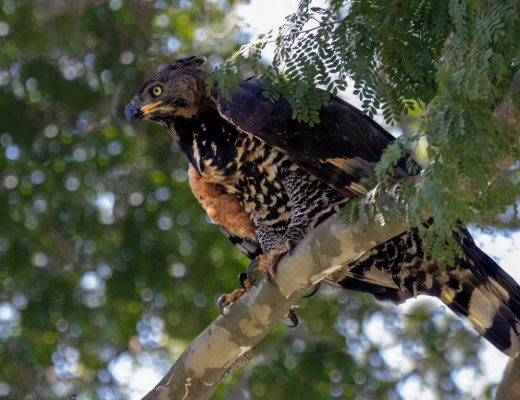
While the crowned eagle may not be the biggest in Africa, it is certainly the most powerful with a wing span of up to 1,8metres and is able to carry up to 30kgs of weight.
Classified by an international conservation body, the ICUN , as ”near threatened – population declining”, there are less than one thousand of these raptors left in South Africa and many see its presence in their neighbourhood as an honour and a privilege.
ALSO READ: Exploring Pigeon Valley: The African Crowned Eagle
Says David Smith, resident of Manor Gardens, “We have seen an adult and a juvenile on several, separate occasions during the past two months. We are thrilled to have them in our area. But all is not happy in the ‘hood’. There have been two recent reports from around Durban of a puppy and a small dog that were taken by a “huge bird” which has since been identified as the crowned eagle. Some residents have complained about harassment of their small pets by these birds and advocate that the “eagles must go”.
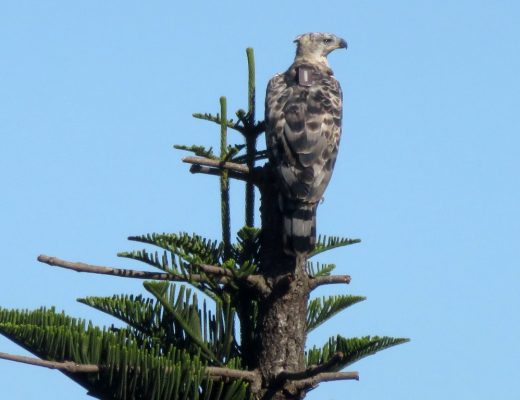
Sadly, once again, the competing needs of humans and nature collide.
“Unfortunately for humans, their small pets may be vulnerable to predation by raptors and this must be an extremely traumatic experience. However, scientific research has shown this is a very uncommon event,” says Crispin Hemson who heads the Friends of Pigeon Valley, the ten hectare nature reserve in the heart of Glenwood where these eagles have been seen.
“Meanwhile, humans benefit from the free services provided by the crowned eagle. Their preferred prey is monkeys, hadedas and duiker all of which are in plentiful supply in our city, the latter being surprisingly prolific (approximately sixty individuals) in Pigeon Valley where carrying capacity has been reached.”
As the crowned eagle is an apex predator, it plays an important role in maintaining this ecological balance within our environment.
Extract one element from the system and the fragile equilibrium, vital to the well being of the entire system, is threatened. Removing the individual crowned eagle is not a viable option – another will simply take its place.
Eagles fall under the wildlife protection ordinances and transgressors are liable to fines.
“The way forward for the owners of kittens and small puppies and the crowned eagles to co-exist,” offers Crispin, “is to take the basic precaution not leaving their pets unattended in gardens, especially at dawn or dusk which are the preferred hunting times for these raptors.
“We are lucky to have a beautiful and endangered creature, playing its role in regulating wildlife in our city,” says Crispin.
“In fact, we may be a world first. Nairobi is the only other mega city in Africa that I’ve heard of where these crowned eagles live in the metropolis, and there, they reside in a very large nature reserve within the municipal boundary.”
Ornithologist Dr Shane McPherson, in his article Crowned Eagles in the Big Cit?, takes a scientific look at this emotive topic.
He writes that raptors pair for life and their chicks have a long dependency phase, only maturing at the age of four or five years.
As adults only tend to rear one chick every other year, these factors impact on their ability to withstand declines in their populations. McPherson’s three year Durban study revealed that pets are hardly at risk.
“Over the course of three summers, we installed 12 nest cameras and gathered 1, 544 days of time-lapse data (just falling short of a million images). 914 individual prey animals were identified from these cameras. Crucially, data showed that cats (feral and pets) comprised just 0.8% of the eagle’s prey.” No dogs were recorded as prey.
Chairperson of the Kloof Conservancy and conservationist Paolo Candotti comments, “We live in a high biodiversity area. There are 36 biodiversity hotspots around the globe which have been identified and South Africa has three: KZN, the Cape Floral Kingdom and the Succulent Karoo.
Our country has the third highest biodiversity in the world. However, this status as a national, natural treasure trove comes with an immense responsibility.
“We need to conserve our extraordinary variety of indigenous plants, animals and ecosystems for the health and sustainability of not only our city but our county and the entire globe,” says Candotti.
“I have great empathy for a caring owner who loses a beloved pet. However, now more than ever, with the global decrease of biodiversity through, among other things, loss of habitat, population pressure and climate change, biodiversity worldwide is under severe threat from humans. It’s imperative that we learn to live together with nature and adapt.”
Indeed, conservationists and scientists believe that we share the planet with many species of plants and animals – and we need them – all of them.
Caxton Local Media Covid-19 reporting
Dear reader,
As your local news provider, we have the duty of keeping you factually informed on Covid-19 developments. As you may have noticed, mis- and disinformation (also known as “fake news”) is circulating online. Caxton Local Media is determined to filter through the masses of information doing the rounds and to separate truth from untruth in order to keep you adequately informed. Local newsrooms follow a strict pre-publication fact-checking protocol. A national task team has been established to assist in bringing you credible news reports on Covid-19.
Readers with any comments or queries may contact National Group Editor Irma Green (irma@caxton.co.za) or Legal Adviser Helene Eloff (helene@caxton.co.za).
Do you want to receive news alerts via Telegram? Send us a message (not an sms) with your name and surname to 060 532 5535.
You can also join the conversation on Facebook, Twitter and Instagram.
PLEASE NOTE: If you have signed up for our news alerts you need to save the Berea Mail Telegram number as a contact to your phone, otherwise you will not receive our alerts
Here’s where you can download Telegram on Android or Apple.