Church celebrates centenary with Portuguese flair
The 100-year celebrations are a major highlight on the church’s calendar.
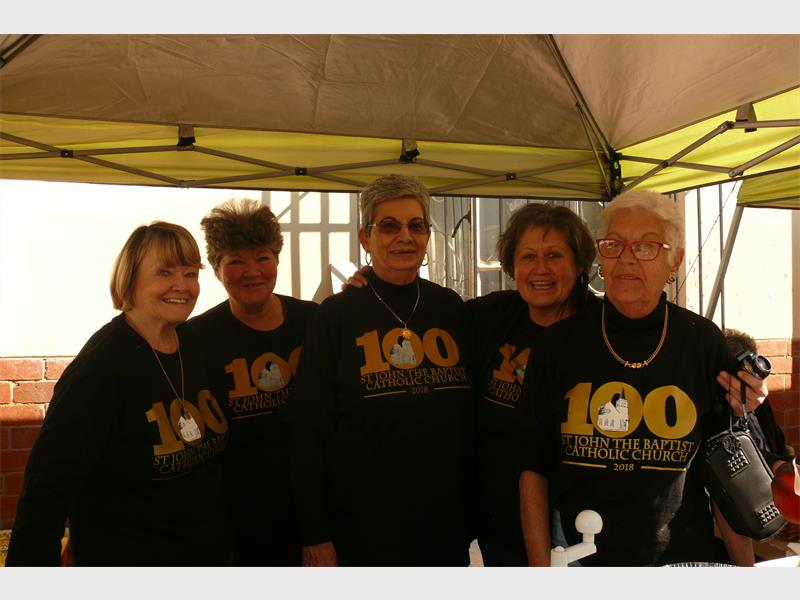
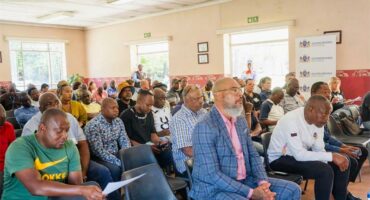
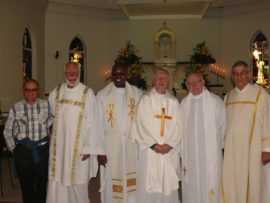
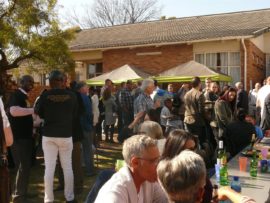
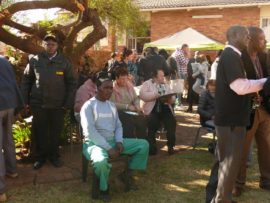
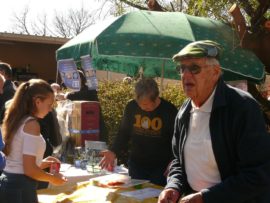
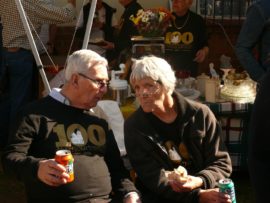
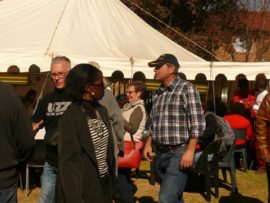
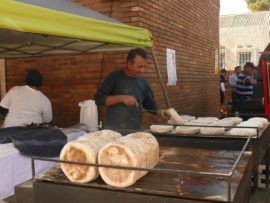
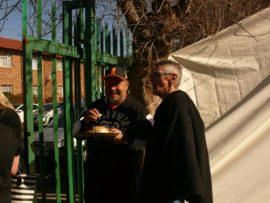
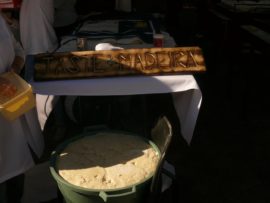
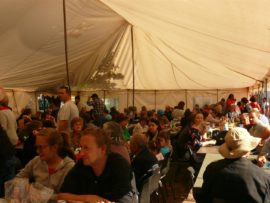
A Festa led by the Portuguese community on Sunday in celebration of the 100th anniversary of the St John the Baptist Catholic Church in Brakpan was well supported by congregants of the church and a large number of visitors.
Formalities included a thanksgiving mass and a procession, after which a fun and relaxing day followed.
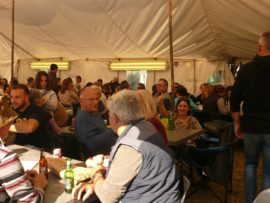
Young and old enjoyed traditional Portuguese food, music, folklore dancing, as well as a karate and self-defence demonstration.
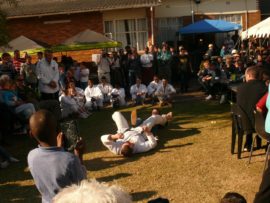
The 100-year celebrations are a major highlight on the church’s calendar and members of the local Portuguese community pulled out all the stops to make the day a memorable one.
The church, which is situated along Queen Avenue, has always had a very supportive Portuguese community attending mass and various activities.
In the 1940s, a group of Portuguese farmers helped with the payment of the church’s glass stained windows, which were imported from Germany.
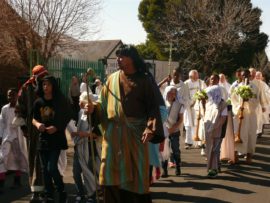
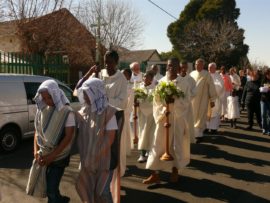
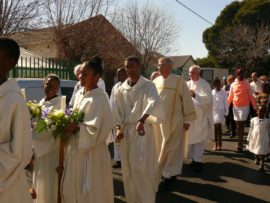
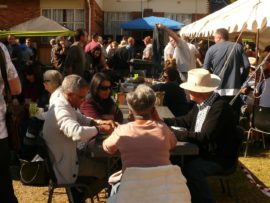
Fêtes were held by the parish in the early 1980s and were greatly supported by the Portuguese community.
In 2006/2007 these fêtes, now called Festas, were revived and a Festa is now held every second year.
According to the commemorative booklet published by the church, plans to build the church were made by Father Kempf, the parish priest in Benoni.
At the time of the laying of the foundation stone on March 24, 1918, World War One was underway.
The foundation stone was laid by Reverend Charles Cox, Vicar Apostolic of the Transvaal Vicariate.
Present at the service was Father Laurence Shapcote, the first Dominican to serve in South Africa, who had arrived a week earlier to be parish priest at Boksburg.
Bishop Cox again visited Brakpan on June 24, 1918, for the feast of St John the Baptist.
Also read: Brakpan church celebrates 100 years with gleaming new addition
The building of the church had been completed only the previous day by contractor M McInerney.
The bishop was assisted with the opening Holy Mass by Father Kempf, who had been serving the parish from Benoni.
Thereafter, until the first resident priest moved to Brakpan in 1925, Father Kempf drove his old motorcycle to say Holy Mass on the second Sunday of each month for the Brakpan congregation.
Father Desmond Murray was the first resident priest and a year after his arrival, he had the front end of the church extended to include a proper sanctuary with an altar.
During the term of Father Gabriel Coyle from 1933, the church was further extended at the south end and a bell tower was built.
The extensions included an entrance vestibule, a re-positioned sanctuary and a new confessional along with a kitchen in the priest’s house.
A new marble altar, imported from Italy, was erected in 1938, along with stained glass windows depicting the five Joyous Mysteries of the Rosary.
A church hall was built in 1941/42 and in later years was dedicated in honour of Pope John XXIII.
The crucifix hanging above the nave of the sanctuary was donated in the late 1930s by Edith Machetto in memory of her husband Guiseppe.
When the cross arrived in South Africa, it was found that one of the arms was missing and another one had to be hastily shipped from Italy.
The Herald reported earlier this year how a beautiful new stained glass window had been commissioned for the church in celebration of its centenary.
The new window, ‘The Holy Spirit’, which features a dove symbolising peace in South Africa, was installed on January 19.
Having been there since 1949, the previous window was bent and broken.
The new addition was the work of Brakpan resident Mervyn Dansie, a congregant of the church and long-standing member of the local Catholic community.
Inspiration was taken from the stained glass window in St Peter’s Basilica in the Vatican in Rome.
Follow us: