How Mosima Mcathule transformed lives at Child Welfare Germiston
From humble beginnings in Limpopo to leading one of Gauteng’s key child protection organisations, Mosima Mcathule is a testament to perseverance and social impact.
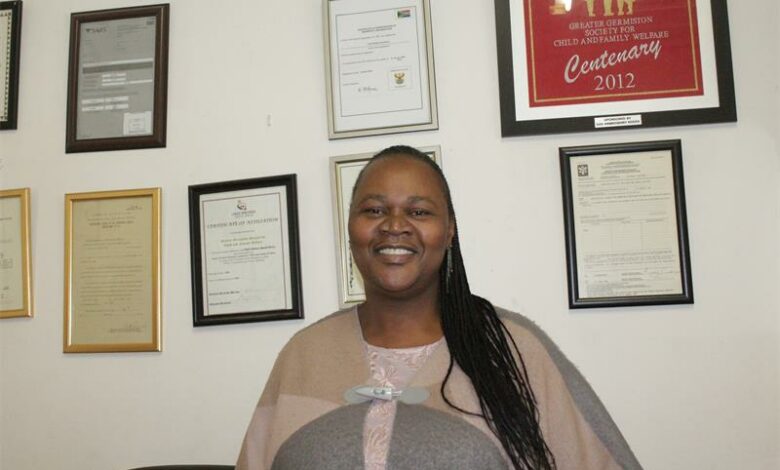
Mosima Ethel Mcathule, operations director at Child Welfare Germiston, embodies the true meaning of consistency and full-circle moments.
Born and raised in Limpopo, she grew up as the firstborn in her family, followed by a younger brother. Her journey has taken her from volunteer to director at Child Welfare Germiston.
From a young age, Mcathule developed a deep love for school and education. Although her parents were not formally educated, they were determined their children would have opportunities they never had.
ALSO READ: Modderfontein residents lead SA-wide blanket drive for animal welfare
“My parents are not learned, but they made sure we went to school. I had the fire to pursue education,” said Mcathule.
Despite coming from an underprivileged background, she never wavered in her dreams. Like any child, she enjoyed playing with friends while remaining dedicated to her studies.
She completed high school, but the road ahead was not without obstacles. After matric, she took a gap year when her parents could not afford further studies.
“My parents said they didn’t have money to pay for my education, and I was angry because I wanted to continue studying,” she said.
Although the setback felt devastating at the time, it became a defining moment that strengthened her resilience and determination.
She later enrolled at Eastside College to study human resources. However, completing the qualification became difficult because she depended largely on her parents for financial support.
She eventually left her studies due to financial challenges and worked at a flower market to support herself and help her family. She remained there for five years.
“I was earning only a small salary. During this time, I met the man who later became my husband. Our relationship grew stronger and today we have been together for 25 years and have two children,” said Mcathule.
“My husband became one of my biggest supporters and believed strongly in my potential. He encouraged me to leave the flower market and return to school to pursue my dreams.”
Taking that advice to heart, Mcathule enrolled at the University of South Africa (UNISA) to study social work. By then, she was already a mother of two, balancing family responsibilities with her studies.
Despite the challenges of raising children while studying, she remained committed to building a career that would allow her to make a difference.
ALSO READ: Hope Foundation spreads Christmas cheer at Welfare Park
During this time, she met a woman who offered her a learnership opportunity to train as a social auxiliary worker at Lethukukhanya Health Institute.
The opportunity opened a new path and brought her closer to her dream of working in social services.
While studying, Mcathule also began volunteering at Child Welfare Germiston in a programme called Asibavikele, meaning “Let’s protect them”.
The programme focused on identifying vulnerable children in communities and finding ways to assist and protect them.
At the same time, she volunteered with SOS Children’s Villages South Africa through the Big Brothers Big Sisters of South Africa programme. The initiative paired volunteers with children who needed mentorship and support.
Through the programme, Mcathule was matched with a child she mentored as a “big sister”. Every weekend after work, she travelled by three taxis to spend time with the child.
Her dedication eventually paid off. After completing her social auxiliary work course at Lethukukhanya Health Institute in 2010, she secured a position as a social auxiliary worker at Child Welfare Germiston.
ALSO READ: Hope Foundation spreads Christmas cheer at Welfare Park
“Starting as an auxiliary worker became the beginning of a fulfilling journey for me,” she said.
“My work involved assisting the social worker I worked under, travelling to court, and learning the practical realities of child protection.”
While working, she continued studying and eventually completed her social work degree. As she progressed to her honours studies, Child Welfare Germiston assisted by helping pay part of her fees.
“In 2015 I qualified from UNISA as a social worker. While writing my final exams, a social worker resigned and Barbara offered me the position. As soon as my results came through, I was so excited.”
Her graduation was a deeply emotional moment for her and her family.
“My mother came to my graduation even though she was not well, and my father was also sick. Hearing your name on stage and receiving your qualification is the best feeling ever.”
She is now registered with the South African Council for Social Service Professions.
For Mcathule, becoming a social worker was not just a career choice but the fulfilment of a lifelong dream.
“It has always been my dream to become a social worker.”
“Studying was not easy because I had to pay the fees myself. It also came from my husband’s pocket, and it was difficult because he was studying towards his LLB.”
He later achieved his own dream and now works as a labour lawyer in the North West.
“He always encouraged me to go back to school. When I said I was ready, he came running to rescue me.”
ALSO READ: Local Child Welfare hosts 72nd AGM
Mcathule still hopes to further her education and pursue a master’s degree in future.
As a qualified social worker, her responsibilities increased significantly. She was assigned her own caseload, ensuring every child under her care received protection and assistance.
The role also meant greater accountability, including attending court and managing sensitive cases involving vulnerable children.
Although demanding, she embraced the independence that came with the position.
“I loved the independence because I was no longer working under a social worker,” she said.
In 2020, Mcathule left Child Welfare Germiston to join Tutela, where she became a senior social worker.
A few months later, the organisation’s head office advertised a director position. Mcathule applied and was selected.
After training, she supervised two offices: Dinwiddie and Mpumalanga.
During this time, she remained in contact with Child Welfare Germiston. When long-serving director Barbara Bouwer began preparing to step down after more than 30 years, Mcathule learned of the opportunity.
In February 2024, she returned to Child Welfare Germiston as director after a rigorous interview process with the organisation’s board.
“The board interviewed me for the position and they did not make it easy. They are highly qualified professionals and they grilled me,” she said.
The leadership transition was carefully planned as part of a succession process. Instead of leaving suddenly, Bouwer worked closely with Mcathule to gradually transfer responsibilities.
“We shared the load and slowly I began to take over. Even now we still connect through Zoom. Barbara is my mentor and the board fully supports me.”
Adjusting to the new role brought challenges.
“It has not been easy to detach from being a field worker, but I understand that my role has changed,” she said.
As director, Mcathule believes strongly in collaborative leadership and transparency.
“I have an open-door policy. I also encourage everyone to understand every part of the work. It is good for people to know every field within the organisation.”
Under her leadership, new systems have also been introduced to improve efficiency and reduce paperwork.
Last month she was appointed a commissioner of oaths, allowing her to certify documents for clients.
“I applied through the Germiston Magistrate’s Court and the certificate was issued through the Johannesburg High Court,” she said.
Although her journey has been filled with achievements, the work has not always been easy. Some cases left a deep emotional impact and reminded her how complex social work can be.
One case that stands out involved a troubled child with severe behavioural problems.
“As his social worker I was constantly called to address incidents involving him,” she said.
Over time, his behaviour escalated.
“He was involved in rape, found guilty of arson and regularly created conflict in children’s homes where he was placed. He even formed gangs within the homes and later began selling drugs.”
Because of the seriousness of the case, she was called to account at the Department of Social Development offices in Kempton Park.
“I prepared thoroughly and made 20 copies of the child’s full history for the meeting.”
When she arrived, she faced a panel of 18 members.
“They questioned me intensely and spoke about me as if I was not even there,” she said.
During the hearing, she received a call from a sister at a children’s home saying the boy had returned to collect a cellphone he had forgotten.
Seeing an opportunity, she asked that he be brought to the hearing.
When he arrived, she told the panel he was old enough to speak for himself.
“He told the panel I had tried everything to help him. He admitted that all the resources were offered to him but he did not want to change.”
He then openly admitted he was selling drugs and even named the drug lord he worked for.
“When he said the name, the whole room went quiet because it was a well-known name in Kempton Park.”
After the hearing, the board decided on further steps. He was later placed with a friend of his father but reportedly left during the journey.
Months later, Mcathule received another call from a woman in Spruitview asking her to fetch the young man.
When she arrived, he admitted he had been arrested for hijacking cars in Kempton Park.
She later appeared in court to explain the full background of the case. The court closed the file as no children’s home was available to accommodate him.
Five years later he again approached a children’s home seeking help, but by then he was 23 and no longer covered under the Children’s Act.
While some cases remain difficult, many have had life-changing outcomes.
One of Mcathule’s most fulfilling cases involved reuniting four children with their biological mother.
The children had been placed in foster care with a non-related guardian after their mother struggled with alcohol abuse.
Mcathule worked closely with both the foster guardian and the mother, supporting the mother through rehabilitation.
Over time the mother stopped drinking, rebuilt stability and began supervised visits with her children. She later remarried and had another child.
When the time came for reunification, the foster guardian had become deeply attached and resisted the process.
Mcathule took the matter to court.
“The magistrate ruled that the children should be returned to their biological mother,” she said.
“The day the judgment was delivered became one of the most memorable moments in my career.”
“Seeing the mother walk out of court with her children, finally reunited, was deeply fulfilling.”
Even after the reunification, Mcathule continued monitoring the family through unannounced visits.
Each visit showed clear progress.
“Within a year the children were performing exceptionally well in school, achieving high grades and even distinctions,” she said.
“People do change and they deserve a second chance in life.”
Another case involved a mother who had fallen into prostitution and struggled with alcohol addiction.
Determined to rebuild her life, the woman voluntarily entered rehabilitation, returned to school and later married.
With continued monitoring and support, she was eventually reunited with her two children.
Stories like these continue to motivate Mcathule and her team at Child Welfare Germiston.
The organisation works to protect vulnerable children aged 0 to 18. Cases include abandoned children, orphans and children with serious behavioural challenges.
Whenever possible, children are placed with relatives. If no family members are available, they may be placed with non-related guardians or in children’s homes.
ALSO READ: Edenvale and Bedfordview child welfare in need of your support
Foster care is usually temporary, with the goal of eventually reuniting children with their biological families once a safe environment is restored.
Beyond case work, the organisation is strengthening community engagement through awareness programmes that equip residents with knowledge and life skills.
Staff have also developed an annual calendar of community initiatives.
Child Welfare Germiston continues to receive funding from the Department of Social Development, with applications submitted each financial year.
However, community needs remain high.
Due to the increasing number of abandoned newborn babies, the organisation is appealing for donations of baby supplies such as clothing, nappies, blankets and baby food.
Community members are also encouraged to donate children’s clothing, toys and non-perishable food.
The organisation hopes to expand its facilities in future and is seeking donations of office furniture and other resources.
In addition, two social workers currently support six primary schools, providing counselling and emotional support to learners.
Plans are also underway to expand the programme to high schools.