Juliet Basson suspension lifted, but PA confirms she was found guilty
Basson is back in office, but the PA president’s explanation provides important context about her disciplinary outcome.
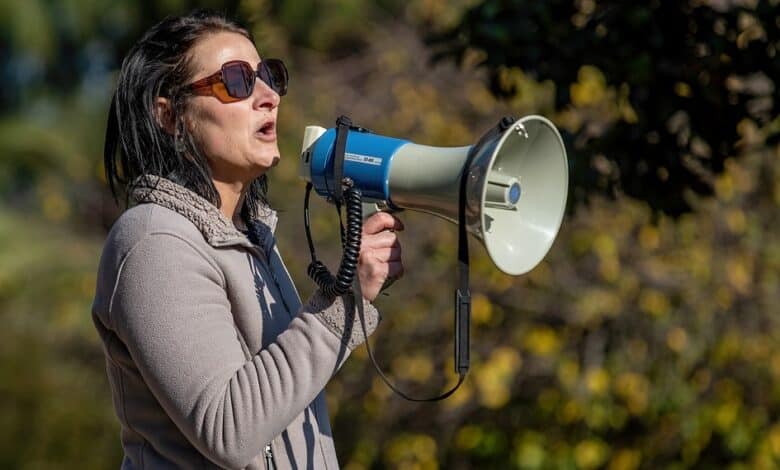
Ermelo MP Juliet Basson has returned to her position after the Patriotic Alliance leadership lifted her suspension, but the party’s president has made it clear that the decision was not an exoneration.
Basson’s suspension being lifted is a legitimate news development.
However, the circumstances surrounding the decision remain an important part of the story, particularly after PA president Gayton McKenzie publicly explained the leadership’s decision.
In a video statement addressing two disciplinary cases within the party, McKenzie said both individuals, including Basson, had been found guilty.
He explained that members found guilty could appeal to the party president and the Founding Members.
McKenzie said the leadership had decided to give both individuals another chance and that they wanted to show mercy.
Most significantly, he expressly stated that Basson and the other member had not been found not guilty by the leadership.
He further said the leadership concurred with most of what had been established during the investigations but had nevertheless decided to exercise leniency.
This distinction is important.
Basson has returned to her position. That is a fact.
But according to the PA’s own president, her return was not the result of the leadership finding that she was not guilty. It was a decision to exercise leniency and give her a second opportunity within the party.
What Highvelder previously reported
The development follows a disciplinary process in which Basson was found guilty of dishonesty by majority decision.
Her appeal was subsequently dismissed and the party confirmed a 12-month suspension.
Highvelder previously reported on Basson’s suspension after her appeal was dismissed.
Highvelder did not initiate that disciplinary process.
Highvelder did not suspend Basson, find her guilty or dismiss her appeal.
We reported the information made available through her own political party and sought her response before publication.
Basson indicated that Highvelder should speak to her representative, which the publication did.
His response was included in the report, together with a request that the article make clear that the process was not yet finalised and that they intended to pursue the remaining avenue available to them in an effort to have the suspension lifted through the founding members.
That was expressly included in the article.
In other words, the report did not present the suspension as being the final outcome.
Basson was given an opportunity to respond
While the matter was still before the Founding Members, Highvelder also contacted Basson and gave her an opportunity to inform the publication of the outcome.
She was specifically told that if her suspension was lifted, Highvelder would report that development accordingly.
Her response was:
“Nee dankie jyt genoeg skade veroorsaak. Lekker aand.”
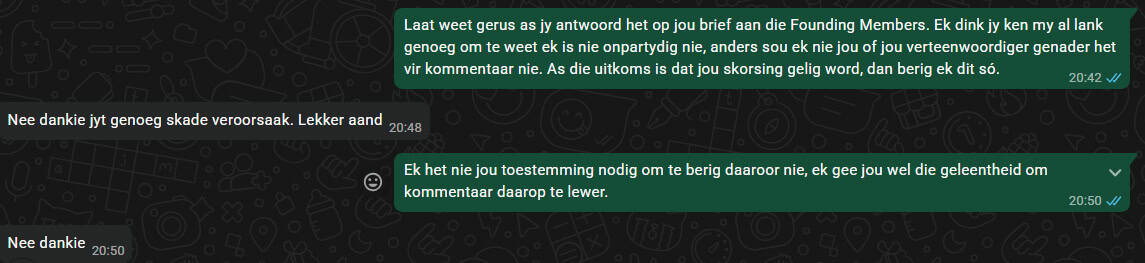
Highvelder subsequently clarified that her permission was not being sought to publish the matter, but that she was being given an opportunity to exercise her right of reply should the suspension be lifted. Basson declined the opportunity to comment.
Basson has since publicly questioned why Highvelder has not published a story about her return to her position.

After seeing Basson publicly tagging Highvelder and questioning why the newspaper had not reported on her return to her position, the editor approached her again to establish whether she had changed her mind.
“Hi, ek sien jy tag ons orals? Het jy nou van besluit verander? Laat weet my gerus, ek doen graag die opvolgberig sodat ons mense in kennis stel op grond waarvan jou skorsing gelig is.”
She did not respond.
The offer was therefore still on the table: Highvelder was willing to report on her return, but intended to provide readers with the necessary context and establish on what basis the suspension had been lifted.
That context is now particularly important following McKenzie’s own explanation that Basson had been found guilty, that the leadership did not find her and the other member not guilty, but instead chosen to show leniency and give her another chance.
The medical story – a matter of public interest
The controversy follows the article involving Basson earlier this year concerning her public claims about her illness and a spider bite.
Basson had publicly stated that she had contracted Lyme disease from the spider bite.
Highvelder investigated the claim and approached experts, who disputed the scientific basis for linking a spider bite to Lyme disease.
Screenshots of Basson’s original social-media post also show that the wording was subsequently changed from “Lyme disease” to “Lyme-like disease” after experts challenged the scientific basis of her claim.
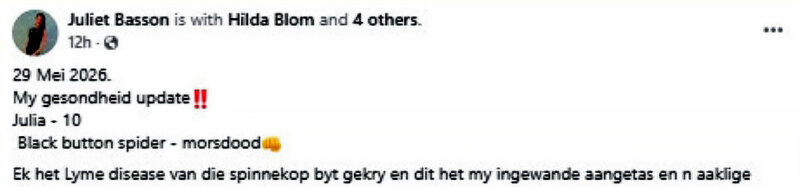
Read Highvelder’s original report on the Lyme disease claim.
The medical documentation supplied to Highvelder by Basson herself referred to “Lyme-like disease” but did not establish that a spider bite was the cause.
This was not a private medical matter that Highvelder sought out.
Basson had chosen to discuss her illness and circumstances publicly with an audience of more than 10 000 followers on her Facebook platform.
The resulting claims were therefore capable of reaching thousands of people, making their accuracy a legitimate matter for journalistic scrutiny.
Highvelder gave Basson an opportunity to respond, and provide defence of her medical experience and treatment, which was included in the report.
Highvelder sought comment from specialists with expertise in arachnids and infectious diseases, including Spider Club of Southern Africa chairman and arachnid expert Rudolph Steenkamp, an independent regional spider specialist and ecologist, and an independent clinical microbiologist.
Their assessments were consistent in disputing the claimed link between a spider bite and Lyme disease.
The position was further supported by information from official South African health sources, including the National Institute for Communicable Diseases (NICD) and Mediclinic Southern Africa.
That is the normal process of testing a public claim.
Claims about Highvelder’s treatment of Basson
Basson has subsequently made several public allegations after her suspension was lifted about Highvelder’s reporting, including claims that the publication bullied her, exploited her medical condition, targeted her and targeted her for monetary gain.
She has also suggested that the newspaper does not care about its community.
Those are serious claims about the publication’s conduct and motives, and the available record provides important context.
Basson has appeared in well over 50 Highvelder articles.
Only two of those reports, relating to the same set of circumstances, were critical, covering claims made by Basson and the subsequent disciplinary action against her. The overwhelming majority were positive, community-focused or factual reports concerning her involvement in local matters and her work in the community.
The suggestion that Highvelder deliberately targeted Basson is therefore not consistent with the publication’s records.
The suggestion that Highvelder does not care
Basson has also used the newspaper’s alleged failure to report on particular matters as evidence that Highvelder does not care about its community.
In a social-media post and subsequent live video, she specifically referred to the case of a two-year-old child battling cancer and questioned why Highvelder had not reported on the matter.
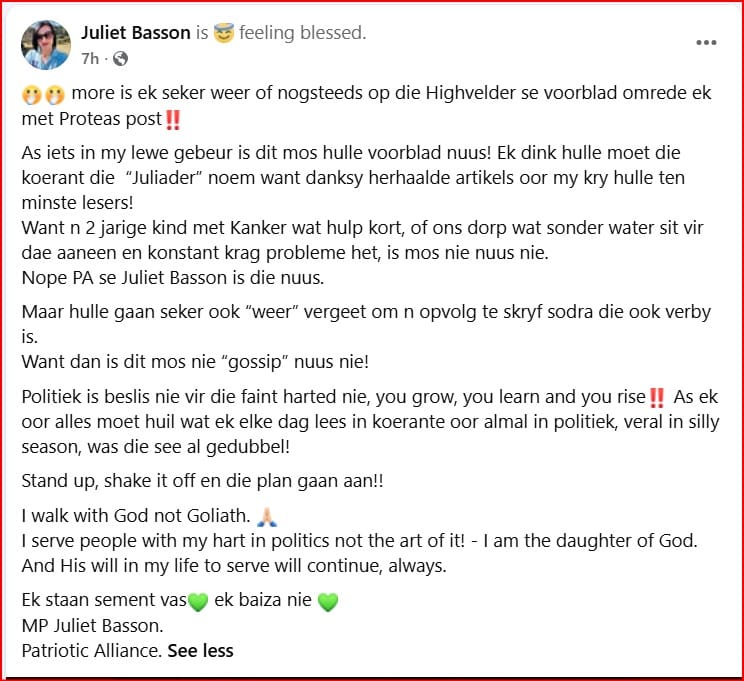
The publication record again provides relevant context.
In its July 17 edition, Highvelder published “Kare Bearz calls on community to aid little Lukas”, covering the child’s battle with cancer, the family’s circumstances and the community’s need for support.
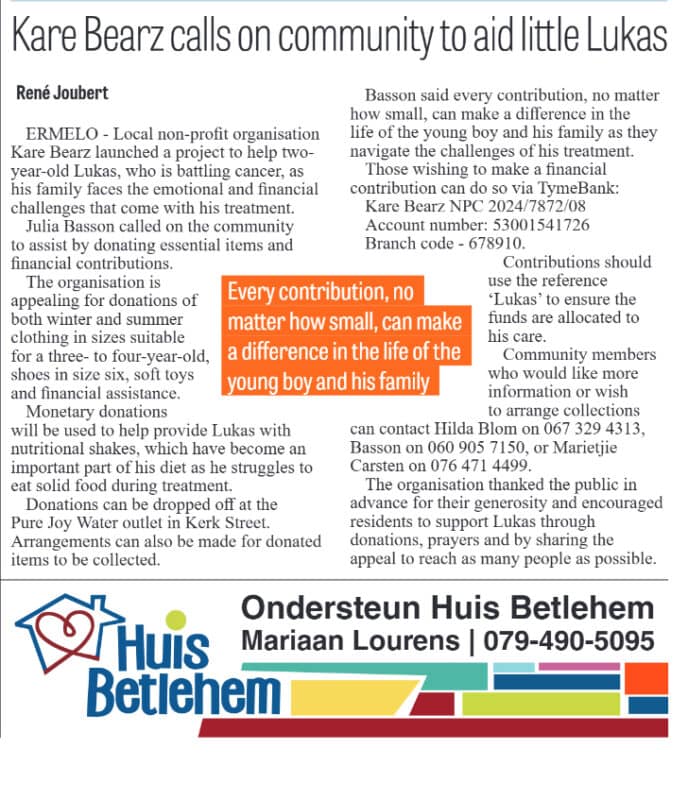
Basson herself was listed in the article as a contact person for the appeal, and the article also reported her call for the community to assist.
Notably, the article was published after the critical reporting on Basson, including the report concerning her contradictory claims.
Whatever disagreement existed over that reporting did not prevent Highvelder from putting those issues aside and focusing on the community’s need for support.
The family had requested that no photograph of the child be used, which Highvelder respected.
The financial allegation
Basson has also alleged that Highvelder writes about her for monetary gain or to sell advertising space.
Highvelder is a free community newspaper, and its editorial coverage is not dependent on charging readers for access to individual stories.
More importantly, the publication’s record demonstrates that editorial decisions concerning Basson have not followed any predetermined pattern.
Her involvement in the community has been reported when it was newsworthy, including after the publication of critical reports.
The question is therefore not whether Basson is entitled to disagree with Highvelder’s reporting. She is.
Nor is it whether she is entitled to be hurt or angry about coverage concerning her. She is.
The issue is whether the public should be left with a misleading impression of Highvelder’s conduct based on claims that are contradicted by the publication record and the available evidence.
This is particularly relevant given that Basson was previously found guilty of dishonesty by her own party, a finding that the PA president has since confirmed was not overturned when her suspension was lifted.
Reinstatement does not erase the disciplinary history
The PA leadership’s decision has created a new development, but it does not erase the events that preceded it.
Basson was found guilty.
Her appeal was dismissed.
Her suspension was imposed.
The suspension has now been lifted.
And the party’s president has publicly stated that the leadership did not find her not guilty, but instead decided to show leniency and give her another chance.
Those facts can all exist simultaneously.
The reinstatement does not establish that Highvelder was wrong and Basson was right all along, as her public narrative may lead her followers to believe.
Without the necessary context, the lifting of her suspension can create precisely that misleading impression.
Highvelder’s responsibility is to report the development while retaining the context necessary for readers to understand what actually happened.
The public deserves the full picture
Basson is a Member of Parliament and a local political representative.
Her disciplinary proceedings and subsequent return to her position therefore have a direct public interest component.
Residents are entitled to know not only that she has returned to her position, but also what led to her suspension and what the party leadership subsequently decided.
Highvelder is not responsible for the disciplinary finding.
We did not suspend Basson.
We did not dismiss her appeal.
We did not decide to show her leniency.
Those decisions were made by the Patriotic Alliance.
Our responsibility is to report them.
That includes reporting Basson’s return to her position, just as it included reporting the disciplinary process that preceded it.
What Highvelder will not do is allow the public record to be reduced to a simple narrative in which Basson was the victim of a campaign and the newspaper was the “bully” responsible for it.
The PA president’s own statement makes clear that Basson was found guilty through the party’s disciplinary process.
They chose to give her another chance.
That is not targeting someone. It is not bullying. And it is certainly not a smear campaign. It is journalism: reporting what happened, providing the necessary context and allowing the facts to speak for themselves, particularly when those facts and that context may be inconvenient to the narrative now being presented by Basson.