
Alien invasive plants spread through Highway
Help stop the spread of alien invasive species, by reporting it to your local conservancies.
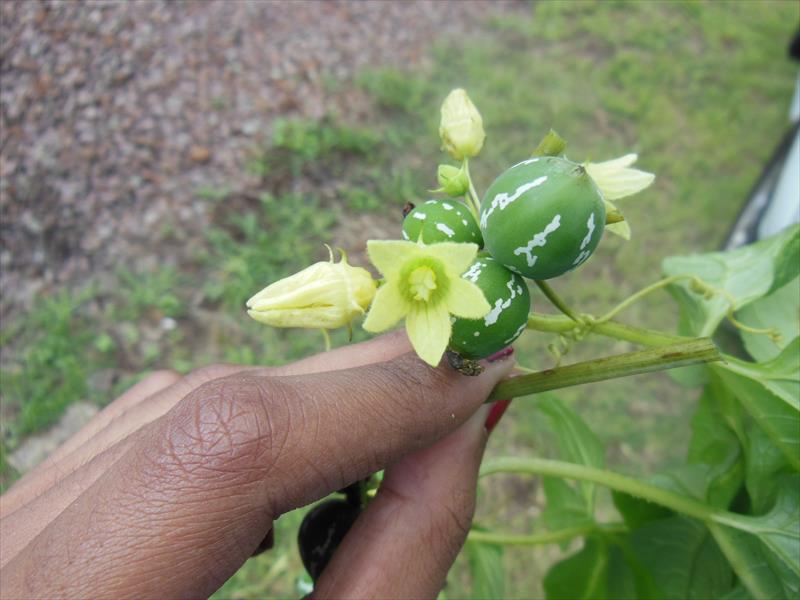
KLOOF Conservancy is desperately trying to stop the spread of two invasive species, the lollipop climber (Diplocyclos palmatus) and Himalayan raspberry (Rubus ellipticus).
The lollipop climber was spotted in Kloof two years ago, but it has since spread across Kloof Town and the conservancy is hoping to stop its spread before it enters the Krantzkloof Nature Reserve, which if it does, will be more difficult to control.
The Diplocyclos palmatus of the Cucurbitaceae family species is a perennial climber with thin stems growing up to 6m long. Native to Australia, it is more commonly known as the lollipop climber or striped cucumber. It is used in India for its medicinal properties in the treatment of rheumatic pain, cough, flatulence and various skin diseases.
The lollipop climber is one of the terrestrial invasive alien plants being investigated by the Early Detection and Rapid Response (EDRR) programme. This hardy but short-lived climber is found in low altitude forests, vine thickets and coastal flats. It has alternate, palmate leaves which are hairy and bright green on the upper surface but pale and smooth underneath. Small yellow flowers bloom between March and April. The fruits are initially green with white blotched stripes and later turn a bright red- orange colour when ripe. This resembles a lollipop hence its common name. The small white seeds in the fruit are toxic. Although the fruit resembles a tiny watermelon, it is poisonous and not edible.
In KZN, two localities of lollipop climber have been identified thus far at the Kloof Memorial Park in Kloof and the Edgecliff Reserve in Pinetown. The control method that has been employed at the Kloof Memorial Park is to manually remove the creeper, paying careful attention to the fallen seeds and the seed pods. The creepers are then placed in black refuse bags, which are exposed to the sun over a considerable period until they have rotted. These are finally dumped at a designated landfill site.
If people are aware of more localities of the lollipop climber, they are urged to contact the EDRR programme on 031 201 9091 or e-mail: alienplants@sanbi.org.za
The second invasive species, the yellow Himalayan raspberry (Rubus ellipticus), was recorded for the first time in SA in August 2013, in the Hillcrest area, by two observant members of the public, Geoff Nichols and Wally Menne.
The Yellow Himalayan raspberry, native to southern Asia, is a robust shrub (7m tall), with stems and branches covered with dense bristles and scattered thorns. It is noted for its capacity to regenerate from cuttings as well as from plentiful seeds dispersed by birds and other animals. Research has suggested the possibility of a long-term, viable soil seed bank. It has the ability to outcompete indigenous species by forming dense thickets and can significantly impact on species diversity in understorey vegetation. Not surprisingly, it is listed as one of the world’s 100 worst invasive alien species.
It has scrambling arching branches, and due to its stout robust stems, plants can grow much taller than other Rubus species. Stems and branches are armed with scattered recurved thorns, and are covered in numerous bristles which are conspicuously red in younger plants but change to brownish colour with age. Leaves are darkish-green, trifoliate, with elliptic to circular leaflets with serrated edges. Flowers are predominantly white; stamens with broad, flattened filaments, in a compact circular arrangement. Raspberry-type fruits are yellow when mature.
The South African National Biodiversity Institute (SANBI) will continue to raise awareness around the threat of this species especially in and around the target area, conduct detailed surveys of roads interlinking known populations which may result in the detection of more populations, investigate suitable control options, conduct risk assessments and investigate whether it should be listed under NEMBA as category 1a or 1b.
SANBI are preparing to send a team during February to find and eradicate the plants but locating these alien species is important. You can assist them by identifying invader spots in your area and report it to the EDRR programme on 031 201 9091 or e-mail: alienplants@sanbi.org.za