Bulk water pipelines improve the environment
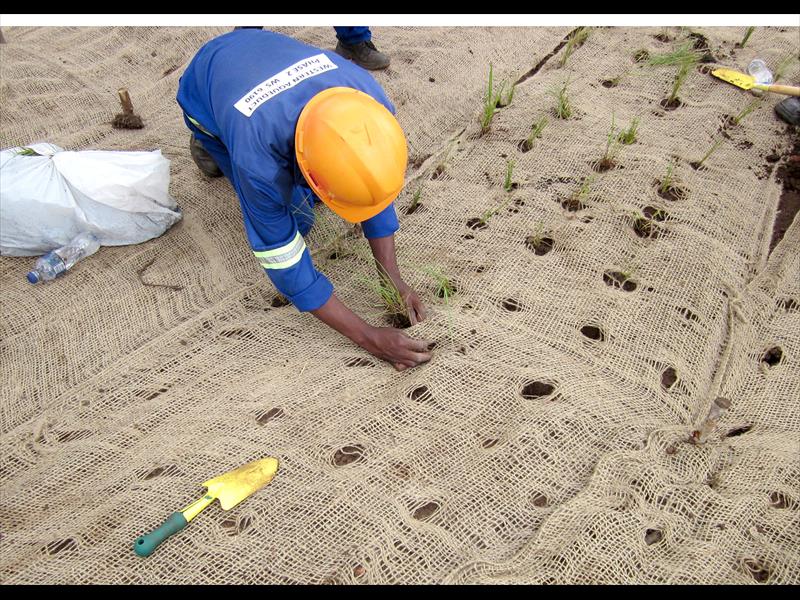
Seven different species of indigenous grasses have been propagated.
CONSTRUCTION of eThekwini Water and Sanitation’s (EWS) Western Aqueduct (WA) bulk water pipeline in the upper highway area is raising the bar when it comes to environmental management of construction projects in the region.
Martin Bright, project manager for the Western and Northern Aqueduct Augmentation projects, said that during the planning process of both projects and in terms of stringent Environmental Impact Assessment (EIA) requirements, rehabilitating areas that had been disrupted in order to lay the pipelines was a priority.
The WA is designed by Knight Piésold/Naidu Consulting/Royal Haskoning DHV Consultants. From the outset, environmental experts and design engineers set out to identify the most environmentally suitable route for each of the pipelines to ensure that, wherever possible, they avoided sensitive habitats such as grasslands and wetlands as well as places of cultural significance such as historical sites.
“The second phase of the WA, in particular, is sensitive as a large section of the pipeline route traverses protected areas. We are not only committed to restoring areas that have been disrupted in order to lay the pipeline to their former status but also plan to improve existing degraded areas along the route. An alien invasive plant control programme is also in place to manage sites following rehabilitation,” he said.
After excavating and installing sections of pipeline, contractors are also required to rehabilitate construction corridors of about 30m wide. They are also ultimately expected to rehabilitate pipe yards, pipe fabrication yards and contractors’ camps once contracts are completed.
Using construction of the first segment of the WA pipeline as an example, which extends for seven kilometres from Inchanga Station to Alverstone Nek, Bright explained that a search and rescue operation is carried out before clearing and grubbing begins. This is to ensure that protected plant species as well as species with rehabilitation value are plotted with the use of GPS co-ordinates and removed to a holding nursery at Alverstone Nek Reservoir. After the initial phase of rehabilitation, shaping of subsoil and the replacement of topsoil is complete, all rescued plant species will be replaced to their exact place of origin. Indigenous plants are also specially propagated in order to enhance the rehabilitation of certain sites.
“Due to the specified rehabilitation of this project, more than a million plant species will be propagated in order to reach the specified coverage as well as diversity requirements of the area,” said Bright.
A permit for the removal and temporary housing of protected plant species was provided by Ezemvelo KZN Wildlife. The protected species include Aloe sp, Watsonia densiflora, zantedeschia aethiopica and a particularly rare species, Argyrolobium longifolium.
Bright stressed that it was important to be flexible when it came to this aspect for the project. “For example, while working on the first contract of the Western Aqueduct, we anticipated that only one specimen of Argyrolobium longifolium would be transplanted once to a new location outside of the working corridor. After closer inspection and survey of the area, a total of 234 specimens were identified and transplanted into a new location,” he said.
He said that construction company Cycad Pipelines which was responsible for the first segment of the Western Aqueduct pipeline had already rehabilitated grassland areas. “Rehabilitation of approximately 1.2km of protected grassland required the propagation of seven different species of indigenous grasses, including Arista junciformis, Themeda triandra, Cymbopogon excavates, Eragrostis capensis, Eragrostis racemosa, Digitaria eriantha, and Hyparrhenia hirta. These grasses were propagated in trays to be planted out in a specified pattern along with six different species of non- grasses to allow for biodiversity in the rehabilitated grassland to be restored,” he added.