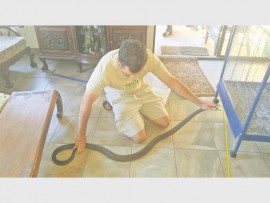
Black mamba slithers into Malvern home
"Fearing for the safety of her family and pets' lives, the wife tried slamming the sliding door before the snake could enter."
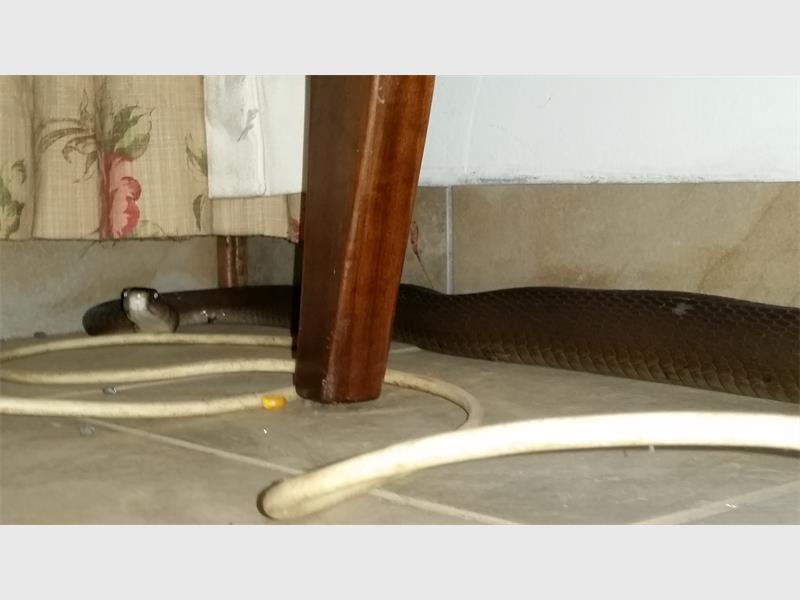
SNAKE catcher, Nick Evans, recently responded to a call-out for a snake removal at a Malvern home on Huntley Road.
The snake, initially thought out to be a Mozambique spitting cobra, actually turned out to be a black mamba.
It slithered in from the garden and tried to enter the house. “I arrived to find an elderly gentleman sitting in his lounge, as if he was watching TV, peacefully keeping an eye on the snake.
“He and his wife had spotted the snake making its way into the home from the garden. Fearing for the safety of her family and pets’ lives, the wife tried slamming the sliding door before the snake could enter.
“She unfortunately caught the snake in the door, a very dangerous situation,” said snake catcher, Nick Evans. The snake was in great pain and retaliated by striking out, luckily missing the homeowner, but it quickly broke free and took cover in the lounge.
“When I entered, the gentleman pointed to where it was hiding. I could just see a section of the thick-bodied snake, which was no spitting cobra. The adrenaline then kicked in,”explained Evans. It was lying anxiously in the corner under the cover of some cabinets. I approached the snake and it didn’t move around too much, as snakes struggle to move on smooth, cold floor tiles.
“I managed to catch it without much difficulty, although in saying that, this snake was incredibly strong,” he said.
Evans admitted that the two-and-a-half-metre-long mamba was the strongest and thickest he has ever dealt with. Once caught, everyone who was at the house, including grandkids. The son of the elderly couple and policemen, enjoyed seeing the iconic black mamba up-close and personal.
“For people to see a mamba capture and the snake up close change their perceptions. It isn’t what it’s made out to be. I had this mamba backed into a corner, yet it made no attempt to attack.
Obviously when you capture one it tries to bite because it has no other options. Other than that, they have no desire to bite,” he said.