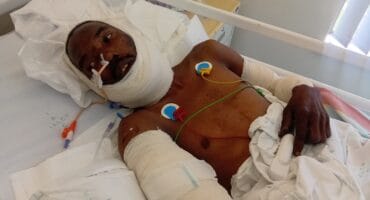
State’s failures highlighted as country marks 16 Days of Activism
South Africa formally declared GBVF a national disaster in November 2025 but many women and children remain victims.

AS South Africa observes the 16 Days of Activism for No Violence Against Women and Children, the rate of these crimes remains worryingly high, which, according to some activists, points to several issues that include the State’s institutional incapacity and the normalisation of violence against women and children.
South Africa formally declared gender-based violence and femicide (GBVF) as a national disaster in November 2025.
Whether this declaration, as well as awareness campaigns usually carried out during these 16 days of activism, is sufficient in the face of the government’s seeming inadequate institutional capacity, and an overburdened police force operating within an underfunded criminal justice system, remains to be seen.
For Advocate Liechen Strydom from Liberation Legal Consulting, and a member of the NACSA4U Human Trafficking Working Group, a broader pattern of violence against women continues despite the formal status of GBVF being declared a national disaster.
“The language used by officials and institutions in responding to GBVF remains critical. When messaging focuses primarily on what women and children should do to keep themselves safe, it risks reinforcing a framing in which the burden of prevention is placed on potential victims rather than on those who choose to perpetrate harm,” said Strydom.
Strydom added that another challenge is the “wider societal normalisation” of GBVF and violence against children.
“Terminology matters. Softening or misclassifying serious offences, for example, describing sexual abuse of a minor who later receives money as child prostitution rather than rape, obscures the nature of the harm and shifts responsibility away from the perpetrator. The sexual exploitation of a child remains rape and a severe form of abuse,” said Strydom.
According to Strydom, a sustained political will, adequate resourcing, specialised training for frontline officials and the consistent application of the legal definitions of these crimes is what is required as a response.
Strydom also called for a shift in societal attitudes that would see perpetrators being held accountable.
Josha Daniels of the Rise up Movement, and also a member of the NACSA4U Human Trafficking Working Group, said slow forensic testing, backlogs in court cases, low conviction rates, and under-resourced police stations resulted in a failure of justice and the protection of women and children.
Also read: Sophisticated criminal networks behind human trafficking in SA
Daniels said focus should be placed on addressing these challenges, and funding safe houses, specialised trauma centres, community policing as well as education programmes geared towards prevention.
University of KwaZulu-Natal Political Studies senior lecturer, Dr Monique Emser, who chairs the NACSA4U Human Trafficking Working Group, said the country’s high levels of GBVF, rape, child sexual violence and murder, “with no sustained decline commensurate with the scale of public investment in prevention efforts” pointed to State and societal failures.
“South Africa has invested heavily in awareness campaigns, community dialogues and public education initiatives, yet there is little evidence that these interventions have produced sustained reductions in serious violent crime at the population level,” said Emser.
According to Emser, a recurring weakness in the country is in the poor implementation of existing legislative framework, with Acts such the Domestic Violence Act, the Criminal Law (Sexual Offences and Related Matters) Amendment Act, and specialised Sexual Offences Courts, and the National Strategic Plan on GBVF providing extensive legal protections on paper.
Emser said challenges that are persistent included detectives overloaded with excessive caseloads; inconsistent investigations, witness intimidation; uneven institutional accountability; and endemic corruption that undermines confidence in the justice system.
“For serious offences such as murder and sexual violence, a high attrition rate of cases in the criminal justice system significantly weakens accountability and public confidence.
“In addition, underreporting remains significant due to fear, trauma, intimidation, economic dependence and distrust of institutions,” said Emser.
Emser said there are proven international practices that could strengthen South Africa’s response if sufficient resources, institutional capacity and political commitment were directed towards implementation.
“The real challenge is rebuilding a justice system in which accountability is credible, investigations are effective, prosecutions are swift, and victims can have confidence that reporting violent crime will lead to meaningful consequences,” said Emser.
For more from the Highway Mail, follow us on Facebook , X and Instagram. You can also check out our videos on our YouTube channel or follow us on TikTok.
Click to subscribe to our newsletter here