
Usually calling a person a diamond is seen as a form of flattery.
However, a recent development in science has made the expression quite literal.
A Swiss start-up company called Algordanza recently developed a unique process which turns deceased human beings into diamonds.
And since diamonds are forever, the keeper of this diamond can carry the memory of the loved one with him/ her for the rest of his/ her days.

Since diamonds consist mostly of pressurised carbon atoms that are squeezed and heated underneath the earth’s mantle, the company simply recreated the process.
Instead of cremating human remains, the company turn them into diamonds and then adds them to pieces of jewellery loved ones can wear everywhere they go.
“Human bodies are bout 20 per cent carbon, which allows the company to grow synthetic diamonds,” said Rinaldo Willy, the founder of Algordanza.
People know that diamonds are expensive and it seems as if this service is only aimed at the rich upper class citizens.
However, Rinaldo claims it could be less costly than cremation.
“The growing premium on real estate for both the living and the dead has increased over the past few years,” Rinaldo said.
The machines used to create these diamonds are incredibly powerful and have the ability to generate a pressure of 60 000 bar and temperatures of 1 400 degrees Celsius.
The process:
“During cremation, the majority of carbon escapes as dioxide,” Rinaldo said. “The remaining ashes then have a residual 1 to 5 per cent carbon.”
The company isolates the carbon from all the other substances in the ash in a laboratory. The isolated carbon then forms the foundation for growing a diamond.
“This process is an example set by nature.”
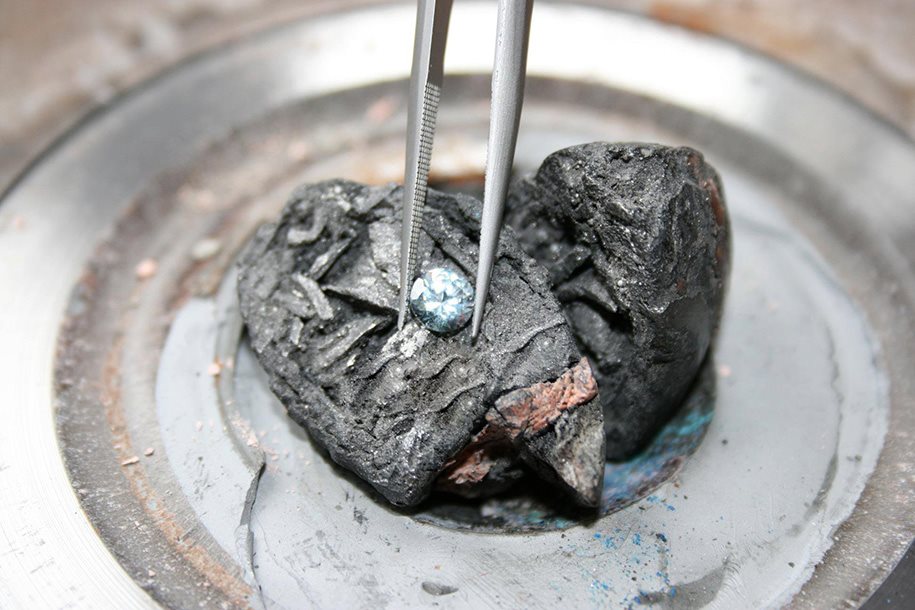
The carbon is put under pressure and baked at high temperatures until it turns into graphite. Purified graphite is the foundation of subsequent diamond transformation in machines they call ‘high pressure-high temperature’ or HPHT machines.

Photo: Algordanza
A diamond starter-crystal triggers the growth of cells and ultimately forms a memorial diamond. The diamond is then melted into a metal alloy. It doesn’t conjoin with the carbon isolated from the cremation ashes and this causes it to form more crystals by slowly crystalising on the surface of the initial triggered cells.
The process takes weeks, but once the dust is removed from the surface of the diamond, the memory of a loved one is captured in the most beautiful and permanent way possible.