
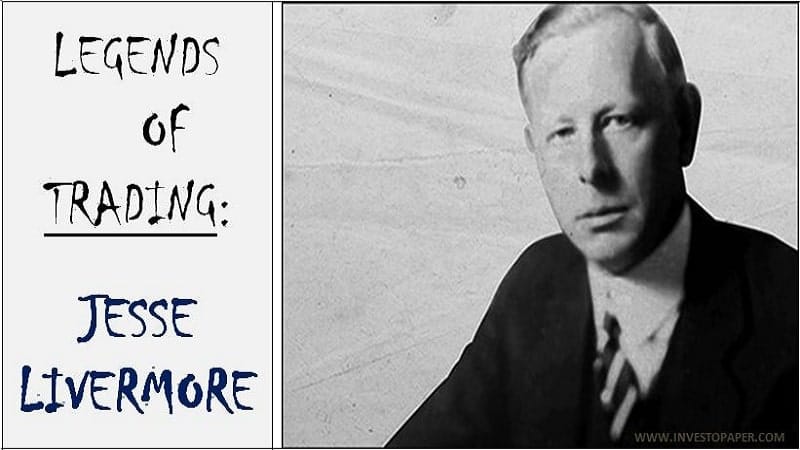
One of those most successful Traders is Jesse Livermore. Every self-respecting Trader studied the life of this, at times, unusual man with remarkable qualities. Jesse earned millions trading the markets. His most known winning trade was shorting the “big market crash” back in 1929.
Jesse Livermore, who is the author of “How to Trade in Stocks” which was published in 1940, was one of the greatest traders of all time. In 1929, Jesse Livermore was at his peak and then worth $100 million, which in today’s dollars roughly equates to a staggering $ 1.5 billion.
What makes Jesse’s trading successes so much more memorable, is the fact that he traded on his own, funded his trading with his own capital and did it all with his own platform. Obviously have many things changed since Jesse traded, however are his rules still applied today by the most successful Traders.
This article contains some of the trading rules applied by Jesse Livermore which formed the basis of his trading success. Learn, apply, and master it and in time watch your trading success take flight.
Enroll now!! Forex Trading for Beginners – FREE Online Video Courses
- “There is nothing new in Wall Street. There cannot be because speculation is as old as the hills. Whatever happens in the stock market today has happened before and will happen again.”
The stock market is made up of all types of Traders. Human nature does not change that much over time. Off course there will be different circumstances in today’s market than there were almost hundred years ago, however the way people react to changes in the stock market will never change.
- “Buy rising stocks and sell falling stocks”
There are very successful Traders and Investors in the world. Although you might become successful at going against the grain on the stock market, it is so much easier to just go with the flow. When a stock is moving in a certain direction it means that most of the Traders have the same idea of where the stock will go. If the majority thinks the stock will go higher, they will decide to buy, which causes the price to rise. Pick the stocks that are trading higher over time and you know that most of the Traders involved believe the price will continue to rise. Do not make it harder for yourself to go against everybody. Instead, learn to recognize the signs of when a stock starts to move so you can enter early. In that way you can profit the most from the big move the stock is going to make.
- “Trade only when the market is clearly bullish or bearish”
It is better to follow the direction of a stock. The same goes for the overall market. Stock trading is hard enough to learn. So, there is no need to make it any harder than necessary. When the market has no clear direction, it is best to sit on the side-line. Just wait and see how the market is forming itself. The stock market is the average of all the stocks traded on the market. When the market is clearly trending in one direction it means that most of the stocks is heading in the same direction. Those are the easy picks for you. When the market has no clear direction there is no saying of what all the individual stock will do.
You might also be interested in: 27 Best Forex Brokers in South Africa
- “Only enter a trade after the action of the market confirms your opinion and then enter promptly”
Before ever making a trade, you need to have your trade plan ready. Not only the reasons of why you want to enter the trade, but also when you should exit it. Be meticulous in your research and make sure the trade fits with your strategy. Create a trade plan for each trade that you want to make. After your trade plan is ready do not rush into the trade. Let the market confirm your thesis. And wait for the trade to expose itself to you.
- “Continue with trades that show you a profit, end trades that show a loss”
You will probably end up with more than one active trade at most of the times. In those cases, it is important to remember to stay with your winners. For most traders it is too difficult to take a loss. First, they take their profit on a winning trade. And hold on to the losing trades. Hoping that those losing stocks will turn around and change in a profit. Off course hope is not a strategy for the stock market and hoping that a losing stock is going to turn around is just foolish. Do not try to fight the market.
- “End trades when it is clear that the trend you are profiting from is over”
You have thought about every trade you make and have created a trade plan. When the market has confirmed your idea about the stock you finally decided to take a position. Now the most important thing is to be aware of all the changes that might make your trade plan worthless. Be prepared to sell your position when the market changes direction. When the confirmation the stock earlier showed is no longer there, there is only one thing you can do and that is to close your position.
- “In any sector, trade the leading stock – the one showing the strongest trend”
In your research you have found a sector that is doing extremely well in the current market. You have decided to look for stocks in that market to trade. Why not only go for the best? Because the lesser stock might seem attractive at a certain time? Do not get tempted to do that. You need to make trading as easy as possible and the leading stock in the sector simply will give you the best chances of success.
Read more: NO DEPOSIT Forex Brokers
- “Never average losses by, for example, buying more of a stock that has fallen”
One of your position is showing a loss. What to do now? Maybe you should add to your position? You still think the stock should go higher. And the buy price is currently lower than the stock you already own. That sounds like a bargain, right? No! Keep your back straight and do not get lured into that loser’s game. The stock that is showing a loss is clearly saying to you that your entry point was wrong. There is no reason in the world why you would want to buy more of something you were wrong about.
- “Don’t become an involuntary investor by holding onto stocks whose price has fallen”
When your trade is not working out and your position shows a loss it is hard to cut it. For us human beings it is extremely difficult to accept our faults. Especially when they will cost us money. But do not be tempted to turn a trade into an investment by holding onto stocks. If you are looking for investments, you should have started with a different set of criteria. You started with a trading view of point. Is the stock not confirming your thesis? Get out of it instantly. Learn from it and start looking for the next opportunity.
- “Markets are never wrong – opinions often are”
Never argue with the stock market. Even if your research was so meticulous. And you are 1000% certain the stock must move in a certain direction. When the market is showing you something else you need to get out of your trade. Your thesis might be proven to be right in the future. Apparently currently the market disagrees. And there is no discussion about it.
- “The highest profits are made in trades that show a profit right from the start”
This is a very important rule to remember. All our best trades have shown a profit right from the moment we bought the stock. The profit simply confirms that your idea about the stock and price action is completely right. Treasure these trades and let them ride if you can.
- “No trading rules will deliver a profit 100 percent of the time”
There are no guarantees in the stock market. All you need to be looking for is to be profitable. Accept the fact that you will never be right 100% of the time. Accept that you are going to need to take losses. Focus on the long-term profitability of your trades. Even with a winning percentage of less than 50% you can be profitable in the long term. Most of this has to do with your risk and money management.
Read Tickmill’s Review here
IMPORTANT NOTICE AND RISK WARNING:
Diversit-e Smart Trade College is an e-training and educational platform, neither Diversit-e Smart Trade College, its employees, sales executives, agents, affiliates and/or contractors are or represent themselves as being registered financial services providers and are not licensed to give any financial and/or investment advice in terms of the Finical Advisory and Intermediary Services Act, No. 37 of 2002. The User understands and acknowledges that self-trading, the capital markets and/or stocks involves risk. Diversit-e Smart Trade College, its employees, sales executives, agents, affiliates and/or contractors do not manage any monies for investment purposes. The User is advised to consult with the preferred stockbrokers of Diversit-e Smart Trade College, a FSCA regulated broker and/or a Financial Advisor before making any investment decisions. Diversit-e Smart Trade College, its employees, sales executives, agents, affiliates and/or contractors accept no responsibility for any losses and or damages suffered by the User in conduction such activities, howsoever arising.